

WEST LAFAYETTE — The Purdue Applied Research Institute (PARI) and Lockheed Martin are expanding their partnership through a new agreement focused on research and development in key defense technologies.
PARI signed a memorandum of understanding with Lockheed Martin on Sept. 17 to create additional opportunities for collaboration across the Purdue University ecosystem.
The agreement will allow Lockheed Martin to connect with Purdue’s research expertise, emerging talent and specialized facilities. Areas of mutual interest include hypersonic technology, rocket and aerospace propulsion, energetic materials, advanced manufacturing, cybersecurity, autonomous systems and microelectronics.
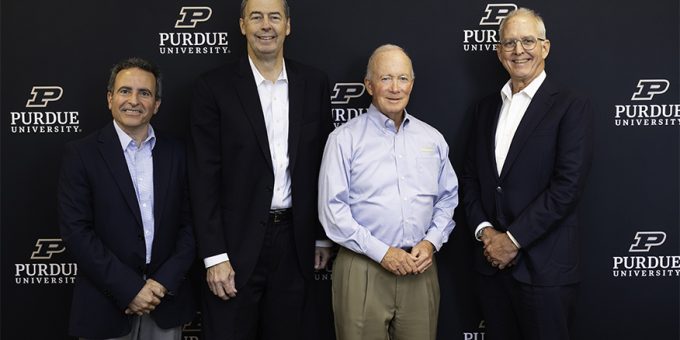
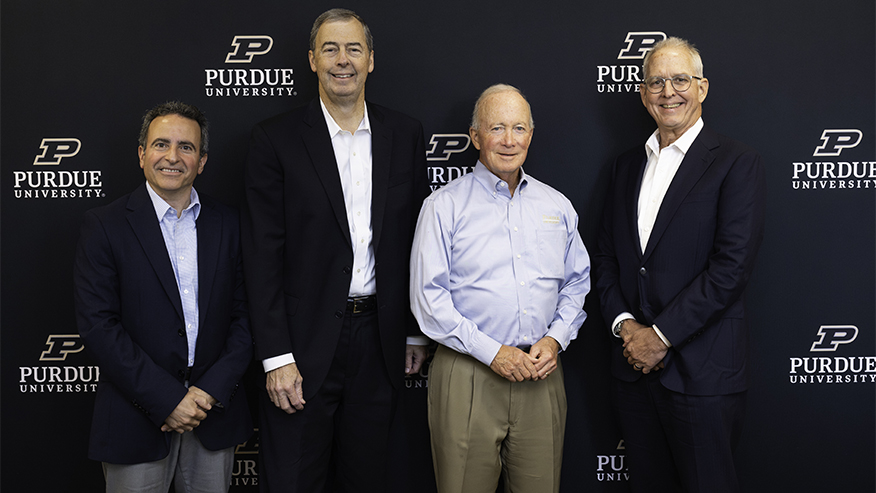
Signatories included interim Purdue President Mitch Daniels; Dan DeLaurentis, executive vice president of research and president of PARI; Tim Cahill, president of Lockheed Martin Missiles and Fire Control; and Craig Martell, vice president and chief technology officer at Lockheed Martin.
“Lockheed Martin’s collaboration with PARI opens the door to deeper engagement with Purdue’s robust national security and defense capabilities,” DeLaurentis said. “From our researchers and students to our specialized facilities and partnerships, Purdue offers unique resources that can help address some of the nation’s most pressing technology challenges.”
DeLaurentis added that the partnership will also provide opportunities for experiential learning, workforce development and research benefiting Purdue students, the community and Indiana.
The new agreement builds on an existing relationship between Purdue and Lockheed Martin that began with a master research agreement in January 2021.
Through expanded research, technology development and workforce training, the organizations will work together on efforts supporting the U.S. defense enterprise.
“This MOU is a tangible expression of our shared commitment to move at the speed of innovation — delivering affordable, scalable capabilities that our defense customers demand,” Cahill said.
The agreement will also create additional opportunities for joint research, small-business partnerships and recruitment of engineers, according to Lockheed Martin.
Purdue and PARI offer specialized facilities designed to support advanced defense-related research.
PARI’s Hypersonics and Applied Research Facility includes the Hypersonics Advanced Manufacturing Technology Center, where hypersonic systems and components can be designed, manufactured, joined and tested in one location.
PARI also operates HYPULSE, a hypersonic wind tunnel capable of testing systems under realistic high-speed flight conditions in a secure environment.
Other Purdue facilities involved in related research include Maurice J. Zucrow Laboratories and the Birck Nanotechnology Center.
Zucrow Laboratories supports research involving combustion, energetic materials, rocket propulsion and high-speed air-breathing propulsion. Birck focuses on advanced research and development involving semiconductors, microelectronics and other technologies at the atomic scale.
The partnership also provides a connection to Purdue students interested in defense technology research.
Through the PARI Scholars Program, undergraduate students can participate in hands-on research involving areas such as hypersonics, microelectronics, energetics and infrastructure.
Students participating in the program may also have opportunities to obtain security clearances, allowing them to enter the defense sector immediately after graduation.
The expanded partnership is intended to strengthen connections among Purdue researchers, students and industry while creating additional opportunities to develop technologies and talent for the U.S. defense sector.

