

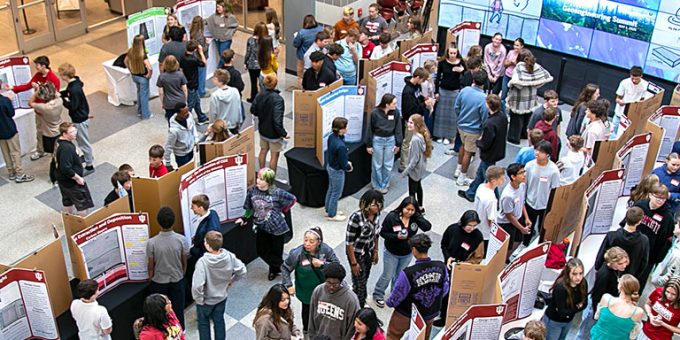
BLOOMINGTON — High school and middle school classrooms are rarely tasked with re-engineering the Earth’s atmosphere, but that is exactly what took place at Indiana University Bloomington’s second annual Geoengineering Summit.
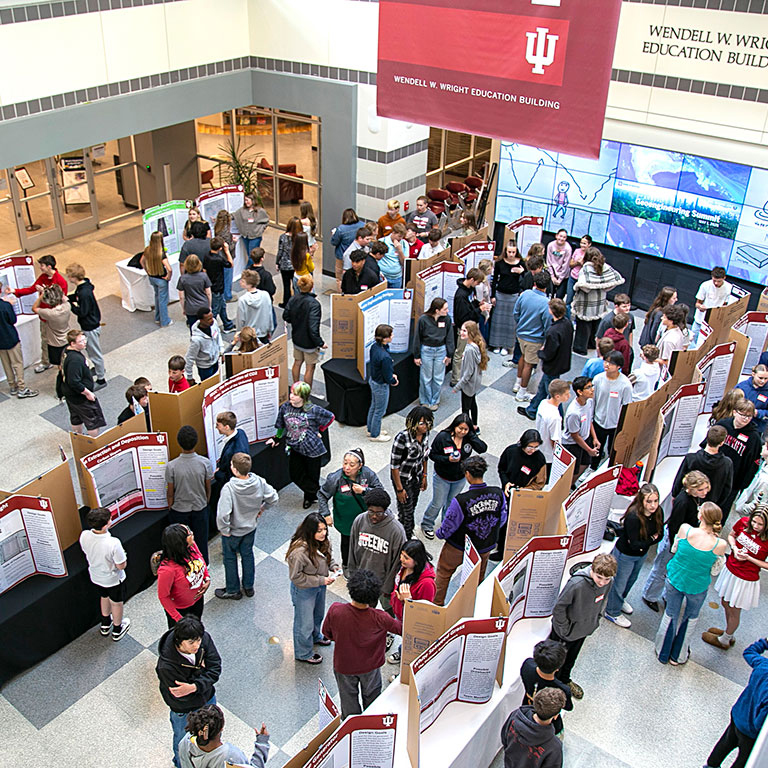
Roughly 160 students from across Indiana gathered at the IU School of Education to present creative, self-designed technologies aimed at slowing global warming. The event served as the culmination of an intensive curriculum designed to transform how young people view the climate crisis.
Before the summit, participating students completed a specialized five-lesson teaching module. The curriculum introduces the complex and emerging field of geoengineering—the deliberate, large-scale manipulation of Earth’s natural systems to counteract climate change.
The lesson plan was co-developed by Adam Scribner, Director of STEM Education Initiatives, alongside IU Department of Earth and Atmospheric Sciences researchers Ben Kravitz and Paul Goddard.
“We want to teach students about the ethical considerations of geoengineering, and we want to engage students in providing their own solutions to some of the world’s biggest issues, like climate change,” Scribner said. Reflecting on his own youth, Scribner noted that while he grew up learning about environmental issues like ozone depletion, students were rarely asked to help fix them. “That’s what we’re doing, we’re having students think about how they would solve climate change.”
The curriculum purposefully encourages creativity, prompting students to think up “wild ideas” before working through the real-world constraints of physics, biology, and economics. At this year’s summit, student concepts ranged from automated atmospheric filters to biological adaptations. Among the standout ideas presented was a proposal from Danville Community Middle School students, who designed a plan to plant genetically engineered bioluminescent trees to replace urban streetlights. Their concept aimed to simultaneously sequester carbon and eliminate energy use and light pollution from artificial bulbs.
Combatting Climate Anxiety with Empowerment
For many young attendees, the hands-on project shifted their emotional relationship with environmental science. Climate change frequently triggers severe anxiety in youth, while others simply feel detached from the issue.
By stepping into the role of the innovator, students reported feeling a newfound sense of agency.
“Before, I knew it was a problem, but I didn’t really think about it that much,” said McKiya Abel, a student presenter from Danville. “Now I actually want to make a difference.”
Her peers echoed the sentiment, noting that increasingly frequent instances of severe weather and heatwaves in Indiana have made the crisis feel personal. Presenting their posters directly to IU faculty and science education graduate students reinforced a crucial lesson: innovation is not exclusive to adults or career scientists.
A Collaborative Effort
The unique program represents a broad bridge between public school systems and advanced university research. The summit was developed via a partnership involving:
- The IU Department of Earth and Atmospheric Sciences
- The IU School of Education
- The Environmental Resilience Institute (ERI)
Educators from six regional schools guided their classrooms through the materials ahead of the trip to Bloomington, including Arsenal Technical High School, Cardinal Ritter High School, Cascade High School, Center Grove Middle School, Danville Middle School, and Purdue Polytechnic High School.
Funding for the initiative was provided by an anonymous foundation alongside 2892 Miles to Go, a social justice education initiative supported by the National Geographic Society.

