

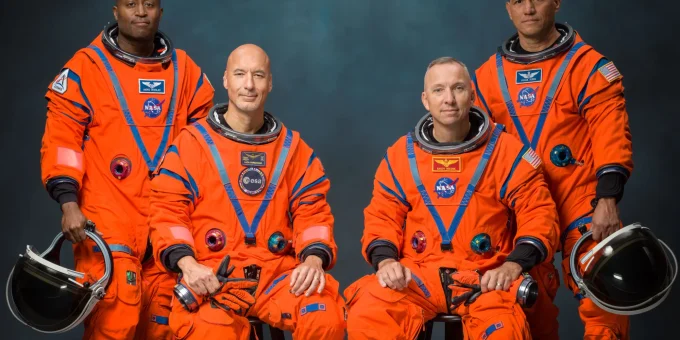
HOUSTON — NASA has officially revealed the international four-member crew for its upcoming Artemis III mission, marking a major milestone in the global push to return humans to the lunar surface.
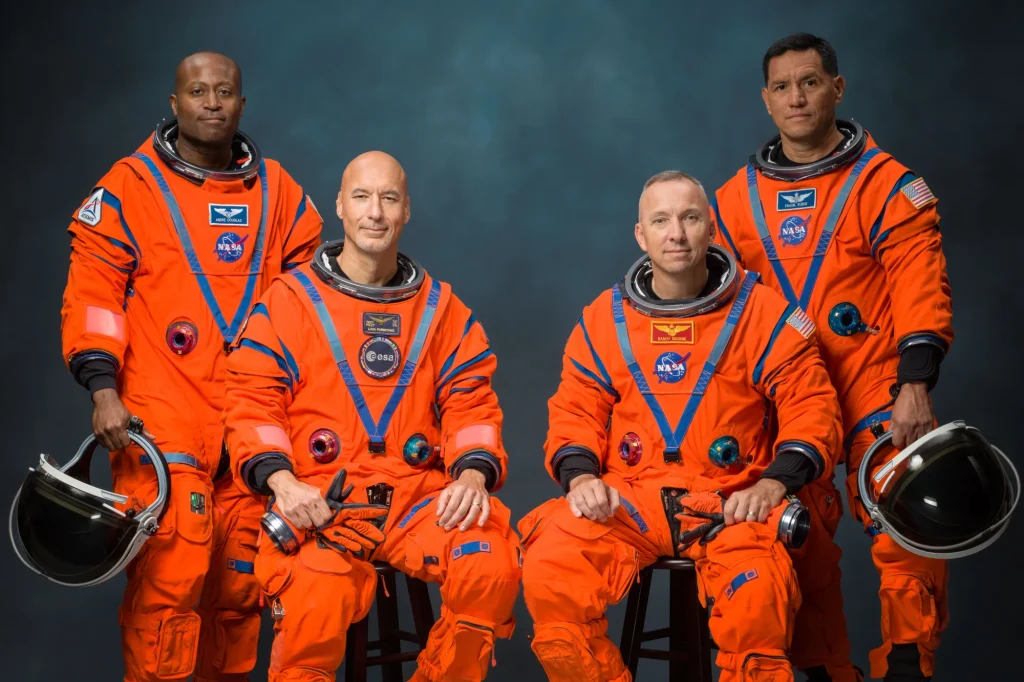
Credit: NASA/Bill Stafford
The announcement, made on Tuesday, June 9, 2026, at the Johnson Space Center in Houston, names three American astronauts and one European Space Agency (ESA) representative to lead the approximately two-week flight. The highly complex mission is scheduled to launch into low Earth orbit (LEO) in late 2027.
“The Artemis III astronauts, alongside ESA and our international partners, are ushering in a new Golden Age of exploration, carrying forward the hopes and dreams of the next generation,” NASA Administrator Jared Isaacman said during the ceremony, where the previous Artemis II crew symbolically passed an “Artemis baton” to the newly appointed team.
Meet the Artemis III Crew
The newly formed quartet brings a diverse mix of long-duration spaceflight experience, military flight testing, and advanced engineering to the high-stakes mission:
- Commander: Randy Bresnik (NASA) — A veteran Marine Corps colonel and former test pilot, the 58-year-old Bresnik is the most senior member of the crew and the only one to have flown on the Space Shuttle (STS-129 in 2009). He has also commanded the International Space Station (ISS).
- Pilot: Luca Parmitano (ESA) — An Air Force colonel from Italy, Parmitano makes history as the first European astronaut explicitly assigned to an Artemis crew. He is an experienced spacewalker and previously served as an ISS commander.
- Mission Specialist: Col. Frank Rubio (NASA) — An Army Black Hawk helicopter pilot and family medicine physician, Rubio holds the record for the longest single-duration spaceflight by an American astronaut, having spent 371 consecutive days in orbit.
- Mission Specialist: Andre Douglas (NASA) — A Coast Guard Reserve commander and systems engineer, the 40-year-old Douglas will be making his first trip to space after previously serving as a backup crew member for Artemis II.
NASA also named veteran astronaut Bob Hines to serve as the prime backup crew member for all positions.
While Artemis III was originally envisioned as the flight that would land the first boots on the Moon since 1972, NASA leadership overhauled the program architecture earlier this year to mitigate technical delays and outpace geopolitical competitors.
Instead of heading straight to the lunar surface, Artemis III will serve as an intense, orbital gauntlet designed to rigorously test commercial hardware in Earth orbit before committing a crew to deep space on Artemis IV in 2028.
The Multi-Launch Campaign Includes:
- The Orion Launch: The crew will blast off from the Kennedy Space Center in Florida aboard the Orion spacecraft, propelled by the agency’s Space Launch System (SLS) rocket.
- The Blue Origin Rendezvous: Orion will first rendezvous and dock with Blue Origin’s Blue Moon lander pathfinder, which will be launched separately on a New Glenn rocket. The crew will spend two days docked, transferring into the vehicle to test life-support, software, and propulsion interfaces.
- The SpaceX Starship Rendezvous: After undocking from Blue Moon, Orion will perform a second rendezvous, docking with a pathfinder version of SpaceX’s Starship human landing system for a day of integrated systems checks.
- Spacesuit Testing: While in orbit, the crew is slated to evaluate NASA’s next-generation Exploration Extravehicular Activity (xEVA) spacesuits, simulating the exact mobility and pressure constraints astronauts will face on the lunar terrain.
By testing two entirely different commercial landing systems during a single flight, NASA officials emphasize that they are taking calculated risks now to ensure safety later.
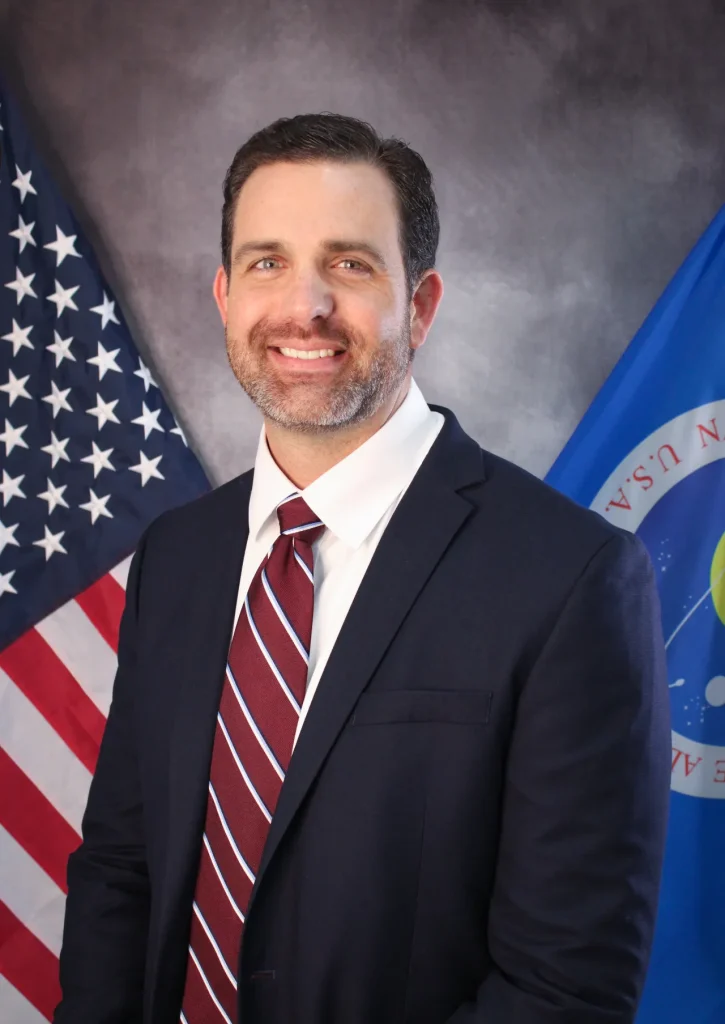
“This test flight will enable us to prove we can carry out highly choreographed operations with our partners across hardware interfaces, software propulsion systems, and life support elements,” said Jeremy Parsons, NASA’s Artemis Program Manager. “This mission is deliberately designed to take calculated risks so that future crews will be safer and ultimately successful when we put boots on the lunar surface… and to ensure we will beat China back to the Moon.”
The crew is slated to begin rigorous training immediately, split between Orion simulators at the Johnson Space Center and newly installed physical mockups of the Blue Moon and Starship landing systems.