


INDIANA – Skywatchers are in for a celestial treat on Nov. 24, 2026, as the full “Beaver Moon” lights up the night sky, marking both a key cultural seasonal marker and the arrival of the first of three consecutive supermoons.
The November full moon will reach its peak illumination at 9:53 a.m. EST (1453 GMT) on Nov. 24, when the lunar disk sits directly opposite the Sun relative to Earth.
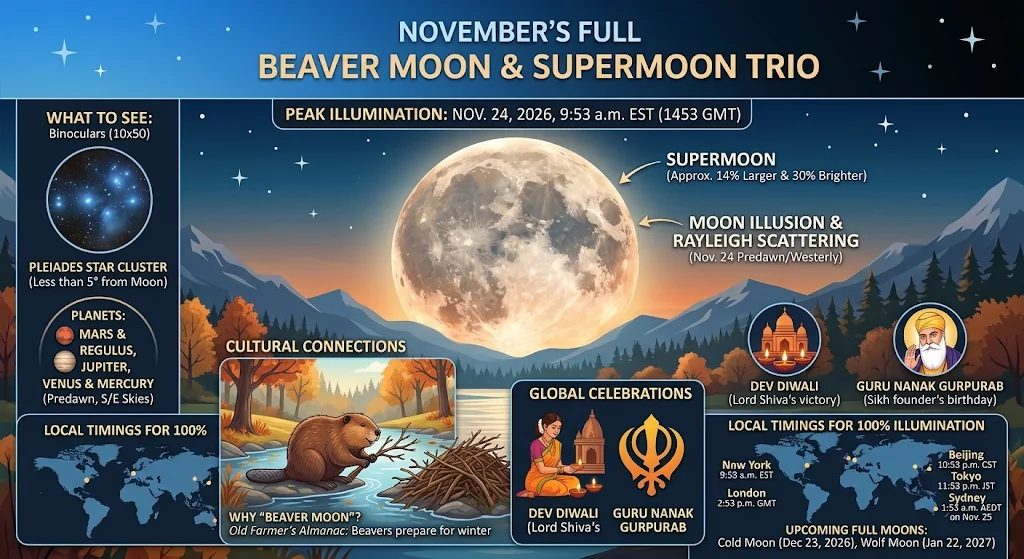
November’s full moon qualifies as a supermoon—an unofficial term for a full moon occurring when our natural satellite reaches within 90% of perigee, its closest approach to Earth in its elliptical orbit. According to NASA, supermoons can appear up to 14% larger and 30% brighter than the year’s smallest full moon.
Because peak illumination occurs during daylight hours for U.S. observers, the best views in North America will take place during the predawn hours of Nov. 24 as the moon sinks toward the western horizon. Viewers watching near the horizon may notice the moon taking on a warm yellow-orange tone—the result of Rayleigh scattering, where Earth’s atmosphere filters out shorter blue wavelengths of light.
Observers close to the horizon will also experience the “Moon Illusion,” a visual trick that makes the lunar disk appear significantly larger when framed by foreground structures and trees than when it shines overhead. The moon will also appear fully lit to the naked eye on the evenings of both Nov. 23 and Nov. 24.
Cultural Significance and Naming
Traditionally known as the Beaver Moon, the name originates from North American seasonal patterns when beavers traditionally take shelter in their lodges after building up food reserves for winter. According to the Old Farmer’s Almanac, it is also referred to as the “Frost Moon” by the Cree people and the “Digging Moon” by the Tlingit, referencing animals foraging in the hardening autumn soil.
The timing of this year’s full moon also aligns with several major international religious observances:
- Dev Diwali: The Hindu festival where worshippers light earthen lamps called diyas to commemorate Lord Shiva’s victory over the demon Tripurasura.
- Guru Nanak Gurpurab: The Sikh celebration marking the birth of Guru Nanak, the founder of Sikhism.
Additional Skywatching Highlights
The predawn sky on Nov. 24 offers several target opportunities for astronomers and stargazers:
- Pleiades Star Cluster: The near-full moon will shine less than 5 degrees from the Pleiades (the “Seven Sisters”). A standard pair of 10×50 binoculars will capture both the moon and the blue-white stars of the cluster in the same field of view.
- Planetary Alignments: High in the southern sky, Mars will appear near the star Regulus in Leo, flanked by yellow-white Jupiter. Low on the eastern horizon, Venus and Mercury will precede the rising sun. Post-sunset observers can spot Saturn shining in the southeastern constellation Pisces.
Following the Beaver Moon, the year will conclude with the “Cold Moon” on Dec. 23 at 8:28 p.m. EST, followed by 2027’s “Wolf Moon” on Jan. 22 and “Snow Moon” on Feb. 20.