

PAOLI — Indiana University Health will bring its mobile lung screening unit to JayCee Park in Paoli on Wednesday, November 4, offering eligible residents an opportunity to receive lung cancer screening close to home.
The screening event will take place from 10 a.m. to 5 p.m. at JayCee Park, located at 399 Cave Street in Paoli. Appointments are recommended, and participants are encouraged to contact the IU Health mobile lung screening team to schedule a visit.
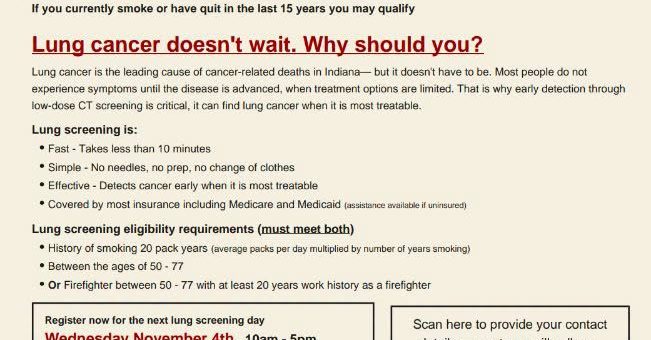
Lung cancer is the leading cause of cancer-related deaths in Indiana, but early detection can significantly improve treatment options. Many people do not experience symptoms until the disease has advanced, making regular screening an important tool for identifying lung cancer when it is most treatable.
The mobile screening unit uses low-dose CT scans to help detect lung cancer early. The process is fast, typically taking less than 10 minutes, and requires no needles, special preparation or change of clothes. Screening is covered by most insurance plans, including Medicare and Medicaid, and financial assistance may be available for uninsured individuals.
Who may qualify for screening?
According to IU Health, individuals must meet eligibility requirements to receive screening, including:
- A history of smoking 20 pack-years, which is calculated by multiplying the number of packs smoked per day by the number of years smoked and being between the ages of 50 and 77.
- Firefighters between the ages of 50 and 77 with at least 20 years of work history as a firefighter may also qualify.
- Individuals who currently smoke or have quit within the past 15 years are encouraged to check whether they meet the screening criteria.
How to schedule an appointment
To schedule a screening or ask questions about eligibility, contact the IU Health mobile lung screening team at 317-962-LUNG (5864) or email lungscreening@iuhealth.org.
Additional information is available at iuhealth.org/lungscreening.
The November 4 event provides an opportunity for eligible residents in Paoli and surrounding communities to take a proactive step toward protecting their health through early detection.