

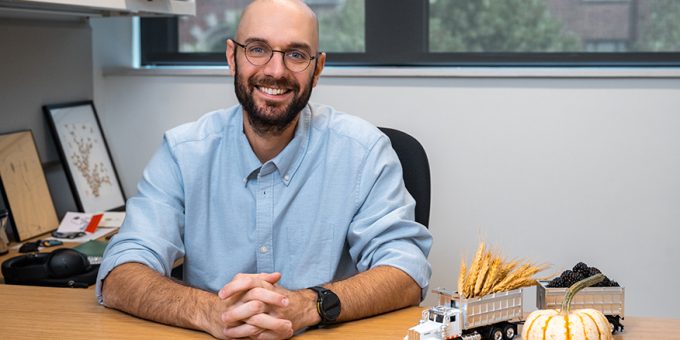
WEST LAFAYETTE — A Purdue University computer science researcher is using technology to address two significant challenges: food waste and food insecurity.
Alex Psomas, an assistant professor of computer science in Purdue’s College of Science, has developed an optimization program called Food Drop that helps redirect excess food shipments away from landfills and toward food banks and pantries that can distribute them to people in need.
The program addresses a problem that often has less to do with the availability of food and more to do with logistics.
According to Purdue, approximately one-third of all food grown and raised goes to waste, while one in 12 people does not have enough to eat.
Food Drop is designed to make it easier for truck drivers and shipping companies to find places that can accept excess food when deliveries cannot be completed as originally planned.
The program evaluates information in real time, including which food banks are open, how much space they have available and what types of food they need. It then considers the locations of trucks and identifies nearby organizations that can accept the food and put it to good use.
For example, a grocery shipment may arrive too late for a store to accept it, or a delivery may contain products that cannot be unloaded because the necessary equipment or employees are unavailable. In other situations, a shipment may be rejected because of scheduling problems or unexpected circumstances.
Although donating the food may seem like an obvious solution, food banks often have limited operating hours, storage capacity, and staffing. A facility may not be able to accept several pallets of food without advance notice.
Food Drop is designed to account for those limitations, helping match available food with organizations that have the ability and need to receive it.
So far, Psomas has worked with two nonprofit organizations in the Midwest, helping save more than 50 tons of food from landfills.
One partnership was established in Indianapolis with the Indy Hunger Network, while another was recently developed in Cincinnati with Last Mile Food Rescue.
Psomas said the project demonstrates how artificial intelligence and computer science can be used to solve practical problems and benefit communities.
He explained that the system automates the process of finding appropriate destinations for excess food, making it easier for businesses to donate shipments rather than dispose of them.
The program also recognizes that food banks and nonprofits are already stretched thin. By automating much of the coordination, the system reduces the additional work required of organizations receiving donations.
Psomas developed the program with doctoral candidate Athina Terzoglou. The algorithms are open source, with the goal of making the technology available to food banks and nonprofits that want to use it.
Ultimately, the project aims to make food recovery more accessible and efficient, helping ensure that food that might otherwise be discarded reaches people who need it.