


WEST LAFAYETTE — A Purdue University professor has helped lead a national research effort identifying four locations on the Moon that could offer valuable opportunities for future human exploration.
Daniel Dumbacher, a professor of engineering practice in Purdue’s School of Aeronautics and Astronautics, co-chaired a committee for the National Academies of Sciences, Engineering, and Medicine. The committee presented its findings on October 21 in a report titled Human Exploration Across the Moon, concluding 18 months of research.
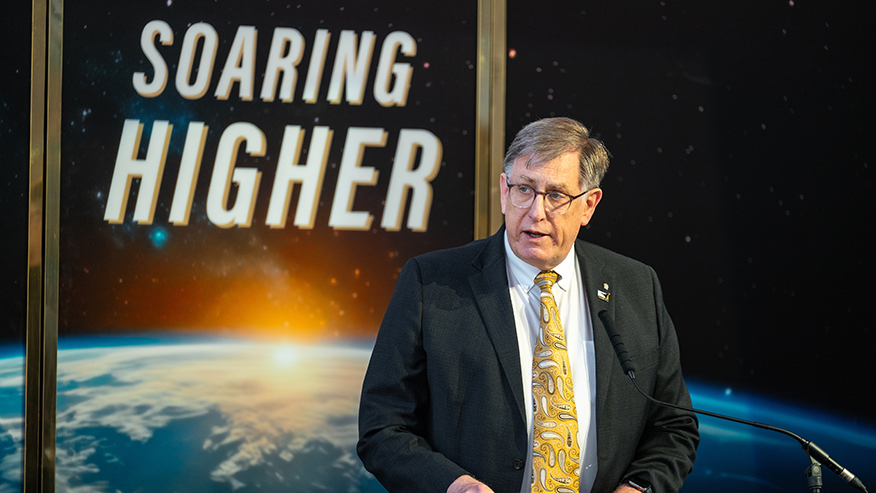
(Purdue University photo/Kelsey Lefever)
The report identifies Bhabha Crater, Mons Hadley, Orientale Basin and Aristarchus as priority locations for human exploration beyond the lunar poles.
Each site offers distinct opportunities to investigate the moon’s geology, space weather, radiation hazards, and potential resources. The findings could help guide planning for NASA’s Artemis program and future missions involving astronauts.
Mons Hadley is particularly notable because it is near the landing site of the Apollo 15 mission. Future explorers could use the area to investigate the lunar environment, examine remaining Apollo-era materials, and explore the possibility of establishing a space weather observatory.
The committee also recommended developing an observational tool that could orbit the Moon. Such a system could support mission planning and provide continuous communications with future human habitats.
The research examines why astronauts may be better equipped than robotic spacecraft to investigate certain scientific questions. Human explorers could help identify potential habitat locations, assess lunar resources and study the moon’s ancient impact basins and volcanic landscapes.
The committee evaluated potential locations based on scientific priorities and NASA’s Moon to Mars Strategy and Objectives. Its recommendations address questions about the history of the solar system, the effects of solar weather, the use of lunar resources, and the origins of dark matter and the universe.
Dumbacher brings extensive aerospace experience to the effort. Before joining Purdue, he served as deputy associate administrator for NASA’s Exploration Systems Development Division in the Human Exploration and Operations Mission Directorate. His work at Purdue focuses on complex systems engineering, project management, propulsion, and power systems.
NASA sponsored the study, which involved a 13-member committee supported by researchers working across planetary sciences, physics, applied sciences, and biology.
The report provides a framework for determining where future astronauts could conduct research that advances scientific understanding while supporting the long-term goal of human exploration beyond Earth.
Read more about the findings in Purdue University’s announcement.