


KENNEDY SPACE CENTER – NASA has provided its most detailed look yet at the upcoming Artemis III mission, outlining a complex low Earth orbit (LEO) test flight designed to evaluate lunar landers from both SpaceX and Blue Origin.
However, despite the comprehensive operational roadmap revealed on October 23 during a press conference at Kennedy Space Center, the exact launch timeline remains up in the air.
During the event, agency officials stressed the immense scale of the undertaking.

“We’re launching three of the most powerful rockets in the world, and undertaking what is likely the most complicated launch campaign ever undertaken,” said Jeremy Parsons, NASA’s Artemis program manager.
The baseline concept of operations relies on three heavy-lift rockets launching from Florida’s Space Coast: Blue Origin’s New Glenn, NASA’s Space Launch System (SLS), and SpaceX’s Starship.
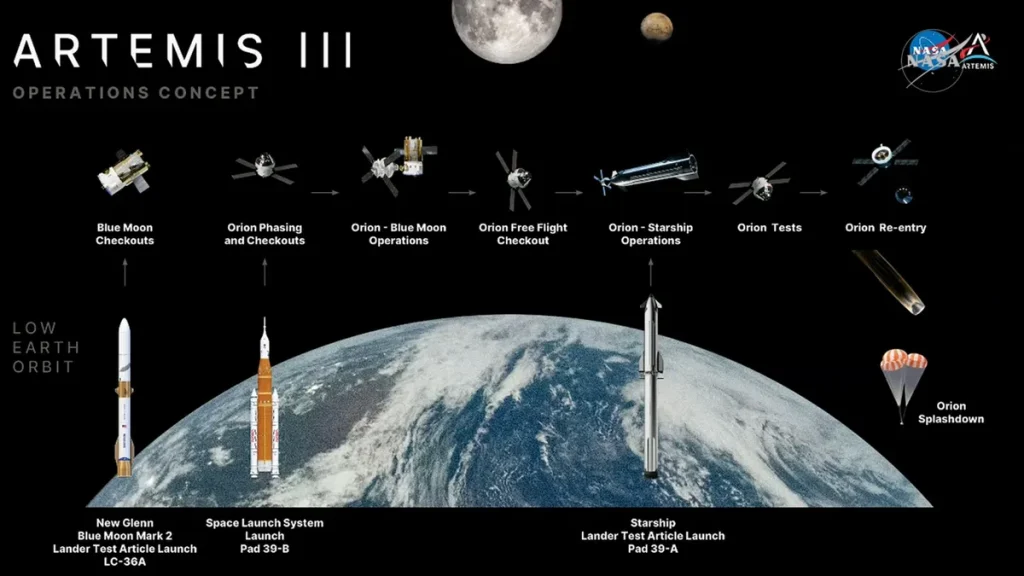
Under the current baseline plan, New Glenn will lift off first, carrying Blue Origin’s Blue Moon lunar lander into low Earth orbit. Next, the SLS rocket will launch the Artemis III crew, NASA astronauts Randy Bresnik, Andre Douglas, and Frank Rubio, along with European Space Agency astronaut Luca Parmitano, aboard the Orion spacecraft.
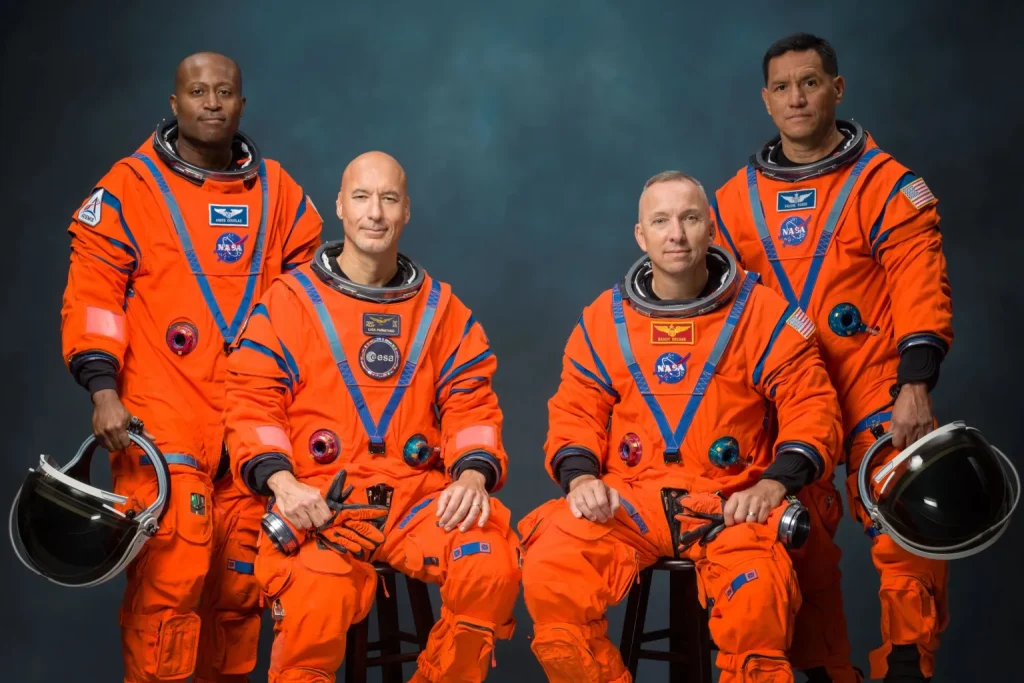
SLS will deploy Orion into a highly elliptical orbit before the capsule maneuvers into an altitude of roughly 345 miles (555 km).
After spending two days checking out Orion’s systems, the crew will rendezvous with Blue Moon on Flight Day 3 at an altitude of 273 miles (439 km). Over the next couple of days, astronauts will open the hatch, enter the lander, evaluate environmental and life-support systems, and run through emergency scenarios and dual-vehicle control.
Around Flight Day 6, SpaceX will launch its Starship upper stage, equipped with a specially built docking adapter on its nose. On Flight Day 8, Starship will rendezvous with Orion in LEO for a brief, roughly two-hour docking demonstration to test pushing forces and joint operations, though the crew will not enter Starship during this mission.
The nominal 14-to-17-day mission will conclude with a parachute-aided ocean splashdown. Throughout the flight, the crew will evaluate survival suits—which were not tested during the 10-day Artemis II lunar flyby—and perform health assessments, scientific experiments, and technology demonstrations.
Paving the Way for 2028 Lunar Landings
Everything done on Artemis III is specifically designed to reduce risk for future missions, setting the stage for Artemis IV, which aims to land astronauts near the moon’s south pole in 2028. NASA has not yet decided whether Blue Origin or SpaceX will execute the first crewed lunar landing since Apollo 17 in 1972, opting instead to preserve optionality.
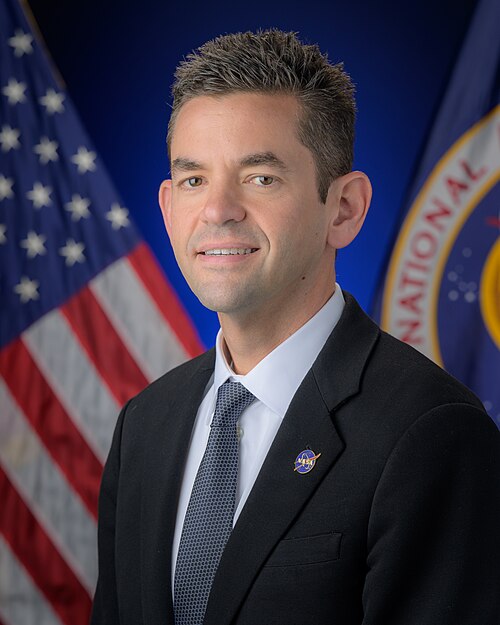
“We have no intention of surrendering a viable path to the surface before the data and schedule compel us to do so,” said NASA Administrator Jared Isaacman during the event.
Both Blue Origin and SpaceX are currently planning for lunar landing missions in 2028, though their mission profiles will look distinct; for instance, while Orion meets Blue Moon in lunar orbit, Starship will likely dock with Orion in Earth orbit to propel it toward the Moon.
While NASA is officially targeting a summer launch next year for Artemis III, meeting that schedule could prove difficult. Last month, in an internal memo to agency employees, Isaacman disclosed that Artemis III was running roughly 90 days behind schedule. Some of the biggest obstacles have involved the supply chain for the mission’s lunar landers, according to Parsons.