

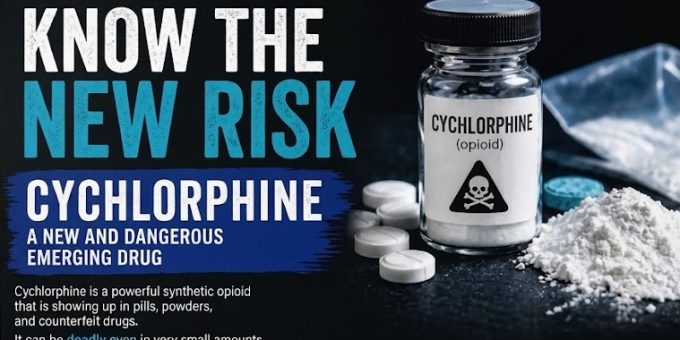
INDIANA – Cychlorpine is appearing with frequency in alerts from state medical examiners, local law enforcement agencies, and college campuses.
The synthetic opioid has been linked to at least 122 fatal overdoses in the United States since July 2025, and in April, the Office of National Drug Control Policy designated it as an “emerging drug threat.” In August 2026, the U.S. Drug Enforcement Administration (DEA) temporarily placed cychlorphine into Schedule I status, officially making it illegal nationwide.
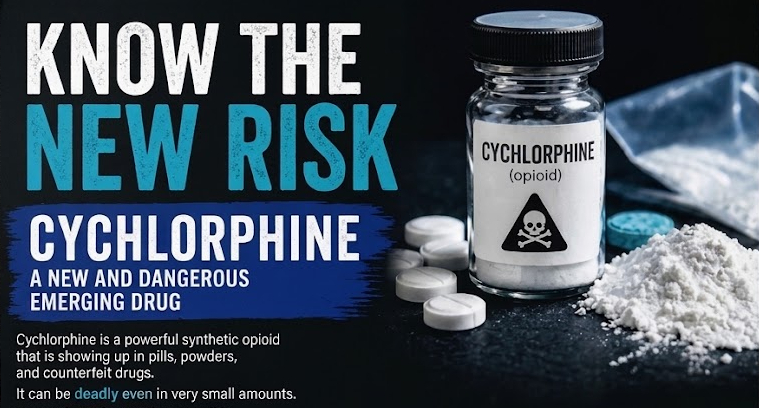
While toxicologists predict cycholorpine may not reach the ubiquitous scale of illicit fentanyl, local public health alerts indicate its footprint is already being felt across the Midwest, including in Indiana.
Here is what you need to know about cychlorphine, its health risks, and its local impact.
Cychlorphine belongs to a relatively new class of opioids known as orphines (or N-propionitrile chlorphine), which have never been approved for medical use.

According to Dr. Nabarun Dasgupta, a street drug scientist at the University of North Carolina at Chapel Hill, cases involving cychlorphine remain sporadic compared to the overwhelming presence of fentanyl. Researchers at UNC first detected the substance in U.S. street drug samples in August 2024, following earlier sightings by European researchers in 2019.
Dasgupta noted that the emergence of cychlorphine is largely a byproduct of global crackdowns on fentanyl analogs. As countries ban fentanyl-related compounds, illicit drug manufacturers turn to non-fentanyl chemical structures that replicate similar psychoactive effects.

Dr. Alex Krotulski, director of toxicology and chemistry at the Center for Forensic Science Research and Education (CFSRE), noted that cychlorphine has been identified in roughly 25 states.
In the Midwest—including Illinois and Indiana—the drug has primarily surfaced in powdered form, frequently blended into illicit batches of fentanyl and heroin. In Southern states, such as Texas, Louisiana, and Alabama, it has more commonly been identified in counterfeit pressed pills.
Indiana health and law enforcement officials have actively monitored the arrival of cychlorphine in the state’s illicit drug supply.
Public health advisories—including warnings issued by law enforcement in Marion County—have highlighted the dangerous presence of cychlorphine in local supply chains. Authorities reported finding the compound mixed into off-white, grey, or tan powders, as well as pressed into counterfeit prescription tablets.
The primary danger for Indiana residents is unknowingly consuming the drug. Because cychlorphine is frequently cut into other street drugs or disguised as prescription pain relievers and sedatives (such as OxyContin or Xanax), users are often unaware of its presence until an overdose occurs.
Extreme Potency and Health Risks
Laboratory models indicate that cychlorphine is significantly more potent than fentanyl. Because of its extreme strength, even a minuscule, barely visible amount can trigger life-threatening toxicity.
As a powerful central nervous system depressant, cychlorphine targets the body’s opioid receptors. Key physical symptoms and health risks include:
- Respiratory Depression: Breathing slows down drastically or stops completely.
- Severe Sedation: Profound drowsiness, stupor, or loss of consciousness.
- Cyanosis: Blue, pale, or greyish discoloration of the lips, skin, or fingernails due to lack of oxygen.
- Unresponsiveness: Inability to wake up or respond to external stimuli.
When combined with other depressants—such as alcohol, benzodiazepines, or xylazine—the risk of a fatal event increases exponentially.
One of the most alarming aspects of cychlorphine is that standard fentanyl test strips cannot detect it. Because it belongs to a distinct chemical class, conventional over-the-counter testing kits will return a negative result for cychlorphine. Furthermore, most standard hospital drug screens do not test for orphine compounds, meaning specialized toxicology testing is required, leading to likely undercounting in official statistics.
Despite its resistance to test strips, naloxone (Narcan) remains effective in reversing a cychlorphine overdose. However, officials emphasize that because of the drug’s high potency, multiple doses of naloxone may be required to restore normal breathing.
If an overdose is suspected:
- Call 911 immediately.
- Administer naloxone (nasal spray or injection) if available.
- Perform rescue breathing if trained, and stay with the individual until emergency responders arrive.
However, public health experts warn that cychlorphine is merely one chapter in an evolving landscape of illicit novel synthetic opioids. As one drug is banned, clandestine manufacturers continuously synthesize new alternatives to bypass legal controls, keeping public health systems and local communities on high alert.