

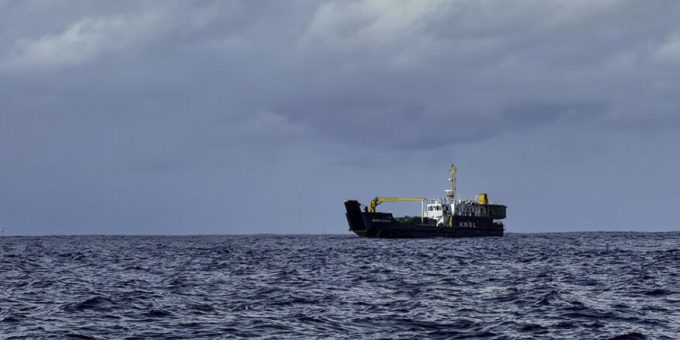
NIKUMARORO, KIRIBATI — Severe weather in the South Pacific prevented members of the Taraia Object expedition team from going ashore Thursday (Oct. 15), temporarily pausing field operations in the search for what could be Amelia Earhart’s Lockheed Electra 10-E.
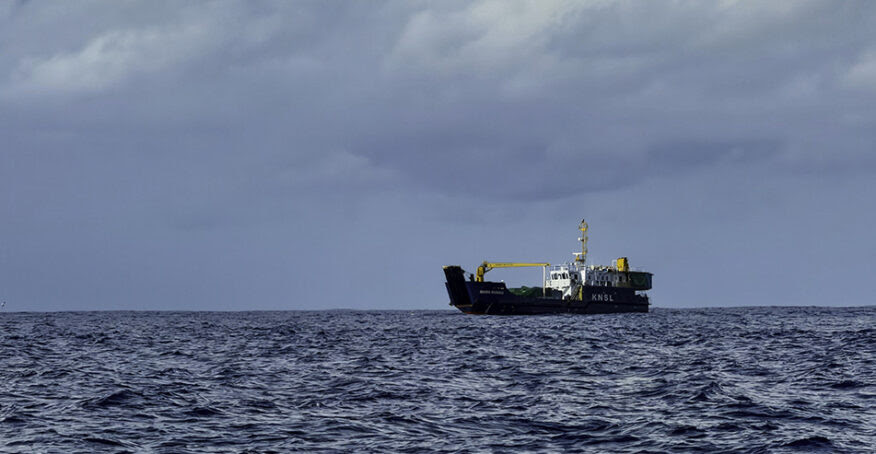
Winds and rough seas near Nikumaroro made conditions unsafe for the 17-person expedition team to use the transport boats from the Marin Mainiku vessel to the island. Despite Thursday’s weather delay, the expedition remains on schedule, with two more days of field operations planned — and an update on the identification of the Taraia Object expected — before the team must depart the atoll and return to Tarawa, Kiribati. Nikumaroro is 17 hours ahead of Eastern time in the United States.
The Archaeological Legacy Institute, Purdue Research Foundation and Purdue University expedition team began its underwater survey of Nikumaroro’s lagoon Wednesday (Oct. 14), using a magnetometer and side-scan sonar to gather data about the Taraia Object, the visual anomaly from satellite imagery being investigated. The team is searching for evidence connected to the castaway hypothesis, the theory that Earhart and navigator Fred Noonan landed on Nikumaroro in July 1937 during Earhart’s attempt to circumnavigate the globe.
The Purdue Research Foundation originally funded Earhart’s Lockheed Electra through the Amelia Earhart Fund for Aeronautical Research. Earhart intended for the aircraft to be returned to Purdue following completion of her historic flight.
Expedition members emphasized that their scientific process requires a multipronged approach to data gathering and analysis before conclusions can be reached about the nature of the Taraia Object. The team expects to have more information to share with the public within the next 48 hours as that work continues.
“We understand the tremendous interest in what we’re doing at Nikumaroro, and we appreciate everyone’s patience,” said Rick Pettigrew, executive director of the Archaeological Legacy Institute. “This is a complex scientific process. You don’t simply arrive at a site and immediately identify what’s there. We have to carefully collect the data, analyze it, and reach sound conclusions.”
Each day’s work on Nikumaroro involves first accessing the island on support boats operated by the Marin Mainiku’s crew. The task of loading equipment and personnel and transporting them to and through the “blasted channel” on the island’s southwestern side is a risky undertaking — frequently on large swells — and involves close coordination between the vessel and the smaller craft. In the interest of safety, the Marin Mainiku may stay as far as a mile away from the atoll’s imposing reef, making the journey the transport boats take an arduous task even under normal conditions. With greater-than-normal wind and swells, the captain may decide the journey is too dangerous to carry out.
The investigation phases planned for the final two days on the island will include the use of a hydroprobe and a water injection dredge to make contact with the object and remove sediment from it to make a visual assessment.
Nikumaroro is part of the Phoenix Islands Protected Area and has been designated as an Important Bird Area by BirdLife International. Three representatives from Kiribati are part of the expedition team.
Earhart came to Purdue in 1935 and spent two years at the university as a women’s career counselor and advisor in the aeronautics department. Her Purdue connection helped make possible the development and acquisition of the Electra she flew on her round-the-world attempt. The Amelia Earhart Terminal at Purdue University Airport honors her legacy as a Boilermaker, which is also remembered across campus through facilities, programs, and organizations.
In a November 1936 letter to President Franklin D. Roosevelt, Earhart said, “As perhaps you know, through the cooperation of Purdue University, I now have a magnificent twin-motor, all-metal plane, especially equipped for long-distance flying. … The operation of my ‘Flying Laboratory’ is under the auspices of Purdue University.” Two months earlier, her husband and manager, George Putnam, had written to Purdue President Edward Elliott explaining that he would “love to see it become the nucleus of a magnificent transportation exhibit at Purdue … paralleling in world interest the Lindbergh collection at St. Louis.”