

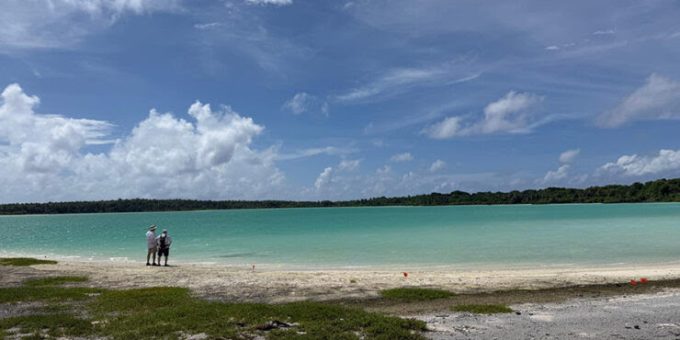
NIKUMARORO — Members of the Taraia Object expedition, a joint effort between the Archaeological Legacy Institute, Purdue Research Foundation and Purdue University, made it ashore on Nikumaroro on Tuesday (Oct. 13), where they began setting up equipment and operations for their investigation into an anomaly that could be what remains of Amelia Earhart’s Lockheed Electra 10-E.
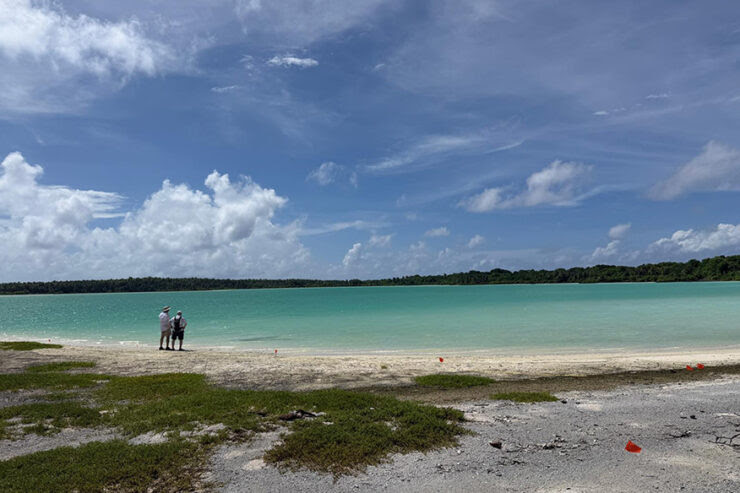
Through the Amelia Earhart Fund for Aeronautical Research, the Purdue Research Foundation funded Earhart’s Lockheed Electra “Flying Laboratory.” Earhart intended for the plane to be returned to Purdue upon completion of her round-the-world flight.
It was the first day onshore for the 17-person expedition team, who arrived too late Monday (Oct. 12) to visit the island after five days of sea travel. As the sun rose, some crew members took smaller transport boats from the Marin Mainiku into the lagoon. The remaining team members set up staging areas and cleared a path to support fieldwork that will begin Wednesday (Oct. 14).
After many years since the last expedition to the island, the traditional path to the lagoon, nicknamed the “Gallagher Highway,” was heavy with undergrowth and coconuts underfoot. Supported by crew members from the Marin Mainiku, the team used a combination of machetes and hand chainsaws and finished cutting a trail to the lagoon within two hours. At least four coconut crabs were encountered along the way, but they posed no threat to the operation.
Though the team expected to spend an entire day setting up operations, the work was accomplished by lunchtime. The joint team, composed of expedition members and the vessel crew, was able to access the Taraia Peninsula by 1 p.m. local time. Nikumaroro is 17 hours ahead of Eastern time in the U.S.
At the peninsula, the team walked the sandspit to look for artifacts in the first phase of terrestrial archaeology work. A series of canopy shelters was erected, and sandbags were filled. The first components of the tech system were erected, and the maritime archaeology team assessed the conditions of the research site, including the sediment on the lagoon floor.
Operations were wrapped up by 4 p.m., and the expedition team retraced its steps to the south side of the lagoon and back through the Gallagher Highway to the beach at the head of the “blasted channel,” a man-made opening near the southwestern corner of the island’s perimeter reef. There, they were picked up by the vessel’s transport boat and carried through large swells back to the Marin Mainiku, where they retired for the evening.