

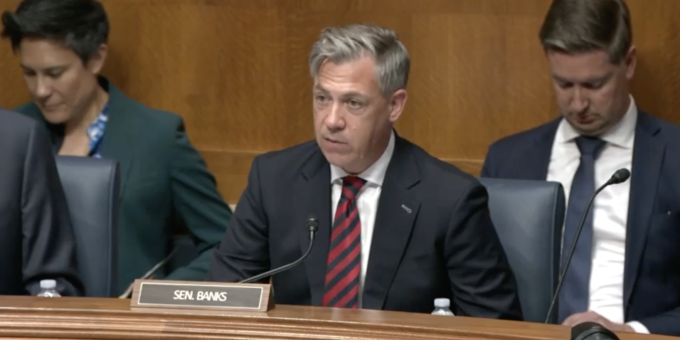
WASHINGTON, D.C. – This afternoon, HELP Employment and Workplace Safety Subcommittee Chairman Jim Banks (R-Ind.) delivered the following opening statement at a hearing titled “The Impact of AI on the Workforce”:
“First, it is an honor and a pleasure to lead the subcommittee. I plan to examine the challenges that American workers face and explore policy solutions to increase opportunity, promote fairness, and support families.
“I appreciate being able to work with you, Ranking Member Hickenlooper, and I intend to be very active in the time we have left.
“Before I go any further, I ask unanimous consent for Senator Blunt Rochester to waive onto the Subcommittee for the purpose of today’s hearing. I want to welcome our witnesses this afternoon. We have a distinguished panel of artificial intelligence researchers and workforce development leaders to put the impact of AI on the workforce in perspective.
“According to Goldman Sachs, AI will drive 7 trillion dollars of worldwide investment and economic activity over the next decade.
“The 7 trillion-dollar question is, who benefits from that?
“But it’s not a question for the future. AI is all around us, and employers, workers, and governments are exploring the answer right now.
“AI promises to raise productivity and reshape work. It can also disrupt how the workplace is organized and create anxiety.
“There’s no shortage of doom-and-gloom predictions about mass displacement of workers, but we haven’t seen that begin to happen.
“Based on all the evidence, three things seem to be happening so far: (1) Hiring of entry-level workers is somewhat weaker; (2) AI is transforming tasks more than jobs; (3) And the skills that employers need and how workers learn those skills are changing.
“The downturn in entry-level hiring is due to several factors, and AI is just one. Some researchers believe the Federal Reserve is partly responsible. I look forward to delving into that today.
“Even in the most AI-exposed occupations, we haven’t seen any significant change in employment, but the way workers allocate their time is changing.
“In some occupations, things like data entry and simple coding are already mostly automated, but checking AI output is a whole new discipline.
“Finally, when we consider how workers acquire and use skills, we have to think about employment pipelines.
“A lot of workforce training happens on the job. Entry-level workers aren’t just hired to do their jobs; they’re hired to gain experience and grow into more advanced jobs.
“Every master craftsman was once an apprentice, every doctor started out as a resident, and most of our staffers started as interns.
“The real challenge is for graduates and young workers to acquire the AI-related skills they need to enter the workforce and get on the first rung of their career ladders.
“If those opportunities dry up or some young workers can’t access them, it will be a big problem in the labor market over the long term.
“Helping workers master the skills they need to succeed in the AI economy starts with getting better data.
“Existing labor statistics too often fail to tell us how occupations’ tasks are changing, what skills are needed, which occupations will grow and shrink, and how workers move through the labor force because of AI.
“That is why I introduced the AI Workforce Prepare Act with Sen. Hickenlooper, Sen. Husted, and Sen. Hassan.
“The Census and the Bureau of Labor Statistics need more expertise to analyze and forecast AI’s impacts. They need to share more data with state and local governments and collaborate with private researchers.
“Billions of dollars of spending on workforce development programs rely on good data. But better data is not a goal in itself. We need to make better decisions to beat China in the AI race.
“We need to train and equip American workers in nearly every industry to compete and win in the AI economy. We also need to make sure small and medium-sized businesses don’t get left behind while the biggest companies race ahead.
“America will win the AI race with China by maximizing the capabilities of all of our companies and all of our workers.
“I look forward to hearing our witnesses’ perspectives on exactly how we can accomplish that.”

