

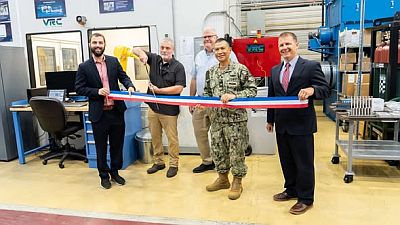
CRANE — Naval Surface Warfare Center (NSWC) Crane has achieved a major technological milestone with a formal ribbon-cutting ceremony for its new Metal Additive Manufacturing Repair Center, known as “MADMAN.”
The state-of-the-art facility significantly upgrades the base’s maintenance operations by introducing advanced “cold spray” technology to repair high-value maritime and aerospace components on-site. By leveraging this cutting-edge process, NSWC Crane can now return critical assets to the fleet in a matter of days rather than months, drastically reducing the military’s reliance on lengthy commercial supply chains.
With this development, NSWC Crane becomes the first Navy organic industrial base facility to be certified under advanced Naval Sea Systems Command (NAVSEA) cold spray standards.
What is Cold Spray Technology?
Unlike traditional thermal spray or welding techniques, cold spray is an additive manufacturing process that does not require melting the metal. Instead, it uses a heated, high-pressure carrier gas (typically nitrogen or helium) to accelerate microscopic metal particles through a supersonic nozzle.
When these particles impact a damaged component at speeds reaching up to Mach 3, they undergo plastic deformation—essentially bonding to the surface at a molecular level without creating a heat-affected zone. This offers several critical advantages for military readiness:
- No Thermal Distortion: Because the substrate material isn’t melted, the structural integrity, temper, and shape of sensitive aerospace and maritime parts are perfectly preserved.
- Diverse Material Matching: The technology allows engineers to deposit a wide variety of metals—including aluminum, titanium, nickel-based superalloys, and stainless steel—directly onto existing parts.
- Substantial Cost Savings: Instead of scrapping expensive, hard-to-source components worn down by corrosion or friction, technicians can systematically rebuild them back to their original manufacturing specifications.
Strategic Impact on Fleet Readiness
The launch of the MADMAN center directly aligns with the U.S. Navy’s broader push to cultivate advanced manufacturing capabilities internally, securing its logistics networks against global supply chain vulnerabilities.
Historically, when specialized parts for warships or aircraft suffered wear or corrosion, replacing them required navigating backlogs with original equipment manufacturers (OEMs). In an era of prolonged lead times, this often left multi-million dollar assets sidelined for months.
By localizing these complex additive repairs within an organic industrial base facility like NSWC Crane, the Navy eliminates shipping delays, bypasses manufacturing queues, and ensures that deployment-ready equipment can be turned around rapidly to support global operational demands.
The advanced NAVSEA certification ensures that every repair completed at the MADMAN facility meets the stringent structural and safety tolerances required for high-stress military environments.

