

WASHINGTON, D.C. — They are plugged into nearly every living room, bedroom, and home office in America, yet extension cords remain one of the most frequently misused household items.
The U.S. Consumer Product Safety Commission (CPSC) issued a stark warning to homeowners, estimating that approximately 4,600 residential structure fires each year are directly associated with extension cords. These preventable disasters result in an average of 70 deaths and 230 injuries annually.
Beyond fire risks, the CPSC notes that faulty or misused cords account for an additional 2,200 electrical shock injuries every year.
Why Extension Cords Overheat
Extension cord fires generally stem from three primary culprits: short circuits, physical damage to the cord, or severe overloading.
According to safety investigators, dangerous overheating can manifest at the plug, inside the wall socket, or along the entire length of the cable. When a plug or wall outlet feels hot to the touch, it is usually a critical warning sign that the inner electrical connections have deteriorated or that the cord is being forced to carry more electrical current than it can handle.
How to Prevent Electrical Overloading
Every extension cord has a specific electrical capacity, which can be found printed on its safety tag or original packaging.
- The Heat Test: If any part of a cord feels warm or hot while in use, it is a clear warning sign of overloading. Disconnect the devices immediately.
- Check the Rating: Before plugging in high-draw electronics, verify that the cord is officially rated to handle the total wattage and amperage of the connected devices.
- Say No to Major Appliances: Extension cords are designed for temporary use with smaller electronics. Heavy-draw appliances—such as space heaters, refrigerators, or microwaves—should always be plugged directly into a permanent wall outlet.
Protecting Cords from Invisible Damage
Hidden damage to a cord’s inner copper wiring is a major ignition source for home fires. To protect your property, safety experts recommend adhering to the following placement rules:
- Never Hide Cords: Do not run extension cords under rugs, carpets, or large furniture. Walking over a hidden cord or trapping it under a heavy couch crushes the insulation and traps ambient heat, creating an extreme fire hazard.
- Avoid Doorways: Keeping cords draped through high-traffic doorways exposes them to pinching and fraying.
- No DIY Repairs: Never use electrical tape to patch up cracked or chewed insulation. Do not trim, cut, or alter the metal plug blades to force them into an outlet.
Safety Rule: Always unplug an extension cord when it is not actively in use. As long as a cord is plugged into the wall, it remains fully energized and capable of shorting out.
Knowing When to Throw Older Cords Away
Older extension cords lack modern safety innovations and should be systematically discarded. When evaluating the safety of the cords in your home, look for these baseline specifications:
| Safety Feature | What to Look For |
| Wire Gauge | Look for an imprint on the cord’s surface. Cords should be at least 16 AWG (American Wire Gauge), unless they are 18 AWG equipped with built-in fuse protection. Note: Smaller AWG numbers mean thicker, safer wires. |
| Certification | Ensure the cord features a stamp from a recognized national testing laboratory, such as Underwriters Laboratories (UL), Intertek (ETL), or CSA-International. |
| Modern Plugs | Safe cords feature polarized blades (one prong wider than the other) and a wide, easy-to-grasp plug face that completely covers the wall outlet slots. |
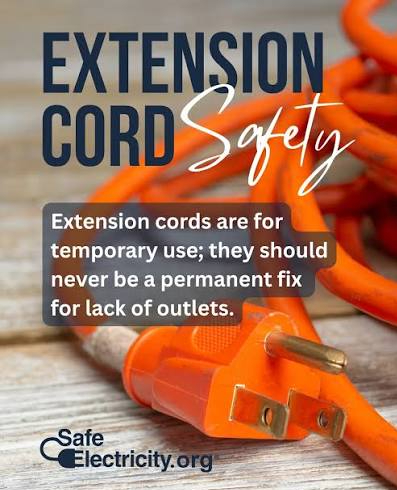
Ultimately, emergency officials emphasize that extension cords are engineered strictly as temporary fixes. If you find your family relying on them as permanent fixtures to power your home, it is time to contact a licensed electrician to install permanent household wiring.

