

INDIANA — New data analysis has placed Indiana’s motorcycle safety regulations under a national spotlight, revealing that nearly two-thirds of the state’s rider fatalities involve individuals who were not wearing a helmet.

The study, conducted by Grigor Law Injury & Car Accident Lawyers, analyzed nationwide traffic data between 2020 and 2024. It found that 66.7% of motorcyclists killed in Indiana were riding without helmets. This alarming statistic ranks Indiana as the 5th worst state in America for unhelmeted rider fatalities.
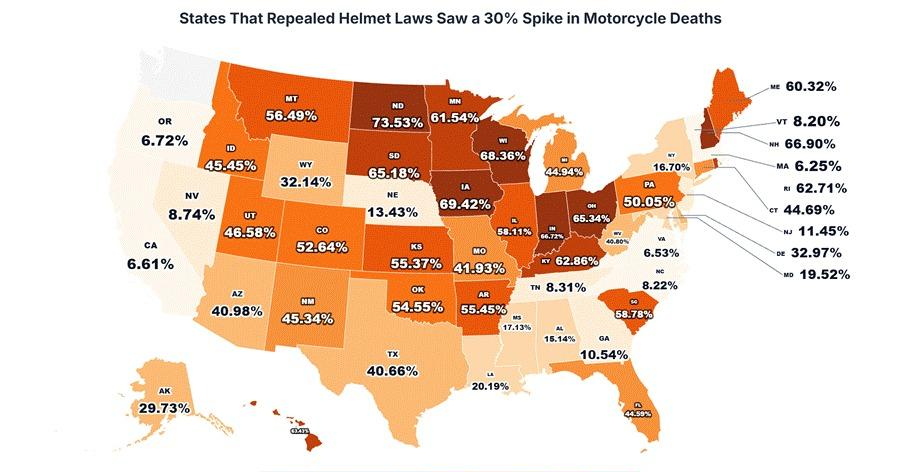
Under current state regulations (Indiana Code § 9-19-7-1), Indiana enforces a “partial” helmet law. This statute mandates DOT-approved helmets and eye protection only for operators and passengers under the age of 18, or those operating with a temporary learner’s permit. Adult riders holding a full motorcycle endorsement are legally permitted to ride without any head protection.
The study highlights a stark disparity between partial-law states and those with universal mandates:
- The Population Disparity: Indiana recorded 658 total motorcycle deaths over the five-year tracking period. This represents 19.4% of all partial-law fatalities across the United States, despite Indiana accounting for just 3.3% of the total population living in partial-law states.
- The Highest Raw Volume: Indiana averages 131.6 motorcycle deaths annually, with 87.8 of those victims riding without a helmet. This gives the Hoosier State the highest raw volume of unhelmeted deaths among all top-10 worst states, more than doubling the next closest state by absolute count.
- The Universal Law Contrast: By comparison, Washington state enforces a universal helmet law requiring head protection for all riders. Washington successfully holds its unhelmeted fatality rate to just 4.5%. Indiana’s rate runs at nearly 15 times that figure.
While states like North Dakota (73.5%) and Iowa (69.4%) have higher percentages of unhelmeted deaths, their smaller populations mean their combined annual death toll (71.8) is barely half of Indiana’s solitary total. This makes Indiana the state where partial helmet laws cost the most lives in absolute terms.
| Rank | State | Helmet Law Status | Avg. Annual Motorcyclist Deaths | % of Killed Riders Unhelmeted |
| 1 | North Dakota | Partial | 13.6 | 73.5% |
| 2 | Iowa | None | 58.2 | 69.4% |
| 3 | Wisconsin | Partial | 98.6 | 68.4% |
| 4 | New Hampshire | None | 29.0 | 66.9% |
| 5 | Indiana | Partial | 131.6 | 66.7% |
| 6 | Ohio | Partial | 206.6 | 65.3% |
| 7 | South Dakota | Partial | 22.4 | 65.2% |
| 8 | Hawaii | Partial | 26.8 | 63.4% |
| 9 | Kentucky | Partial | 98.0 | 62.9% |
| 10 | Rhode Island | Partial | 11.8 | 62.7% |
Understanding the Safety and Legal Implications
The Bureau of Motor Vehicles’ “Ride Safe Indiana” safety program continues to push for better rider education, training a record 9,163 riders in 2024 alone. State collision data demonstrates that the top contributing factors to these crashes are failure to yield the right-of-way, unsafe speed, and improper lane movement. State tracking reports show that in multi-vehicle motorcycle accidents, the driver of the passenger vehicle is deemed at fault more than 75% of the time, often due to distracted driving or failing to spot the smaller profile of a motorcycle.
However, when a crash does occur, the physical and legal consequences of riding unhelmeted are severe. According to the National Highway Traffic Safety Administration (NHTSA), proper helmet use is 37% effective in preventing rider fatalities and reduces the risk of traumatic brain injuries by 69% to 85%.
Beyond the emergency room, choosing to ride without a helmet carries heavy legal ramifications in civil court. Because Indiana operates under a comparative negligence law, insurance adjusters and defense attorneys heavily scrutinize helmet compliance during personal injury or wrongful death claims. If an unhelmeted rider suffers a severe head or facial injury in an accident caused by another driver, judges or insurers frequently argue the rider failed to mitigate their damages. This can result in a court finding the rider partially negligent, drastically reducing or eliminating the financial compensation they can recover.

