

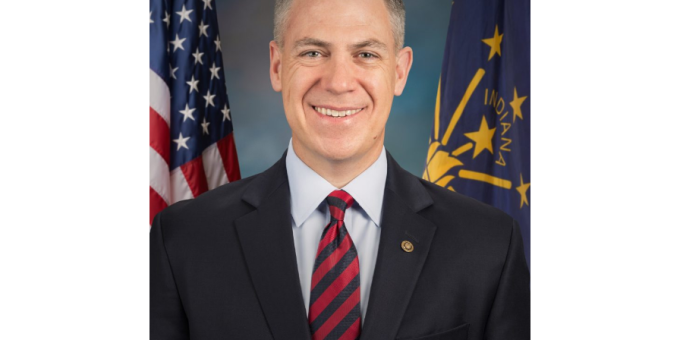
WASHINGTON, D.C. – Last week, Senator Jim Banks (R-Ind.) and seven Senate colleagues sent a letter calling on Ambassador Jamieson Greer, U.S. Trade Representative, to prioritize stronger protections against China’s efforts to undermine U.S. automakers as discussions surrounding the United States-Mexico-Canada Agreement (USMCA) continue.
The letter was signed by Senators Marsha Blackburn (R-Tenn.), Katie Britt (R-Ala.), Ted Budd (R-N.C.), Bernie Moreno (R-Oh.), Pete Ricketts (R-Neb.), Rick Scott (R-Fla.), and Tommy Tuberville (R-Ala.).
Read more about the letter here.
See the full letter here or read below:
Dear Ambassador Greer:
As the Trump Administration continues to negotiate an extension of the United States-Mexico-Canada Agreement (USMCA) with Mexican and Canadian officials, we urge you to prioritize strengthened guardrails that protect American automakers from China’s efforts to gain market share within the North American auto industry. The Chinese Communist Party (CCP) has launched a multi-pronged campaign to weaponize supply chains, flood U.S., Mexican, and Canadian markets with subsidized autos, and displace American workers in the process. A strong auto manufacturing sector is the beating heart of America’s industrial base, and it depends on a North American trading block that is free from market manipulation by foreign adversaries. We are encouraged by your comments reaffirming the Administration’s strong commitment to American automakers, and we urge you to deploy strong leverage in USMCA negotiations to strengthen this trade deal’s guardrails and ensure Mexico and Canada adopt strong protections to prevent side doors for Chinese vehicles into the U.S. and malign greenfield investment by Chinese automakers.
The CCP’s “Made in China 2025” strategy makes clear its intention to dominate global auto manufacturing.[1]The CCP has made strides toward achieving its goal since this strategy was first announced in 2015. China is now the largest global exporter of automobiles—both electric and internal combustion engine (ICE) vehicles. The country’s vehicle exports have surged from just over 700,000 autos in 2019 to more than 7 million last year.[2]
This dramatic export spike did not occur in a vacuum—it is the direct result of the CCP’s long record of anti-competitive practices. The ascendence of Chinese automakers has been built on sizeable state subsidies, routine trade violations, preferential financing and tax breaks, slave labor, rampant intellectual property theft, and preferential market access policies.
President Trump is singularly responsible for stopping the tide of Chinese state-sponsored autos from crossing the shores of the United States so far. He perceived the dire threat of heavily subsidized Chinese vehicles early, and he wisely imposed tariffs on Chinese vehicles in 2018.[3] These tariffs, which have since been increased and strengthened, have built a strong protective wall against imports of vehicles directly from China to the United States, and they have stopped China from gaining any share of the U.S. auto market to date. Information and Communication Technologies and Services rulemaking barring the sale and import of vehicles with Chinese hardware and software has added an additional vital layer of protection.
But Chinese automakers are now attempting an end-run around President Trump’s tariffs by building Chinese auto factories in countries that have favorable trade deals with the United States or negotiating direct shipments of Chinese autos to those countries. Mexico and Canada lie at the heart of this strategy.
The CCP has made alarming progress in breaking into the Mexican auto market through direct investment. One in five cars sold in Mexico is now a Chinese auto.[4] Chinese carmakers have built at least 12 new manufacturing facilities in Mexico since 2019, and even more auto component facilities.[5] China’s direct investment in Mexico—largely concentrated on the country’s auto industry—doubled between 2021 and 2024, and it has grown further since.[6] As you and other Administration officials negotiate with President Sheinbaum, adjusting USMCA’s rules of origin to exclude vehicles with significant Chinese-origin content and securing a commitment from Mexico to adopt investment screening processes that block new Chinese auto investments should be top priorities.
As President Trump’s America First Investment Policy Memorandum outlines, “certain foreign adversaries, including the People’s Republic of China (PRC), systematically direct and facilitate investment in United States companies and assets to obtain cutting-edge technologies, intellectual property, and leverage in strategic industries.”[7] This same logic applies to the North American trading block, especially as it pertains to the American auto industry, and it is vital that America lead the way in blocking China from manipulating North America’s industrial base through malign direct investment.
Across America’s northern border, the CCP has employed a different strategy. While Canada retains notable guardrails to block malicious direct investment from foreign adversaries, China has held hostage Canadian agriculture interests to negotiate direct shipments of Chinese EVs into Canada at lower tariffs, which were previously aligned with the U.S.. As announced by Prime Minister Carney in January 2026, the country now intends to allow 49,000 Chinese EVs to be imported into Canada each year at a heavily discounted tariff rate.[8] This represents more than one quarter of annual EV sales in Canada, and it will greatly damage American automakers’ market share in the country, harming their prospects to grow and invest in new technologies. Securing a commitment from Prime Minister Carney to restore Canada’s high trade protection against Chinese EVs should be a top priority.
For more than a century, a thriving auto manufacturing sector has fueled America’s dominance in both commercial and defense industrial endeavors. American automakers do not just deliver indispensable products to our families; they build and preserve ecosystems of technology innovation and a skilled manufacturing workforce that strengthens our nation and has cascading benefits through many corners of the U.S. economy. As the U.S. continues to negotiate improvements to USMCA with the Mexican and Canadian governments, we applaud you for prioritizing strong reforms that preserve the might of America’s auto industrial base and protect the North American trading block from malign Chinese investment during your April meeting with President Sheinbaum. We urge you to continue prioritizing such measures during the first official round of bilateral USMCA negotiations next week.
Thank you for your attention to this important matter.

