

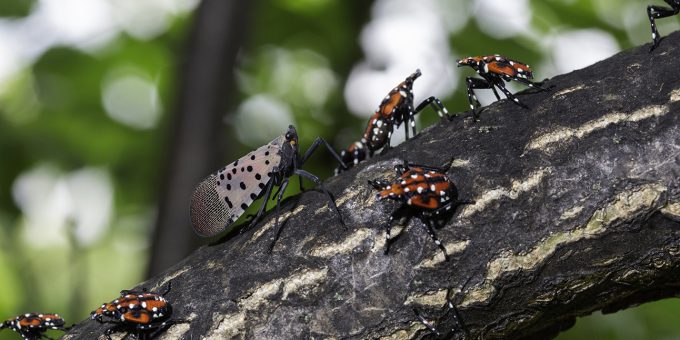
BLOOMINGTON—The City of Bloomington is alerting residents to the growing threat of the Spotted Lanternfly (Lycorma delicatula). This invasive insect has been confirmed in Bartholomew County, approximately 50 miles from Bloomington. This pest poses a serious risk to local agriculture, landscapes, and natural ecosystems.

Originally from Asia, the Spotted Lanternfly (SLF) is a plant hopper that feeds by sucking sap from trees and plants, weakening them over time. SLFs are often found congregating on or near a Tree of Heaven, a fast-growing invasive tree common in disturbed areas. See how to identify this host plant on the Purdue Extension: Identifying Tree of Heaven webpage.

While its preferred host is the Tree of Heaven, SLF is known to feed on more than 70 plant species, including grapevines, soybeans, maples, and fruit trees. SLF infestations can spread rapidly and cause widespread damage to crops, gardens, and natural areas. Early detection and swift action are critical in slowing its spread and minimizing its impact on the community.
“Parks and Recreation’s urban forestry and natural resources teams are in the process of identifying and confirming the presence of Tree of Heaven on public lands across the city,” said Urban Forester Haskell Smith. “This allows us to strategically schedule removals and minimize the tree’s role as a host for the invasive Spotted Lanternfly, while also protecting the integrity of our urban forest.”
SLF has distinctive markings at different stages of its life. In the early stages, it appears black with white spots, then red with black and white patches. Adults are roughly one inch long with gray wings that reveal bright red underwings when opened. See photos of SLF life stages, plus images of its egg masses and lists of host plants, on the Indiana Department of Natural Resources Division of Entomology Spotted Lanternfly webpage.
If you suspect you’ve seen a Spotted Lanternfly:
- Collect a sample or take clear photos
- Destroy the insect if possible
- Report the sighting immediately through the Indiana Department of Natural Resources.
Residents are also encouraged to contact the area’s State Entomology Inspector, Will Drews, for further guidance.

