


BLOOMINGTON — Indiana University has officially opened its new Applied Research Center (ARC), a first-of-its-kind facility in the state designed to accelerate partnerships between the university, government agencies, and private industry on critical national security initiatives.
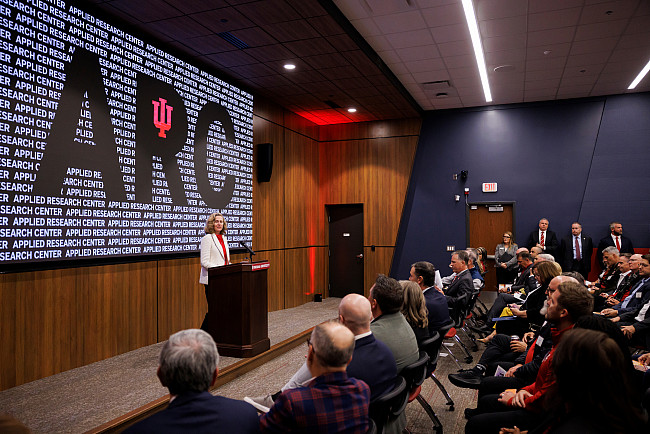
University leaders joined state and federal officials on Nov. 13 in Bloomington to celebrate the opening of the facility, which features specialized laboratories, offices, and collaborative workspaces capable of accommodating all levels of security classification.
Operating under IU Inc.—the university’s nonprofit front door connecting outside organizations to IU’s more than $1 billion research enterprise—the ARC will coordinate expertise across multiple disciplines. Its core research areas include artificial intelligence, cybersecurity, microelectronics, autonomous systems, and biotechnology.
“Meeting our nation’s evolving national security needs requires a coordinated approach to research, innovation, and talent development, and Indiana University is creating the infrastructure necessary to advance this important work,” IU President Pamela Whitten said. “The ARC builds on IU’s longstanding strengths in intelligence and defense while supporting the innovation ecosystem that will power discoveries and partnerships that benefit our state and country for decades to come.”
Beyond advancing federal research investments and state competitiveness, the center is designed to serve as a workforce pipeline. IU students will gain hands-on experience working directly alongside faculty researchers, industry leaders, and government collaborators on real-world defense challenges.
The launch builds on IU’s historical ties to national defense, including its 19th-century ROTC roots, the Air Force origins of its Language Training Center, and ongoing collaborations with Naval Surface Warfare Center (NSWC), Crane Division.

“This facility embodies the enduring partnership between Indiana University and NSWC Crane,” said Angela Lewis, technical director at NSWC Crane. “The Applied Research Center bridges the gap between scientific discovery and mission impact, ensuring that the breakthrough science happening in Indiana aligns to our national defense priorities.”
State and federal leaders echoed the center’s strategic importance for both Hoosiers and national defense:
- Indiana Gov. Mike Braun: “Indiana has the research expertise, industry partnerships and talented workforce to strengthen our nation’s national security. Indiana University’s Applied Research Center brings these strengths together to drive innovation, advance our defense capabilities and create new opportunities for Hoosiers.”
- U.S. Senator Todd Young: “The rapid pace of technological advancement requires that we regularly replace outdated tools with breakthrough technologies. ARC will provide the science, data, and advanced technologies to protect the United States against modern, invisible threats.”
- U.S. Senator Jim Banks: “Indiana University is doing important work to advance cutting-edge research and innovation that strengthens our national security and keeps America competitive.”
David Rosenberg, president and CEO of IU LAB and IU Inc., noted that the ARC streamlines how external partners engage with the university to turn academic discoveries into practical defense solutions.

“By fostering collaboration across disciplines and sectors, the center will help move breakthrough ideas from the lab to real-world application,” added Russell J. Mumper, IU vice president for research. “We can demonstrate the value of IU as a partner, expand IU’s role in the national defense research enterprise, and create new pathways for innovation, workforce development, and economic growth.”