

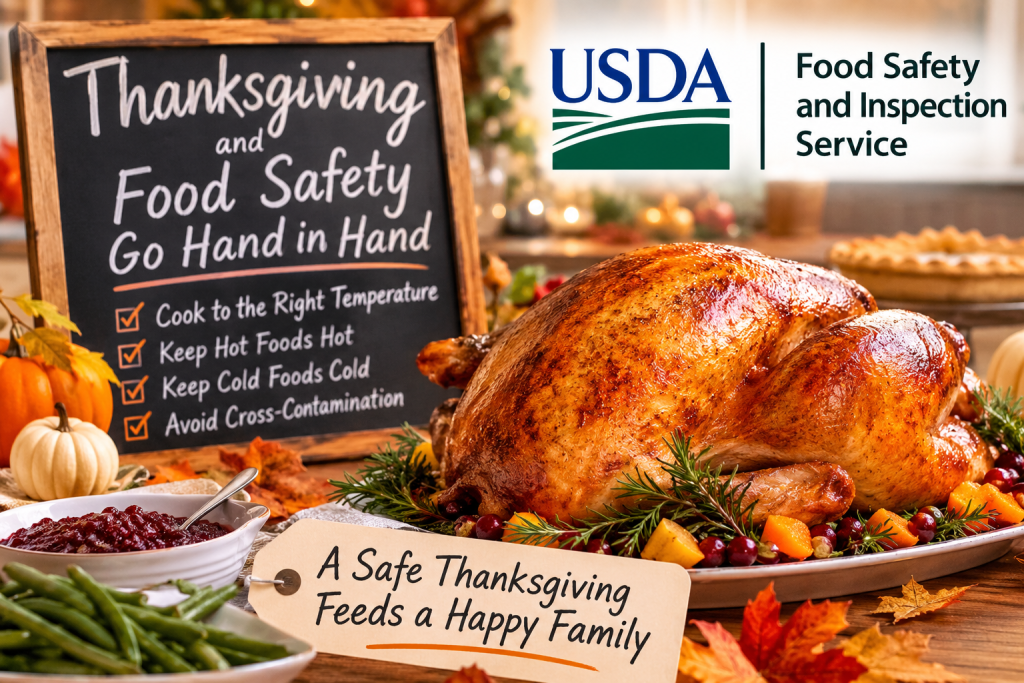
INDIANA — As families across Indiana and the nation pull together their menus and finalize holiday travel plans, the U.S. Department of Agriculture’s Food Safety and Inspection Service (FSIS) is issuing a timely reminder: the secret ingredient to any great Thanksgiving is food safety.
“Thanksgiving is one of America’s most cherished traditions, bringing family and friends together around the table,” said USDA Under Secretary for Food Safety Dr. Mindy Brashears. “By following a few simple food safety steps at home, families can protect their loved ones and focus on what matters most — enjoying a safe and memorable Thanksgiving together.”
Each November, food safety specialists field thousands of questions through the USDA Meat and Poultry Hotline. To help hosts navigate everything from turkey sizing to leftover storage, the USDA offers an interactive thawing and cooking calculator alongside its comprehensive Your Safe Thanksgiving Guide online.
To ensure your holiday meal is remembered for the right reasons, experts recommend following four critical food safety steps:
1. Plan and Thaw Safely
Whether you prefer fresh or frozen, planning ahead is your first line of defense:
- Fresh Turkeys: If shopping just one to two days before Thanksgiving, opt for a fresh bird. Check the manufacturer’s “best-by” or “use-by” date, and keep the turkey unopened in the refrigerator until you are ready to prep it.
- Frozen Turkeys: If buying weeks in advance, keep it frozen. Never thaw a turkey on the kitchen counter. Instead, use one of two safe methods:
- Refrigerator Thawing: Allow roughly 24 hours for every 4 to 5 pounds of turkey.
- Cold Water Thawing: Submerge the turkey in cold tap water, changing the water every 30 minutes. Allow about 30 minutes per pound.
2. Cook to 165°F
Relying on skin color or pop-up timers isn’t enough. A food thermometer is the only foolproof way to guarantee your turkey is safe to eat.
- Check the internal temperature in three distinct locations: the thickest part of the breast, the innermost part of the wing, and the innermost part of the thigh. It must reach a minimum internal temperature of 165°F.
- The Stuffing Rule: For optimal safety and even cooking, the USDA recommends cooking stuffing outside the bird in a casserole dish. If you do stuff your turkey, ensure the center of the stuffing also reaches 165°F.
3. Keep Foods Out of the “Danger Zone”
Bacteria multiply rapidly at temperatures between 40°F and 140°F—known as the food safety “Danger Zone.”
- Hot Foods: Keep hot dishes steaming in the oven, chafing dishes, slow cookers, or warming trays at or above 140°F.
- Cold Foods: Keep cold appetizers and sides refrigerated or nestled in ice until serving time.
- The Two-Hour Rule: Never let perishable foods sit at room temperature for more than two hours. Refrigerate leftovers promptly in shallow containers so they cool quickly.
4. Store and Reheat Leftovers Safely
The best part of Thanksgiving might just be the leftovers, provided they are handled with care:
- Divide large amounts of turkey, gravy, and side dishes into shallow, smaller containers to speed up cooling in the refrigerator.
- Properly stored refrigerated leftovers are safe to eat for up to four days. If you can’t finish them in time, move them to the freezer, where they remain safe indefinitely (though quality is best within a few months).
- When it’s time for round two, thoroughly reheat all leftovers to 165°F before serving.