


INDIANA – With Black Friday fast approaching on November 27, Indiana shoppers are preparing to hunt for holiday bargains. However, consumer experts are warning residents to stay vigilant as online sales reach record highs, bringing an elevated risk of digital shopping scams.
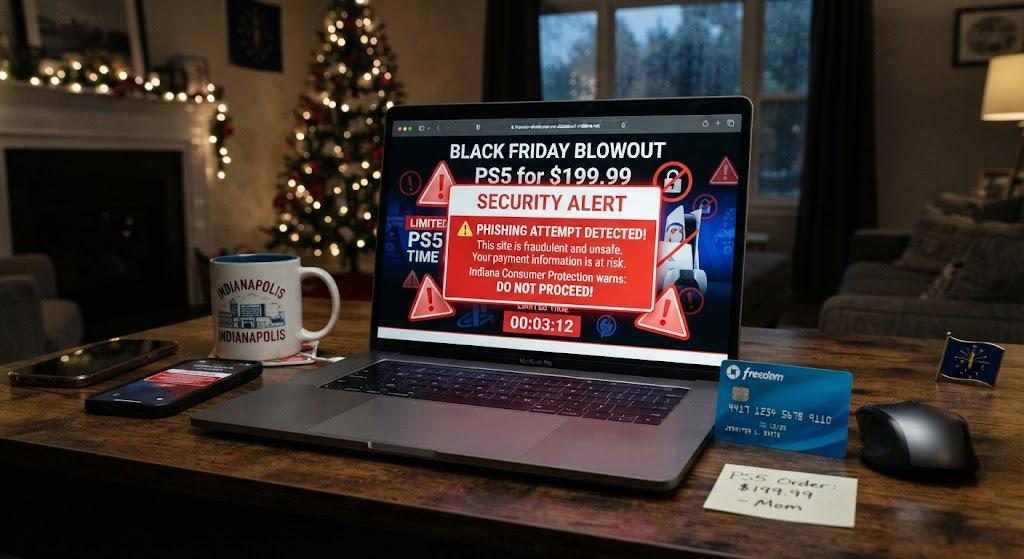
Adobe forecasts that total U.S. online sales will hit $275.1 billion over the holiday season, with $12.9 billion spent online on Black Friday alone—a 9.2% increase over last year. While Americans are spending more online than ever, scammers are actively preparing to capitalize on unsuspecting buyers.
A new study by independent comparison site WhatAreTheBest.com analyzed five full years of online shopping scam reports submitted to the Federal Trade Commission (FTC). The findings reveal that while Hoosiers fare better than residents in most other states, they still face significant financial risks.
How Indiana Compares Nationally
Online shopping scam reports from Indiana listed an average loss of $585 per incident in 2025. This figure represents the seventh-lowest average among all 50 states and stands 31.5% below the national average of $854.
Between 2022 and 2025, Indiana residents reported losing a collective $10.6 million to online retail scams, ranking the state 25th nationally in total dollars lost. That figure includes $9.0 million lost between 2023 and 2025, and $3.3 million lost in 2025 alone.
When adjusted for population, Indiana ranks among the safest states in the nation regarding total financial impact:
- Losses per Capita: Indiana lost $153,817 per 100,000 residents to online shopping scams between 2022 and 2025. This was the second-lowest figure in the nation (behind only Minnesota) and 42.5% below the 50-state average of $267,428. By comparison, top-ranked Wyoming recorded $621,693 in losses per 100,000 residents.
- Scam Prevalence: Between 2021 and 2025, Indiana residents filed 27,422 online shopping scam reports with the FTC. This equates to 398.1 reports per 100,000 residents, placing Indiana 38th out of 50 states and 11.8% below the national rate of 451.3.
In 2025, Indiana recorded 81.5 reports per 100,000 residents (the 10th lowest rate nationally), down from its five-year peak of 85.2 in 2021. Scam report rates in Indiana rose 5.0% between 2024 and 2025, a slower rate of growth than the national average increase of 6.3%.
Among neighboring Midwestern states, Indiana remains relatively safe. Illinois (455.2 reports per 100,000; 23rd), Michigan (432.3; 29th), and Ohio (428.6; 31st) all reported higher scam rates than Indiana, while Kentucky recorded a slightly lower rate (397.9; 39th). Delaware recorded the nation’s highest overall report rate at 649.6 per 100,000 residents.
Money Lost to Online Shopping Scams: How Indiana Compares
| Rank (Losses per 100k) | State | Money Lost per 100,000 Residents (2022–2025) | Total Money Lost (2022–2025) | Average Loss per Report (2025) |
|---|---|---|---|---|
| 1 | Wyoming | $621,693 | $3.6 million | $1,777 |
| 2 | Alaska | $556,604 | $4.1 million | $1,218 |
| 3 | Nevada | $449,059 | $14.5 million | $945 |
| 4 | Delaware | $438,177 | $4.6 million | $820 |
| 5 | New Hampshire | $358,351 | $5.0 million | $489 |
| 6 | Florida | $350,605 | $80.7 million | $999 |
| 7 | Vermont | $348,056 | $2.3 million | $830 |
| 8 | Washington | $325,458 | $25.7 million | $890 |
| 9 | California | $324,883 | $127.5 million | $963 |
| 10 | New York | $311,384 | $61.9 million | $911 |
| 49 | Indiana | $153,817 | $10.6 million | $585 |
Busting Age Myths and Staying Safe
Albert Richer, Founder of WhatAreTheBest.com, noted that younger shoppers—not older demographics—are mathematically the most vulnerable to retail scams during peak shopping events.
“A lot of people assume that elderly people are the most vulnerable to scams, particularly online shopping scams,” Richer said. “However, younger shoppers are the most likely to lose money to online shopping scams nationally, according to the FTC.”
According to FTC data, reports from consumers aged 19 and under resulted in a financial loss 87.3% of the time in 2025, compared to 69.2% for individuals aged 80 and over. Shoppers aged 20 to 29 reported the highest typical individual loss at $146, while consumers aged 40 to 49 reported the most money lost overall ($59.6 million).
“This goes to show that anybody can fall victim to an online scam, especially around busy shopping periods like Black Friday and Christmas shopping,” Richer added. “This is when people tend to let their guard down in the rush, which is exactly when scammers will strike.”
Three Quick Checks Before You Buy
Experts urge Indiana residents to make three quick checks before completing a transaction on an unfamiliar retail website this holiday season:
- Verify the Store: Search the store’s name alongside words like “scam” or “reviews.” Look for a verifiable physical address, a working customer service phone number, and a clear returns policy. Be cautious if an item is listed significantly cheaper than at every major retailer.
- Use Secure Payment Methods: Pay using a credit card, which offers fraud protection. Avoid retailers requesting direct bank transfers, gift cards, wire transfers, cryptocurrency, or peer-to-peer payment apps.
- Save Your Paperwork: Keep all digital order confirmations, product pages, and seller communications until your package arrives safely.
If you suspect you have fallen victim to a scam, contact your credit card provider or bank immediately to dispute the charges, and file an official report with the FTC at ReportFraud.ftc.gov.