


WEST LAFAYETTE — Purdue University is partnering with Arizona State University and the University of Tennessee, Knoxville, to help address a growing shortage of skilled professionals needed to support the nation’s expanding nuclear energy industry.
The three public research universities have formed the New Nuclear Academic Consortium, an initiative designed to prepare engineers, managers, and other professionals to help develop, operate, and expand next-generation nuclear technologies.
The partnership comes as demand for electricity rises and interest grows in small modular reactors and microreactors, which could provide additional options for generating power. However, the industry faces a workforce challenge as experienced employees approach retirement and new projects require professionals with expertise spanning engineering, safety, regulation and energy systems.
Traditional nuclear engineering programs often focus on specialized research and reactor design. The consortium aims to broaden educational opportunities to include the range of skills needed to deploy and operate nuclear technologies safely and effectively.
Each university will contribute its own strengths to the partnership.
Arizona State University will draw on its experience with online education and technology-based learning to develop undergraduate micro-certificates that introduce students in several engineering disciplines to nuclear energy concepts.
The University of Tennessee, Knoxville, will contribute its nuclear engineering programs and research connections with Oak Ridge National Laboratory, as well as its relationships with nuclear-related companies and energy projects in the region.
Purdue will contribute its nuclear engineering program and Purdue University Reactor Number One, known as PUR-1. The university’s reactor is licensed by the U.S. Nuclear Regulatory Commission to operate with a fully digital safety and control system.
Purdue will also contribute expertise in reactor operations, safety research, and digital twin technology. Digital twins are computer-based representations of physical systems that can support simulations, research and training.
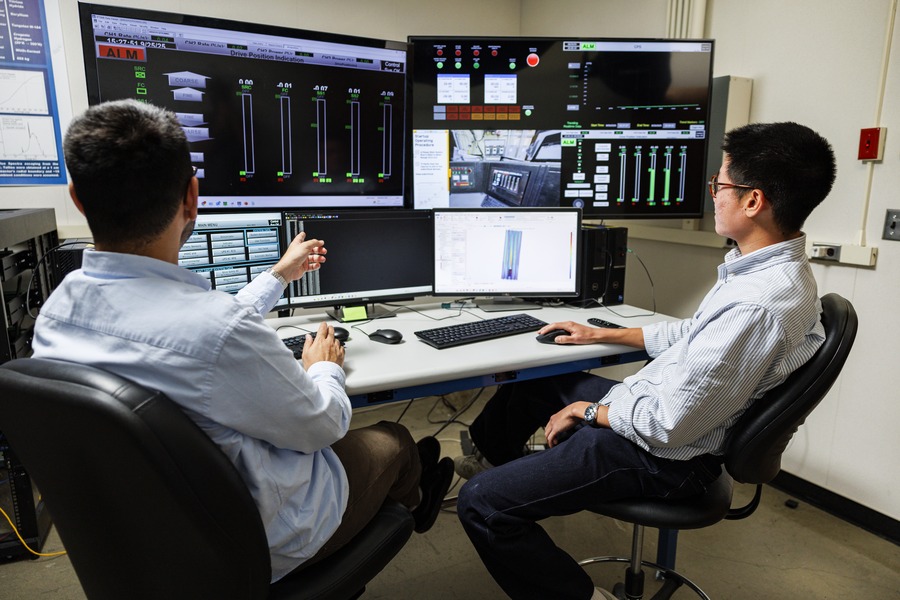
(Purdue University photo)
One planned area of collaboration involves developing interactive digital twins of PUR-1. The project could allow students and institutions to access virtual reactor models for educational purposes, potentially expanding nuclear engineering training beyond campuses with their own reactor facilities.
The consortium also intends to create educational credentials that can be adopted or adapted by other universities, expanding access to nuclear-related instruction for students in mechanical, civil, electrical, materials and systems engineering.
Stylianos Chatzidakis, an assistant professor in Purdue’s School of Nuclear Engineering and one of the consortium’s founding partners, said the collaboration offers an opportunity to combine the universities’ expertise and prepare students to work with advanced nuclear systems and digital technologies.
The universities plan to invite additional research institutions to join the effort over the following six to 12 months. Future opportunities could include shared research projects, expanded educational credentials, and additional access to digital reactor training tools.
By bringing together academic programs, research facilities and industry connections, the New Nuclear Academic Consortium aims to help develop the workforce needed to support the next generation of nuclear energy technology.
More information is available through Purdue University’s College of Engineering.