

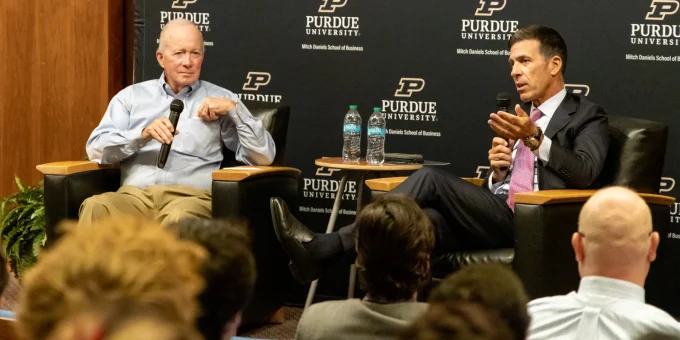
WEST LAFAYETTE — As artificial intelligence continues to change the financial industry, Goldman Sachs President and Chief Operating Officer John Waldron encouraged Purdue University students to view the technology as an opportunity to develop new skills rather than simply a threat to future employment.
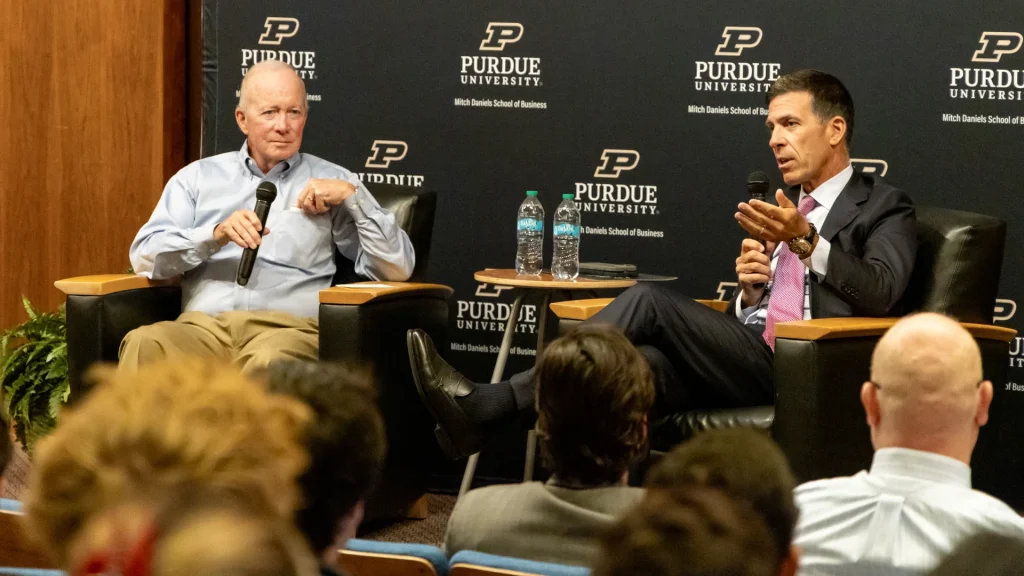
Waldron shared his perspective during a conversation with Purdue Interim President Mitch Daniels about the changing financial services industry, the future of entry-level positions and the skills students will need to succeed in an increasingly AI-driven workplace.
Although artificial intelligence is expected to automate some tasks traditionally performed by employees, Waldron said he believes the technology will also create new opportunities and change the nature of existing jobs.
At Goldman Sachs, which employs approximately 46,000 people, including more than 10,000 engineers, AI is already influencing how employees handle information and complete routine work.
Waldron explained that AI tools can reduce the time spent gathering and organizing information, allowing employees to focus more on interpreting results, making decisions and working directly with clients.
For early-career professionals, that could mean more opportunities to participate in client meetings, ask questions and learn from experienced colleagues.
Waldron emphasized that mentorship and on-the-job learning will remain important, even as technology changes how employees perform their responsibilities. He suggested AI could strengthen traditional apprenticeship models by helping new employees learn more efficiently.
He also encouraged students to become comfortable experimenting with AI tools and learning how to use them effectively. Rather than attempting to predict every change the technology will bring, students should remain curious, adaptable and willing to learn.
However, technical knowledge alone will not be enough to prepare graduates for the future workforce.
Waldron highlighted the importance of communication, listening, logical thinking and relationship-building alongside technical expertise. In financial services, he said, successful professionals increasingly need to understand both technology and the business problems they are helping solve.
That combination aligns with Purdue’s emphasis on interdisciplinary education. Daniels highlighted the university’s integrated business and engineering program as an example of preparing students to work across traditionally separate fields.
Waldron’s own career illustrates the value of adaptability. He studied English as an undergraduate at Middlebury College before becoming interested in finance through accounting coursework and a business program at the University of Chicago.
His message to students was that career success will depend not only on technical abilities but also on the human qualities that help professionals apply those abilities effectively.
As AI continues to transform workplaces, Purdue students are being encouraged to develop technological fluency while strengthening their judgment, curiosity and interpersonal skills.