

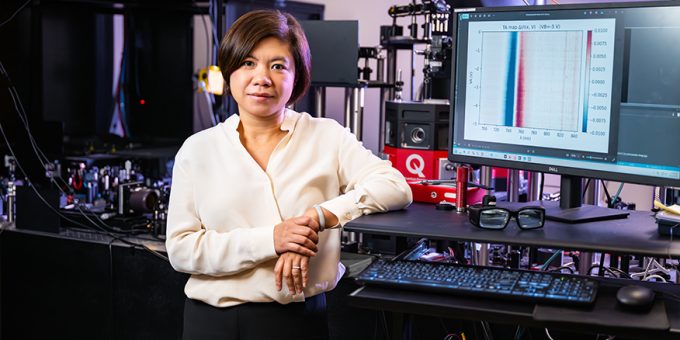
WEST LAFAYETTE — Purdue University researcher Libai Huang is using an ultrafast microscopy technique to capture the movement and interactions of quantum particles at speeds reaching one quadrillion images per second, research that could help advance future computing and electronic technologies.
Huang’s work focuses on understanding how light and matter interact at extremely small scales. These interactions play an important role in developing technologies such as quantum computers, solar cells, computer chips, and light-emitting diodes, commonly known as LEDs.
The technique allows researchers to observe processes that occur too quickly for conventional imaging methods to capture. By recording these rapid changes, scientists can better understand how energy moves through materials and how tiny particles behave.
One area of Huang’s research involves excitons, which are formed when an electron interacts with the positively charged space it leaves behind, and polaritons, which combine characteristics of light and matter.
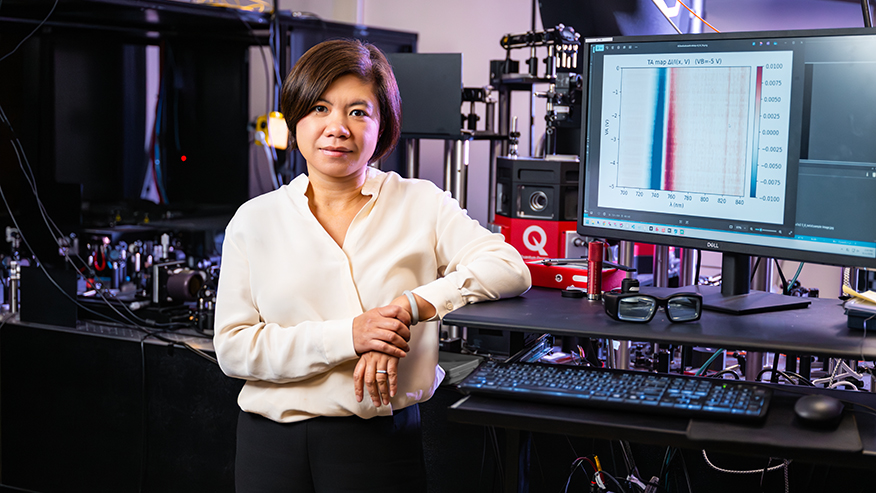
Photo by Purdue University photo/Kelsey Lefever
Understanding these particles is important because their behavior can influence how materials absorb, transport, and release energy.
Huang’s microscopy system works somewhat like a digital camera, using lenses and light detectors. Instead of a conventional shutter, however, the system relies on a pulsed laser that can fire as quickly as once every femtosecond, an extremely short time interval.
This allows researchers to capture snapshots of particles moving and interacting within materials before those processes change.
A major focus of the work is quantum coherence, the ability of quantum systems to maintain coordinated behavior. Researchers hope to better understand how to preserve that behavior while still allowing particles to interact and be manipulated.
That balance is particularly important for quantum computing, where scientists must control quantum states without allowing unwanted interactions to disrupt them.
By studying interactions between light and matter, Huang and her research group are working to establish principles that could help scientists design materials and devices with more precise control over their properties.
The research contributes to broader efforts to develop next-generation technologies by improving scientists’ understanding of the fundamental processes that govern materials at the quantum level.