

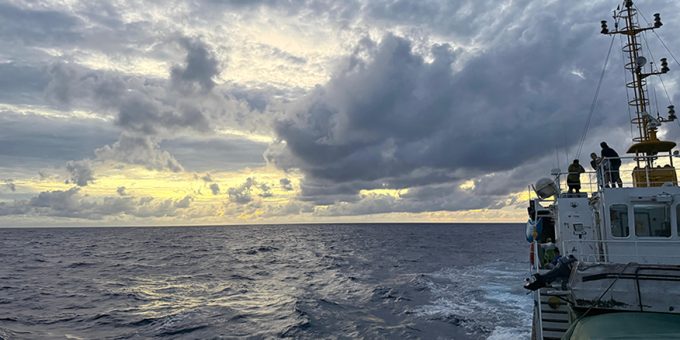
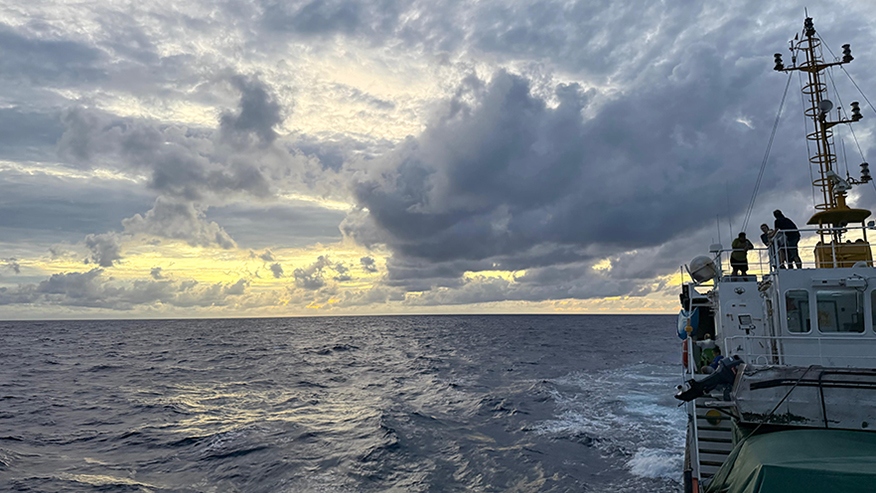
HALFWAY BETWEEN TARAWA AND NIKUMARORO, KIRIBATI — The Marin Mainiku, the Kiribati National Shipping Line vessel transporting the Taraia Object expedition team, is approaching the halfway point on Friday as the crew continues its voyage across the vast South Pacific toward Nikumaroro Island.
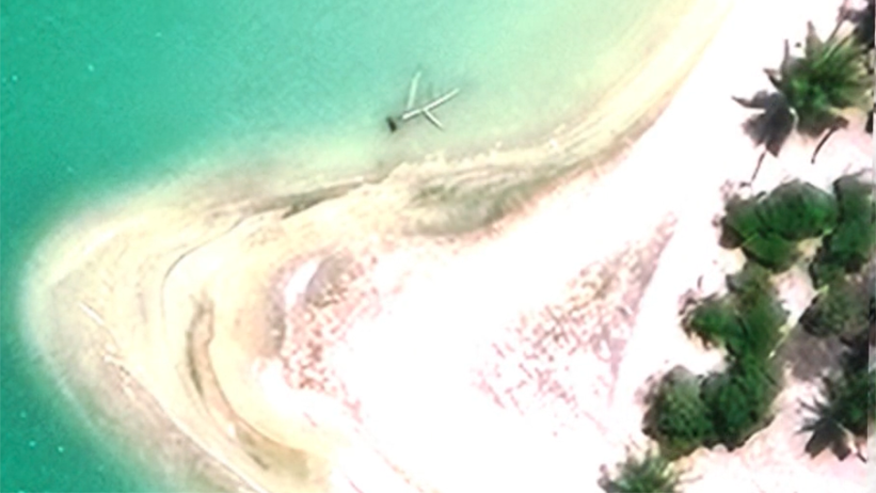
The Archaeological Legacy Institute (ALI), Purdue Research Foundation, and Purdue University have embarked on this expedition in an attempt to solve the disappearance of Amelia Earhart during her mission to become the first person to fly around the world at the equator. Their focus will be inspecting the Taraia Object, an anomaly in Nikumaroro’s lagoon first noticed in satellite imagery in 2020 and later confirmed to be visible on aerial photos taken as far back as 1938.
The vessel is making good time and is tentatively expected to arrive at Nikumaroro around midday Monday, Oct. 12, Eastern time.
Traveling at an average speed of 7 knots, or about 8 miles per hour, the crew had sailed approximately 370 of the 830 nautical miles from Tarawa, Kiribati, to Nikumaroro at the time of this publication.
Located about 1,800 nautical miles south of Hawaii and more than 230 miles from the nearest inhabited island, Nikumaroro is among the most isolated places on Earth. The coral atoll has long been central to theories surrounding Earhart’s disappearance in 1937.
The crew reports mostly calm seas and favorable wind conditions as they continue on their journey. No other ships are nearby, and the ocean floor is 70,000 feet beneath them. Despite the remoteness, they are amazed they are able to stay connected and communicate with satellite technology. They have also reeled in two fresh tuna to add to their regularly scheduled meals at sea.
“We saw photos and had a pretty good idea of what we were getting into, but nothing can prepare you for the real thing,” said Steve Schultz, Purdue senior vice president and general counsel, serving as Purdue’s expedition team lead. “The sights, the sounds and overall conditions on a working ship plying through the rolling ocean swells is a unique experience. But we all signed up for a seafaring adventure, and we’re focused on the work ahead.”
Three members of the team have visited Nikumaroro before, including expedition leader Rick Pettigrew, ALI executive director; Aaron Arrants, safety officer for the expedition; and Renato LaRocca, ALI field assistant and retired cancer medicine physician.
“Having had the honor of being on many tropical islands around the world, Nikumaroro is up there from an aesthetic point of view,” LaRocca said. “Of course, things that are equally important: absent mosquitoes, no snakes, no spiders. Now, there is a problem with coconut crabs and hermit crabs, but otherwise it’s a magical place.”
Once the vessel reaches Nikumaroro, the crew will use a drone to survey the island before beginning the complex process of positioning specialized equipment for use at the Taraia Peninsula. That includes getting equipment off the vessel and onto a smaller transport boat, then navigating the “blasted channel” through the island’s high reef to reach the beach.
On the island, the team will divide into two groups, with one assigned the task of cutting a passage through the jungle to the island’s lagoon, while the other guides additional smaller boats around the island’s southern perimeter to reach the natural opening of the lagoon, known as the Tatiman Passage, on its western end. The team will then reunite on the south side of the lagoon, where they will establish a staging area. That will be the jumping-off point each day for the work at the Taraia Peninsula on the north side of the lagoon.
“We will start our remote sensing work using magnetometers and sonar to get a better idea of what is there before we actually uncover it. After that is all done, we will uncover it using a hydraulic dredge,” Pettigrew said.
The expedition is the result of years of research into Earhart’s disappearance by Pettigrew, the Archaeological Legacy Institute and members of The International Group for Historic Aircraft Recovery. After reviewing evidence collected, Pettigrew approached Purdue and the Purdue Research Foundation in February 2025 due to the university’s historic connection to Earhart. Through the Amelia Earhart Fund for Aeronautical Research, the Purdue Research Foundation funded Earhart’s Lockheed Electra “Flying Laboratory.”