

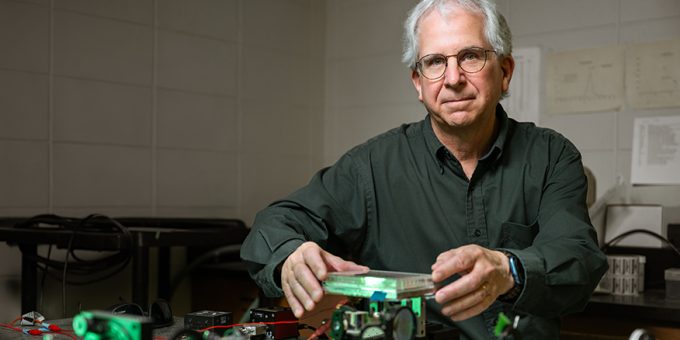
WEST LAFAYETTE — Purdue University researchers are combining laser light, the Doppler effect and artificial intelligence in an effort to help doctors determine which chemotherapy treatments may work best for individual cancer patients.
Purdue scientist David Nolte is developing an imaging system designed to measure extremely small movements inside living tissue. The goal is to use those movements to better understand how tumors respond to different drugs.
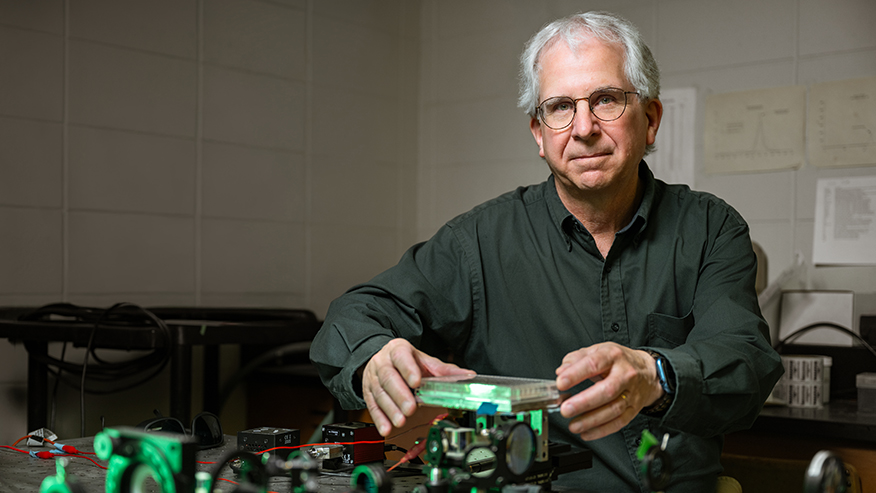
(Purdue University photo/Kelsey Lefever)
The technology is currently being used to evaluate experimental chemotherapy treatments for osteosarcoma, a type of bone cancer.
Nolte recently installed a prototype system in the laboratory of Karen Pollok, a professor of pediatrics at Indiana University School of Medicine. Pollok will use the equipment to study experimental chemotherapy drugs against tumor cells from more than 30 osteosarcoma patients.
The research includes a cell line donated from the tumor of Tyler Trent, a Purdue student who died from osteosarcoma in 2019.
The researchers hope the technology eventually could help doctors analyze a patient’s tumor and determine which chemotherapy treatment is most likely to be effective.
The system uses laser light to detect incredibly small movements within living cells. Those changes are then analyzed using AI algorithms that have been trained using images with known outcomes.
Researchers have previously tested the approach in bladder cancer research, where the system successfully predicted whether patients would benefit from a particular chemotherapy treatment. The technology has also been used in research involving esophageal cancer and canine lymphoma.
Nolte’s research is supported by the National Science Foundation and the National Center for Advancing Translational Sciences.
The long-term goal is to move the technology toward prospective clinical trials and determine whether it can help doctors make faster, more personalized treatment decisions.