


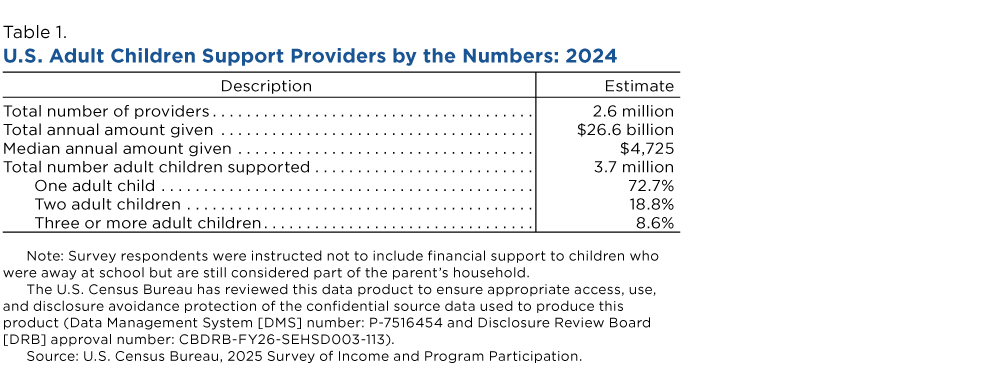
WASHINGTON, D.C.— Financial support from parents does not end when children reach adulthood or move away from home. According to new data released by the U.S. Census Bureau from the 2025 Survey of Income and Program Participation (SIPP), approximately 2.6 million American parents provided $26.6 billion in voluntary financial assistance to 3.7 million adult children aged 21 or older who lived outside their households.
The figures highlight a widespread trend of informal parental aid, which adult children frequently use to cover routine living costs, food, and monthly bills.
The findings reflect assistance provided to children living independently and do not account for financial support extended to adult children living at home. Census Bureau data shows that in 2024, 58.3% of men and 56.4% of women aged 18 to 34 resided with their parents.
Frequency and Historical Trends
Among parents who provided aid to children living elsewhere, the vast majority supported a single adult child:
- 1 Adult Child: 72.7% of supporting parents
- 2 Adult Children: 18.8% of supporting parents
- 3 or More Adult Children: 8.6% of supporting parents
In 2024, the median annual amount provided per supporting parent was $4,725.
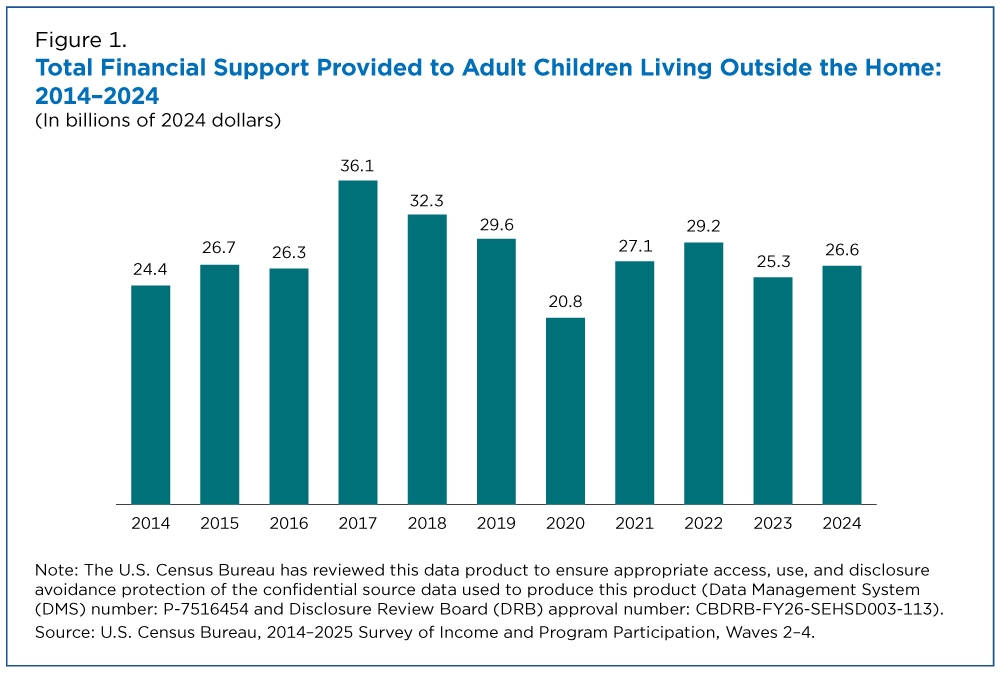
Because informal support is given voluntarily—either in lump sums or through regular installments—annual totals historically fluctuate based on broader economic conditions. SIPP data tracking the 11-year span from 2014 to 2024 showed a notable surge in financial aid in 2017 and 2018, coinciding with national wage growth. That trend was followed by a sharp drop in 2020 during the onset of the COVID-19 pandemic.
Demographic Profile of Supporting Parents
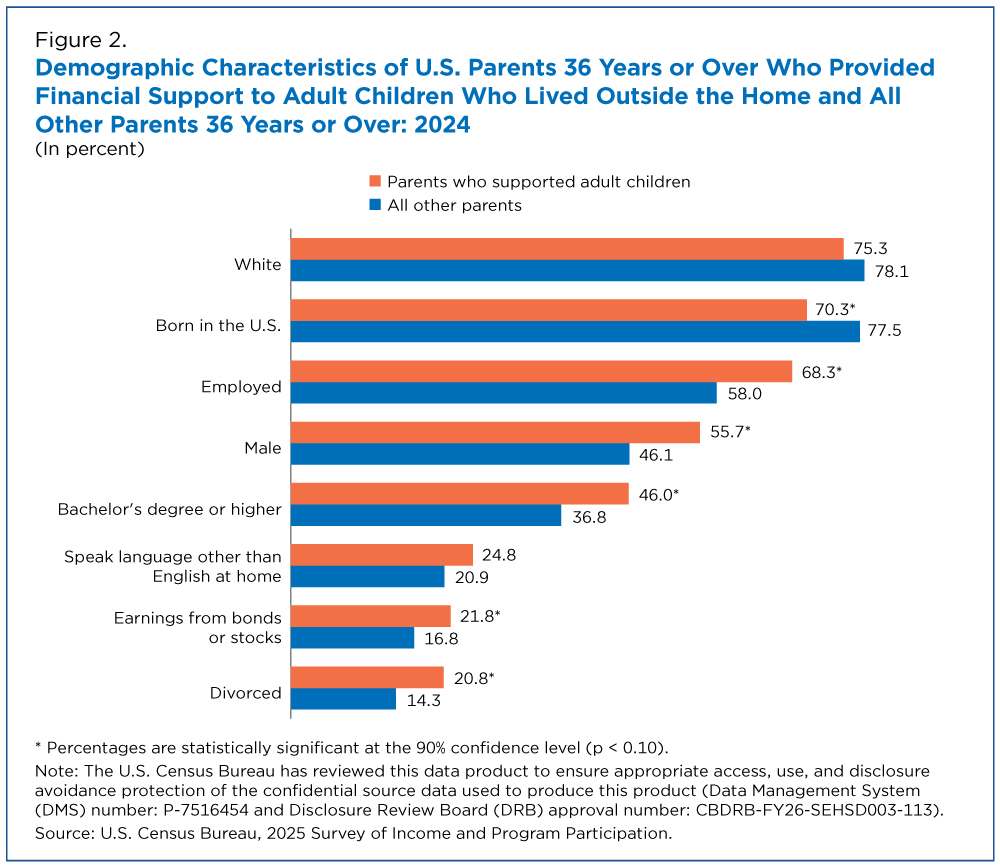
Parents providing financial aid to independent adult children differed demographically from other parents aged 36 and older. Supporting parents were less likely to be U.S.-born (70.3% vs. 77.5%) and were more likely to:
- Be male: 55.7% vs. 46.1%
- Be employed: 68.3% vs. 58.0%
- Hold a bachelor’s degree or higher: 46.0% vs. 36.8%
- Be divorced: 20.8% vs. 14.3%
- Earn income from stocks or bonds: 21.8% vs. 16.8%
Parents offering financial aid reported higher median individual annual incomes than those who did not ($63,440 vs. $41,930). However, median overall household incomes between the two groups remained statistically comparable ($110,700 vs. $98,110). Census Bureau analysts attribute this alignment to household size: parents who did not provide outside support were significantly more likely to live in households of three or more people (48.3% vs. 31.3%).
Financial Support Extended Across Generations
Assistance to adult children represents one part of a larger network of informal transfers between relatives. In 2024, approximately 11.4 million U.S. residents provided a total of $78.1 billion to 19.0 million individuals living outside their primary households.
Beyond adult children, financial providers assisted:
- 7.2 million parents ($20.2 billion)
- 5.8 million other relatives ($22.8 billion)
- 2.4 million nonrelatives ($8.4 billion)
Nearly two-thirds (64.6%) of all financial providers directed assistance to either their parents or adult children, confirming that immediate family members remain the primary recipients of informal financial safety nets in the United States.
About the Survey
The Survey of Income and Program Participation (SIPP) is a nationally representative, longitudinal survey conducted by the U.S. Census Bureau. It tracks income, employment, household composition, and government program participation to measure economic well-being across the nation. Detailed data quality documentation and methodology guides are accessible via the SIPP Technical Documentation portal.

