

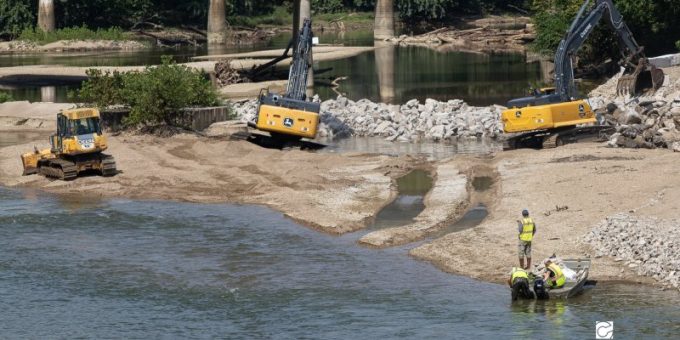
COLUMBUS — Demolition is officially underway on a deteriorating low-head dam spanning the East Fork White River in downtown Columbus, marking a major milestone in the city’s long-term riverfront redevelopment efforts.
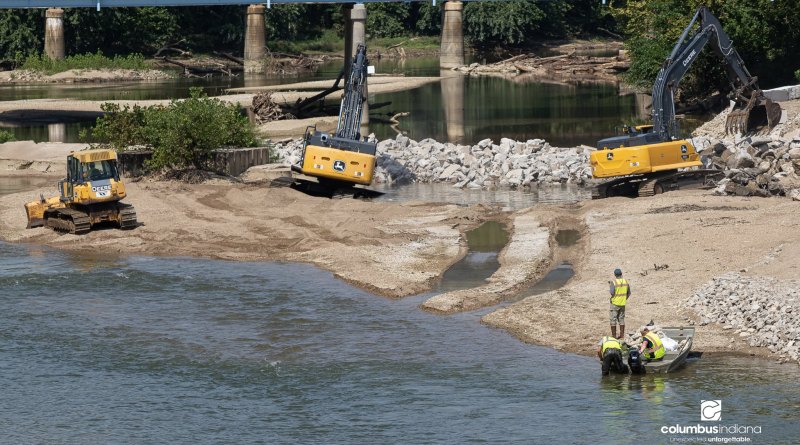
Crews began breaking up the structure—located between the Second Street and Third Street bridges—and expect demolition to take about a week to complete, depending on weather conditions.
City officials have targeted the dam for removal due to longstanding public safety and environmental concerns.
Often referred to as “drowning machines,” low-head dams create a severe underwater recirculating current that can trap swimmers, kayakers, and boaters. In addition to eliminating the hydraulic hazard, taking down the structure will provide emergency first responders with safer, more direct water access.
Beyond public safety, the dam’s crumbling state has accelerated severe bank erosion on the river’s west side, threatening to expose a former city landfill that is a delisted Indiana Department of Environmental Management (IDEM) Superfund site, while unearthing local sewer lines.
Removing the dam restores natural sediment flow, improves overall water quality, and enables fish passage for aquatic species.
The dam removal—funded largely through a combination of state and federal grants, including support from the U.S. Fish and Wildlife Service’s National Fish Passage Program—serves as the centerpiece of the broader “Our River… Our Riverfront” initiative.
The multi-phase effort aims to seamlessly integrate the riverfront with downtown Columbus through several key infrastructure upgrades:
- Pedestrian Access: Completing the city’s People Trail loop, extending it under the Second Street bridge to connect with Mill Race Park.
- Downtown Integration: Linking the riverfront to the extension of the 1821 Trail, the Second Street thoroughfare project, and the Downtown 2030 master plan.
- Gateway Enhancements: Revamping the entrance plaza welcoming visitors off the iconic cable-stayed Robert N. Stewart Bridge.

