

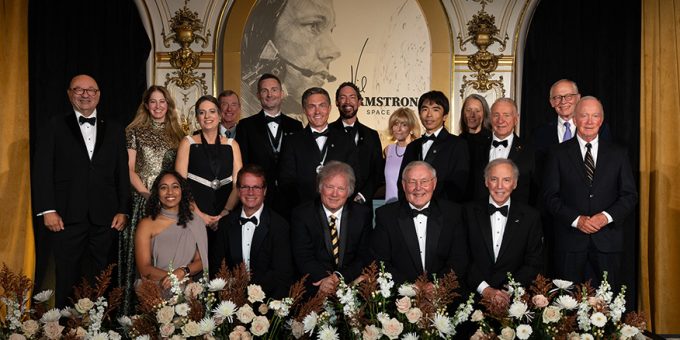
WASHINGTON — A team of SpaceX engineers responsible for developing the Falcon 9 rocket’s reusable booster landing technology has received Purdue University’s first Neil Armstrong Space Prize.
The Falcon 9 Booster Landing Team was selected for its work developing the rocket’s ability to land vertically and be reused, a technology that has changed the way rockets are launched and helped reduce the cost of sending payloads into space.
The international award recognizes achievements in space discovery, innovation and human achievement during the past 10 years.
The award was presented Tuesday, Sept. 15, during a ceremony at the Cosmos Club in Washington, D.C. NASA Administrator Jared Isaacman also participated in the event.
Representing the Falcon 9 Booster Landing Team were:
- Lars Blackmore, senior principal Mars landing engineer
- Shana Diez, senior director of Starship reliability
- Jon Edwards, senior vice president of Falcon & Dragon projects
- Yoshiaki Kuwata, principal GNC engineer
- Eduardo Velazquez, director of Crew Starship engineering
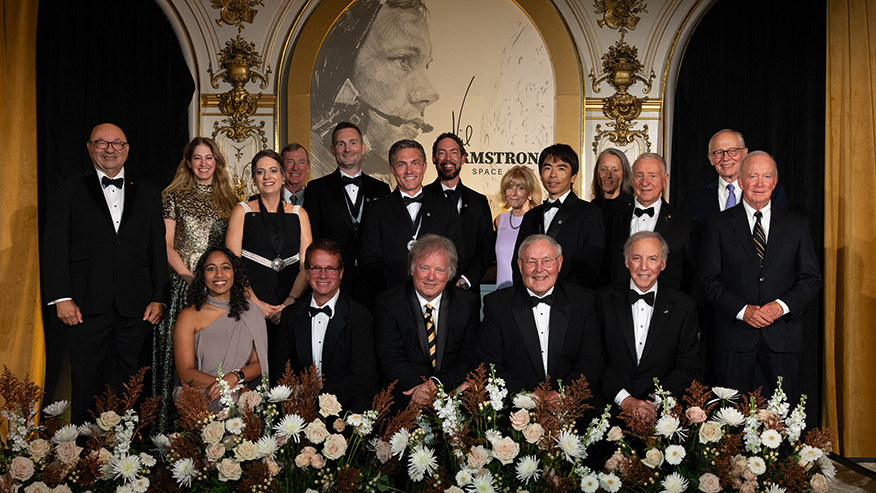
The team was honored in the prize’s Innovation category, which recognizes space technologies that benefit humanity.
Dan Dumbacher, chair of the Neil Armstrong Space Prize selection committee and a professor of engineering practice in Purdue’s School of Aeronautics and Astronautics, said the team’s work on reusable rockets was a major factor in its selection.
“Their work has had a very clear impact and a very visible impact,” Dumbacher said.
Purdue noted that Falcon 9 recorded 164 launches in 2025, with one booster being used more than 35 times.
The prize is named after Purdue graduate and astronaut Neil Armstrong, who earned his bachelor’s degree in aeronautical engineering from Purdue in 1955. Armstrong became the first person to walk on the moon as part of the Apollo 11 mission on July 20, 1969.
Purdue has long been associated with the U.S. space program and is known as the “Cradle of Astronauts.” The university has 30 alumni who have flown in space or been selected as NASA astronaut candidates. Eight Purdue astronauts attended Tuesday’s ceremony.
Mark Lundstrom, dean of Purdue’s College of Engineering, said the Falcon 9 team’s work reflects the engineering and teamwork demonstrated by Armstrong and the Apollo program.
“By making rocket reuse practical at unprecedented scale, they changed the economics of spaceflight and opened new possibilities for science, exploration and commerce,” Lundstrom said.
The Neil Armstrong Space Prize includes three categories: Innovation, Discovery and Human Achievement. The award can recognize achievements from government, defense and commercial areas of the space industry.
The prize program is sponsored by Purdue alumni Paul and Florence Stahura.
Purdue’s space-related research and partnerships include work in hypersonics, advanced propulsion systems, in-space manufacturing and lunar and planetary surface mobility.
Nominations for the 2027 Neil Armstrong Space Prize are being accepted now through Nov. 1 at https://www.purdue.edu/space/prize/.

