

WEST LAFAYETTE — Building a sustainable human presence on the moon, Mars and beyond will require more than getting astronauts there — it will require finding ways to construct, repair and repurpose infrastructure without constantly sending large amounts of materials from Earth.
That challenge is at the center of a new NASA-funded project involving AnalySwift LLC, a Purdue University-affiliated company that has received an $899,738 Phase II Small Business Technology Transfer (STTR) award.
The two-year project will focus on developing robotic technology capable of welding and unwelding thermoplastic composite structures in space.
The technology could allow large structures to be disassembled, reconfigured, and reused for different missions, potentially reducing the amount of material that must be launched from Earth.
AnalySwift President and CEO Allan Wood said the goal is to develop a system that can unweld and weld composite joints, allowing large truss structures to be taken apart and rebuilt.
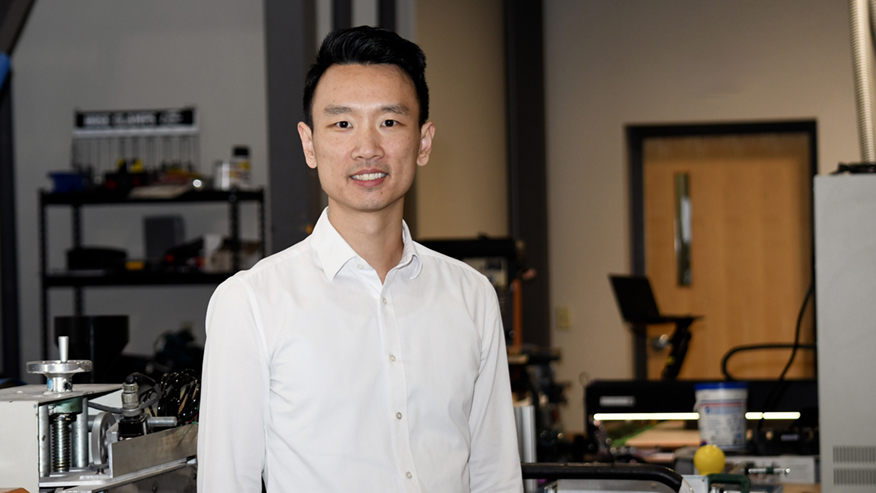
Photo by Purdue University
“This capability allows the repurposing of spacecraft components for other missions, achieving multiuse structures and assembling large structures without the limit of launch-fairing dimensions,” Wood said.
AnalySwift specializes in engineering software used to design and analyze composite material structures. As part of the NASA-funded project, the company will use its simulation technology to study the advanced materials and structures involved, including whether full-scale truss structures could eventually be repurposed.
Developing robots for space construction
The NASA-funded project has four primary objectives:
- Develop thermoplastic composite joints with embedded resistance heaters.
- Build robotic manipulators capable of welding and unwelding the joints.
- Demonstrate robotic disassembly and reassembly of a prototype truss structure in a laboratory setting.
- Evaluate the feasibility of repurposing full-scale structures.
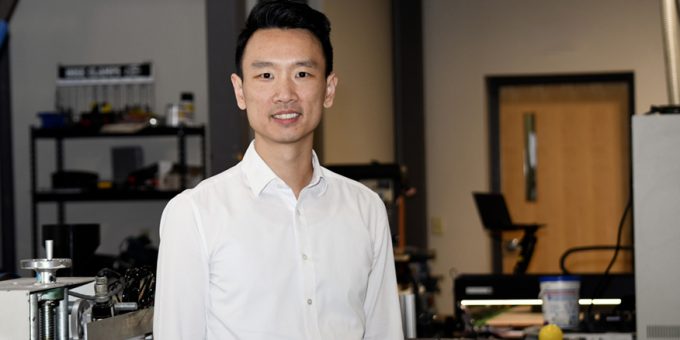
Kawai Kwok, an associate professor in Purdue’s School of Aeronautics and Astronautics, is serving as the project’s principal investigator. Yu She, an assistant professor in Purdue’s Edwardson School of Industrial Engineering, is leading work involving the robotic systems.
Kwok’s team will develop composite joints containing embedded resistance heaters. The heaters will allow the thermoplastic material to reach the temperature needed to bond or separate the joint from the composite structural members.
“The embedded heater provides in situ heating to bring the thermoplastic matrix to the processing temperature for bonding and debonding the joint-strut interface by mechanical forces,” Kwok said.
Robotic systems will then perform the welding and structural reassembly needed to reconfigure the trusses.
She said robotics will be particularly important for handling large structures in space, where precise and repeatable movements will be necessary.
“My team will develop a dual-arm robotic system that uses vision, tactile sensing, and force and thermal feedback to locate composite joints, activate their embedded heaters, and carefully separate or reconnect the structural components,” She said.
Addressing the challenges of space construction
The project is aimed at one of the major logistical challenges facing long-duration human space exploration: how to get enough infrastructure to the moon, Mars and other destinations without dramatically increasing launch costs and cargo requirements.
Large structures are already needed to support equipment such as communication antennas, solar arrays, thermal radiators and telescope mirrors. Many of these structures can require dimensions of tens of meters or more.
However, current launch vehicles are limited by both cargo mass and the size of their launch fairings, which are roughly five meters in diameter.
Wood said these limitations create a significant obstacle when trying to transport large infrastructure from Earth.
Launch costs can also be substantial, with the cost of sending material to low Earth orbit ranging from approximately $2,000 to $20,000 per kilogram, according to AnalySwift.
Rather than launching every large component in its final configuration, the technology being developed could allow structures to be assembled, disassembled and repurposed in space.
That could make it possible for a single structure to serve multiple purposes or missions, helping reduce the amount of new material that needs to be transported from Earth.
“Long-duration crewed missions to the moon, Mars and beyond require infrastructure to be constructed sustainably on these surfaces,” Wood said.
Building on earlier NASA research
The new Phase II award follows a Phase I NASA STTR award received by AnalySwift in 2024, which began exploring the potential for spacecraft infrastructure to be repurposed during long-duration missions.
The latest award will allow the Purdue-affiliated company and university researchers to move that work into further development and testing.
If successful, the project could provide NASA with another tool for constructing and maintaining large-scale infrastructure in space while reducing dependence on Earth-based resupply.
AnalySwift develops composite simulation software that combines structural and micromechanics modeling to help engineers analyze and design composite structures more efficiently. Its SwiftComp technology was developed at Purdue University and licensed through the Purdue Research Foundation.
The project also brings together expertise from Purdue’s aerospace engineering, industrial engineering and research communities, highlighting the university’s role in developing technologies aimed at future space exploration.

