

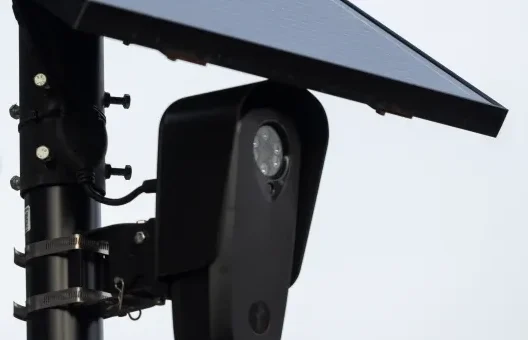
INDIANA — Across South-Central Indiana, automated license plate readers have become an increasingly common presence, though their prevalence varies drastically from county to county, according to newly released statewide mapping data.
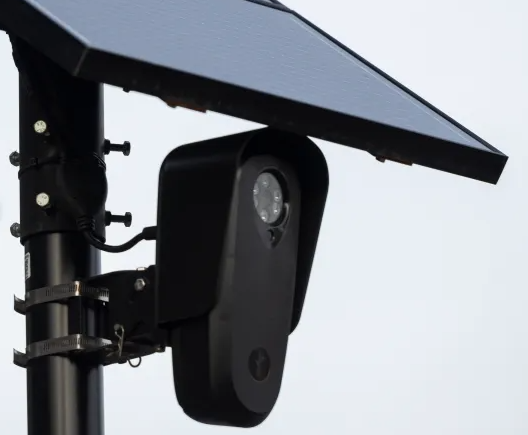
A report published on August 20, 2026, by the nonprofit Eyes Off Indiana identifies at least 2,792 automated license plate readers across the state, with at least 2,501 confirmed as Flock Safety units. The organization notes its count represents a baseline estimate, meaning actual numbers may be higher.
For residents in South-Central Indiana, surveillance density ranges from heavily monitored regional hubs to areas with zero tracked cameras:
- Monroe County leads the local region with 36 documented cameras (2.6 per 10,000 residents; 9 per 100 sq mi).
- Greene County follows with 25 cameras, boasting a high density relative to its population (8.0 per 10,000 residents; 5 per 100 sq mi).
- Jackson County sits mid-pack with 18 cameras (3.8 per 10,000 residents; 4 per 100 sq mi).
- Lawrence County ranks in the middle tier with 15 cameras (3.3 per 10,000 residents; 3 per 100 sq mi).
- Orange County records 5 cameras (2.5 per 10,000 residents; 1 per 100 sq mi).
- Daviess County reports just 1 camera (0.3 per 10,000 residents; 0 per 100 sq mi).
- Martin County stands out as one of nine counties in the entire state with 0 documented cameras.
The growth of Flock cameras has sparked ongoing debates over public safety and personal privacy. Proponents emphasize that automatic license plate readers are crucial tools for law enforcement, making it significantly easier to trace stolen vehicles, solve local crimes, and locate missing persons. Opponents, however, voice concern over automated tracking and the lack of statewide legislation governing data retention, search access, or independent auditing.
The advocacy group’s statewide tracking initiative has identified at least 2,792 ALPR cameras deployed across Indiana, with at least 2,501 confirmed as Flock Safety units. Eyes Off Indiana notes that its live crowd-sourced mapping project—which currently reflects over 3,570 identified ALPR units across 84 of Indiana’s 92 counties—represents a baseline count, with actual statewide numbers likely much higher. According to the organization, Indiana now ranks 6th nationally in ALPR cameras per capita, with approximately one reader for every 2,132 residents.
Statewide, Marion County holds the top spot with 478 cameras (121 per 100 sq mi), while Blackford County records the highest per-capita rate at 11.0 cameras per 10,000 residents despite ranking 47th overall.
Full Rankings: Indiana’s 92 Counties Ranked by Number of Flock Cameras
- Marion County — 478 cameras
- Hamilton County — 210 cameras
- Lake County — 132 cameras
- St. Joseph County — 108 cameras
- Allen County — 102 cameras
- Elkhart County — 101 cameras
- Clark County — 100 cameras
- Johnson County — 100 cameras
- Vanderburgh County — 98 cameras
- Hendricks County — 91 cameras
- Porter County — 90 cameras
- Madison County — 76 cameras
- LaPorte County — 74 cameras
- Hancock County — 56 cameras
- Tippecanoe County — 55 cameras
- Vigo County — 49 cameras
- Boone County — 41 cameras
- Dearborn County — 37 cameras
- Delaware County — 37 cameras
- Monroe County — 36 cameras
- Kosciusko County — 35 cameras
- Grant County — 33 cameras
- Dubois County — 28 cameras
- Greene County — 25 cameras
- Henry County — 23 cameras
- Shelby County — 23 cameras
- Bartholomew County — 22 cameras
- Floyd County — 22 cameras
- Warrick County — 21 cameras
- Knox County — 20 cameras
- Howard County — 19 cameras
- Marshall County — 19 cameras
- Morgan County — 19 cameras
- Noble County — 19 cameras
- Jackson County — 18 cameras
- Huntington County — 17 cameras
- Spencer County — 17 cameras
- Adams County — 16 cameras
- Randolph County — 16 cameras
- Wabash County — 16 cameras
- Lawrence County — 15 cameras
- Putnam County — 15 cameras
- Sullivan County — 15 cameras
- Tipton County — 15 cameras
- DeKalb County — 14 cameras
- Montgomery County — 14 cameras
- Blackford County — 13 cameras
- Wayne County — 12 cameras
- Wells County — 11 cameras
- Harrison County — 10 cameras
- Posey County — 10 cameras
- Decatur County — 9 cameras
- LaGrange County — 9 cameras
- Starke County — 9 cameras
- Cass County — 8 cameras
- Jefferson County — 8 cameras
- Steuben County — 7 cameras
- Whitley County — 7 cameras
- Brown County — 6 cameras
- Miami County — 6 cameras
- Newton County — 6 cameras
- White County — 6 cameras
- Fulton County — 5 cameras
- Orange County — 5 cameras
- Vermillion County — 5 cameras
- Warren County — 5 cameras
- Clinton County — 4 cameras
- Gibson County — 4 cameras
- Jennings County — 4 cameras
- Owen County — 4 cameras
- Parke County — 4 cameras
- Carroll County — 3 cameras
- Crawford County — 3 cameras
- Jasper County — 3 cameras
- Pulaski County — 3 cameras
- Rush County — 3 cameras
- Scott County — 3 cameras
- Fayette County — 2 cameras
- Perry County — 2 cameras
- Washington County — 2 cameras
- Clay County — 1 camera
- Daviess County — 1 camera
- Ripley County — 1 camera
- Union County — 1 camera
- Benton County — 0 cameras
- Fountain County — 0 cameras
- Franklin County — 0 cameras
- Jay County — 0 cameras
- Martin County — 0 cameras
- Ohio County — 0 cameras
- Pike County — 0 cameras
- Switzerland County — 0 cameras
Privacy Debates and Statutory Gaps
The rapid expansion of Flock Safety networks—where cameras scan passing vehicle plates and log location records—has sparked intense debate across the state. Law enforcement agencies praise ALPR technology as a vital tool for recovering stolen vehicles, locating missing persons, and identifying suspects in real time.
However, civil liberties advocates and privacy groups highlight the total absence of statewide Indiana laws governing ALPR data. Currently, Indiana places no statutory restrictions on how long agencies or vendors can retain location data, who can access or search the databases, or whether plate records can be shared with out-of-state entities or third parties.
Eyes Off Indiana is actively lobbying state lawmakers to establish a “floor” of statutory protections. The nonpartisan organization is advocating for six legislative standards:
- Mandatory 7-Day Data Retention: Deleting unflagged vehicle scans after seven days unless tied to an active warrant or ongoing criminal investigation.
- Prohibition of Data Sales: Barring vendors and agencies from selling, licensing, or trading plate records.
- Restricted Data Sharing: Limiting external data sharing strictly to legitimate public safety and law enforcement purposes.
- Probable Cause Requirements: Mandating that an automated camera alert cannot serve as the sole justification for a police stop or search.
- Audit Logging & Portals: Requiring detailed search logs maintained for two years and monthly public transparency portals.
- Open Contracts: Enforcing transparency in vendor contracts and enabling judicial remedies if regulations are violated.