

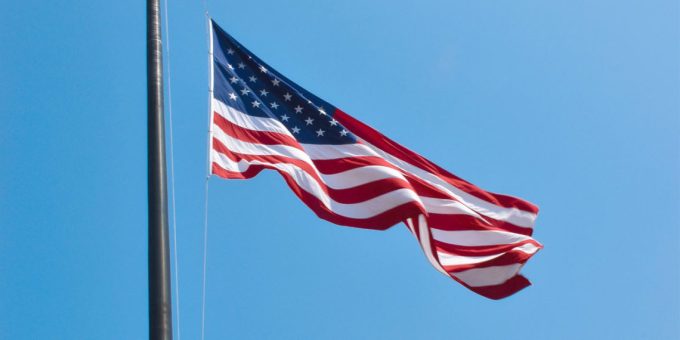
NATIONWIDE – The Stars and Stripes are recognized instantly around the world today, but Old Glory did not always look the way it does now. While the red, white, and blue color palette has remained constant since the nation’s birth, the flag’s physical design has evolved 27 times.
Each design iteration reflected a growing nation, responding directly to the entry of new states into the Union. Along with the changing aesthetic, a strict, formalized set of protocols grew around how the banner must be treated.
From the Revolution to the 50-Star Standard
The visual history of the United States flag is a timeline of political expansion. Below is the journey of how the flag transformed from a colonial symbol to the 50-star design flown today.
1776: The Grand Union Flag. Source: Wikipedia / Continental Union Flag – Wikipedia
1777: The First Official Flag. Source: Wikimedia Commons / File:Betsy Ross flag.svg – Wikimedia Commons
1795: The 15-Stripe Variant. Source: Liberty Flags / 15 Star Outdoor Historic U.S. Flags 1795 – LibertyFlags.com
1818: Reverting to 13 Stripes. Source: Liberty Flags / 20 Star Outdoor Historic U.S. Flags 1818 – LibertyFlags.com
1960: The Modern 50-Star Flag. Source: The Philadelphia Inquirer / The UpShot: The 50-star U.S. flag was first raised in Valley Forge …
1. 1776: The Grand Union Flag
During the American Revolution, the Grand Union Flag (also known as the Continental Colors) was created to represent the collective colonies. It featured 13 alternating red and white stripes to symbolize the original colonies. However, because full independence had not yet been declared, it still displayed the British Union Jack in the upper left corner.
2. 1777: The First Official Design
Following the Declaration of Independence, the Continental Congress passed the Flag Act of 1777. This official decree replaced the Union Jack with a new element that defined the banner’s future: 13 white stars set in a blue field (the canton). The stars were frequently arranged in a circle, a design meant to symbolize equality and unity among the newly independent states.
3. 1795: The Star-Spangled Banner
When Vermont (1791) and Kentucky (1792) joined the Union, Congress added two more stars and two additional stripes. This 15-stripe, 15-star flag became the only official US flag to feature more than 13 stripes. This exact design flew over Fort McHenry during the War of 1812, inspiring Francis Scott Key to write the poem that became the lyrics to the US national anthem.
4. 1818: Realignment of the Stripes
By 1818, five more states had joined the Union. Realizing that adding a new stripe for every state would quickly make the flag look unwieldy, Congress passed the Flag Act of 1818. This law permanently reduced the stripes back to 13 to honor the original colonies, while dictating that a new star would be added for every new state on the 4th of July following its admission. The 20 stars of 1818 were sometimes arranged in straight rows and other times in the shape of a giant star, earning it the nickname “The Great Star Flag.”
5. 1912: Standardization of Proportions
As the country expanded westward, the star count climbed. When New Mexico and Arizona were admitted to the Union in 1912, the count reached 48. To prevent manufacturers from arranging the stars in chaotic patterns, President William Howard Taft issued an executive order. For the first time, this order established the official proportions of the flag and mandated that the stars be arranged in a rigid grid of six horizontal rows of eight.
6. 1960: The Modern Era
The 27th and most recent official design change occurred in 1960. Following the admission of Alaska and Hawaii in 1959, the flag took on its current look: 50 stars arranged in nine alternating rows of six and five. It has remained unchanged for over 65 years, making it the longest-running flag design in American history.
The Rules of Respect: Understanding Flag Etiquette
As the design grew more uniform, the traditions surrounding its handling became formalized. In 1942, Congress officially adopted the Federal Flag Code (Public Law 77-829), turning decades of military and civilian traditions into a guide for public behavior.
Time and Illumination
The general rule states that the flag should only be displayed from sunrise to sunset on buildings and stationary flagstaffs. However, the flag can be flown 24 hours a day if it is properly illuminated during hours of darkness, ensuring it is never left in total obscurity.
Weather Contingencies
The protocol explicitly states that the flag should not be displayed on days when the weather is inclement, such as during heavy rain, snow, or windstorms. The only exception to this rule is if the display utilizes an all-weather flag made of durable materials like nylon or heavyweight polyester.
Positioning and Display
- The Canton: When displayed either horizontally or vertically against a wall, the blue field of stars must always be at the top and to the observer’s left.
- Groupings: When flown alongside state, local, or society flags on separate staffs, the US flag must be positioned in the center and at the highest point of the group.
- The Ground: When lowering the flag from a flagpole, handlers must exercise extreme care. The flag must never touch the ground, floor, water, or anything beneath it.
Strict Prohibitions (The “Don’ts”)
The Flag Code contains several strict rules against using the flag for practical utility or commercial advertisement:
- No Markings: You may never write on, draw on, or place any mark, insignia, letter, word, or object onto any part of the flag.
- No Apparel or Drapery: The flag should never be used as wearing apparel, bedding, or drapery. It should never be festooned, drawn back, or up in folds, but always allowed to fall free. For athletic uniforms, a patch or lapel pin may be worn over the heart.
- No Single-Use Advertising: It should not be printed or embroidered on articles like cushions, handkerchiefs, napkins, or boxes intended to be discarded after use.
When an American flag becomes worn, torn, or faded to the point that it is no longer a fitting symbol for display, it should not be simply thrown in the trash. The Federal Flag Code outlines a specific, dignified process for retiring the symbol.
According to the law:
“The flag, when it is in such condition that it is no longer a fitting emblem for display, should be destroyed in a dignified way, preferably by burning.”
The proper and respectful methods for disposal are outlined below.
1. Burning (The Preferred Method)
Burning is the traditional and official method for retiring an American flag, but it must be done with reverence, safety, and proper preparation.
- The Fire: Build a fire that is large and hot enough to completely incinerate the flag.
- The Ceremony: Fold the flag into its traditional tri-corner shape before placing it onto the fire. This should be done with a moment of silence, a salute, or the recital of the Pledge of Allegiance.
- Complete Incineration: The flag must be burned completely to ashes. Handlers should stay with the fire until the flag is entirely consumed.
- The Ashes: Once the fire has cooled completely, the ashes should be buried in a respectful manner.
A Note on Modern Flags (Nylon and Polyester): Many modern flags are made of synthetic materials that produce toxic, hazardous fumes and melt into an environmental hazard when burned. For nylon or polyester flags, recycling or utilizing a local drop-box (detailed below) is highly recommended over burning.
2. Drop-Off Locations and Disposal Services
If you do not have the space, the proper environment, or the desire to burn the flag yourself, many community organizations collect flags and hold large, formal retirement ceremonies on days like Flag Day (June 14th).
You can typically drop off worn flags at:
- Veterans of Foreign Wars (VFW) Posts
- American Legion Posts
- Boy Scouts and Girl Scouts Troops
- Local Government Buildings (Many town halls or police stations feature dedicated “flag retirement” drop-boxes resembling mailboxes).
3. Respectful Burial
If burning is not an option, burying the flag is an entirely acceptable alternative.
To bury a flag properly, find a dignified wooden box or container. Fold the flag into the traditional 13-fold triangle, place it inside the container, and bury it deep enough in the ground so that it will not be easily disturbed. Take a moment of silence to honor the flag as it is buried.
4. Professional Recycling
Because so many modern flags are made of synthetic polymers, a few dedicated textile recycling companies specialize in taking old flags, breaking down the nylon fibers, and spinning them into new materials. Many of the veteran organizations listed above partner with these recyclers to ensure flags are handled appropriately without harming the environment.

