

INDIANA — Fireworks are a quintessential American tradition, but federal safety experts warn that handling them incorrectly can rapidly turn a festive Independence Day celebration into a medical emergency.
According to a comprehensive annual report released by the U.S. Consumer Product Safety Commission (CPSC), fireworks-related injuries in the United States have experienced a staggering surge. In its latest data cycle, the CPSC reported an estimated 14,700 fireworks-related emergency room injuries and 11 non-occupational deaths nationwide, representing a massive 52% increase in injuries and a 38% rise in fatalities compared to the previous reporting year.
Public safety officials emphasize that roughly 67% of these injuries occur during a single, highly volatile one-month window surrounding the Fourth of July holiday. The data reveal that young people are disproportionately impacted, with children under the age of 15 accounting for 36% of all estimated injuries. Furthermore, a substantial 65% of all injured victims are innocent bystanders rather than the individuals actually igniting the fuses.
Fireworks, Fire, and Injury Facts
- Fireworks started an estimated 32,302 fires in 2023, including 3,760 structure fires, 849 vehicle fires, 27,252 outside fires, and 441 unclassified fires. These fires caused an estimated 15 civilian deaths, 58 civilian injuries, and $142 million in direct property damage. (Note: Totals may not equal sums because of rounding error.)
- In 2023, U.S hospital emergency rooms treated an estimated 9,700 people for fireworks related injuries; a 1-month special study period between June 16, 2023 and July 16, 2023 found that nearly half of the fireworks-related injuries treated in U.S. hospital emergency departments were to the extremities (35% hands and fingers, 8% legs, 5% arms) and 22% were to the head, face, and ears.
- Only 11% of the fireworks fires were structure fires, but these incidents accounted for 77% of civilian deaths, 83% of civilian injuries, and 88% of direct property damage.
- Children younger than 15 years of age accounted for 32% of the estimated 2023 injuries. These injury estimates were obtained or derived from the U.S. Consumer Product Safety Commission’s 2023 Fireworks Annual Report.
When a firework malfunctions or is misused, the physical consequences are often severe and permanent. Emergency room admissions indicate a highly consistent pattern regarding which parts of the body sustain the most damage:
- Burns (37%): The single most common diagnosis, resulting from direct contact with sparks, flames, or thermal explosions.
- Hands and Fingers (36%): Blasts frequently cause profound lacerations, fractures, and traumatic amputations.
- Head, Face, and Ears (22%): Victims commonly suffer permanent hearing loss, facial scarring, and severe eye trauma. In fact, the American Academy of Ophthalmology reports that one in six eye-related fireworks injuries results in permanent visual impairment.
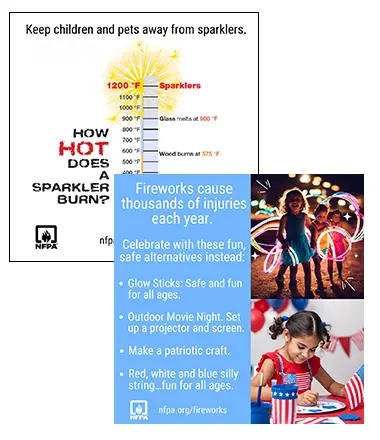
The CPSC also noted a sharp rise in injuries involving everyday sparklers, which alone accounted for roughly 1,700 emergency department visits. While many parents consider sparklers a harmless novelty for young children, safety experts warn that they burn at approximately 2,000°F (1,093°C), hot enough to instantly melt certain metals and cause deep third-degree burns.
Fatal Misconceptions: Tragically Preventable Losses
Federal investigators emphasize that nearly all fireworks-related deaths are tied to the misuse of commercial products, altered fuses, or the illegal handling of professional-grade artillery. Law enforcement agencies routinely warn against using professional display devices or banned items like M-80 salutes, cherry bombs, or any firecrackers containing more than two grains of pyrotechnic powder.
To illustrate how quickly a malfunction can prove fatal, federal databases highlight several real-world tragedies caused by illegal or reckless handling:
- The Mortar Shell Standoff: A 37-year-old Indiana man suffered massive, fatal head trauma after standing directly over a commercial mortar shell that featured a homemade, altered fuse. The device detonated instantly upon ignition.
- The Improvised Helmet Blast: An 18-year-old Iowa youth was killed after taping a commercial mortar tube to a football helmet to launch fireworks directly from his head. A secondary mortar shell became lodged inside the tube, exploding directly against his skull.
- The Handheld Launch: In separate incidents in Florida and South Carolina, young men aged 16 and 24 suffered fatal, penetrating shrapnel wounds to their chests and hearts after choosing to hold fiberglass mortar launching tubes in their hands while igniting the fuses.
- The Shoulder-Fired Artillery: A 49-year-old Texas man suffered catastrophic internal injuries, multiple rib fractures, and lung lacerations on New Year’s Eve after launching heavy artillery shells from an improvised PVC pipe device resting on his shoulder.
The Essential Pre-July 4th Safety Checklist
To protect your family, guests, and neighborhood properties during holiday celebrations, emergency responders and the CPSC recommend adhering to the following strict safety guidelines:
- Enforce Active Adult Supervision: Never allow toddlers or young children to hold, play with, or ignite fireworks of any kind, including sparklers. Older children should be monitored at all times, and horseplay or running near active firing zones must be strictly prohibited.
- Clear the Launch Zone: Only set off fireworks outdoors in wide, open clearings. Stay far away from residential houses, parked vehicles, dry leaves, brush, or other highly flammable structures. Ensure all spectators are safely out of physical range before lighting a device.
- Prepare for Emergencies: Keep a pressurized garden hose or a large bucket of water immediately accessible at the firing site to douse rogue sparks or small grass fires.
- Never Relight a “Dud”: If a firework fails to ignite or launch, do not approach it or attempt to relight the fuse. Wait at least 20 minutes from a safe distance, then approach and thoroughly soak the malfunctioning device in a bucket of water before discarding it in a trash receptacle.
- Maintain Bodily Distance: Never place any portion of your body directly over a fireworks device while lighting a fuse. Ignite products one at a time, and retreat to a safe distance immediately. Never light fireworks inside glass, plastic, or metal containers.
- Avoid Impairment: Operating fireworks while under the influence of alcohol or drugs drastically slows reaction times and impairs judgment. Historical data indicate that roughly 44% of fireworks fatalities involve impaired handlers.
- Know Local Ordinances: Laws vary drastically by state and municipality. Always check with your local police or fire department regarding specific legal restrictions, banned items, and designated shooting hours within your community.

