

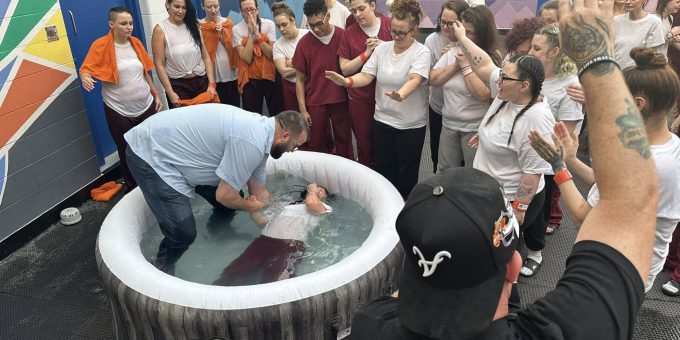
BLOOMINGTON — A national watchdog group has accused the Monroe County Sheriff’s Office of violating the U.S. Constitution following a late-May Christian devotional event inside the county jail that featured the baptisms of nearly 50 inmates and performances by faith-driven rappers.
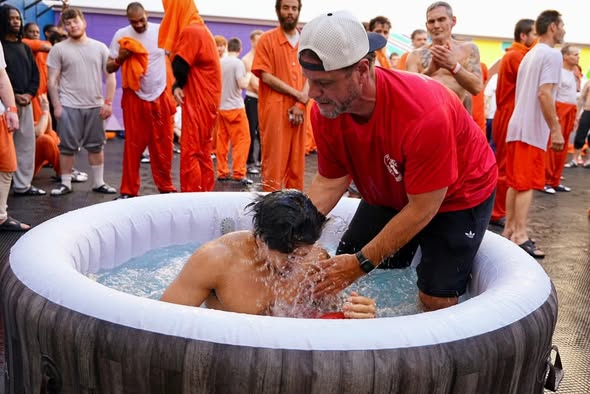
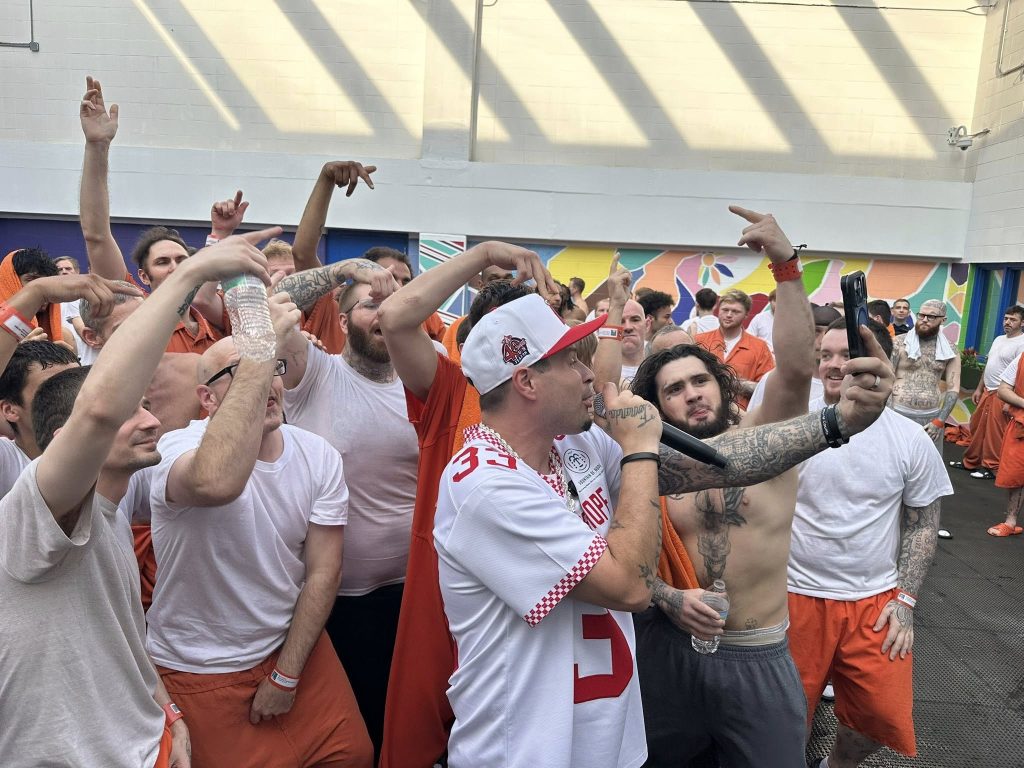
The controversy ignited after the Sheriff’s Office published a May 31 post on its official Facebook page detailing the event. According to the post, 49 inmates were baptized inside the Monroe County Correctional Center in Bloomington. The event also featured live performances and speeches from Christian hip-hop artists Redeemed and J. Truth.
“Recently, something powerful happened inside the Monroe County Correctional Center,” the Facebook post read, praising the jail commander, staff, and outside rehabilitation groups for delivering a “message of hope, faith, and transformation.” Published photos showed uniformed jail staff actively participating and speaking at the event.
The Madison, Wisconsin-based Freedom From Religion Foundation (FFRF), a national nonprofit that advocates for the separation of church and state, filed a formal complaint. The organization argues that the sheriff’s office unconstitutionally used state resources to promote Christianity and created an inherently coercive environment for inmates.
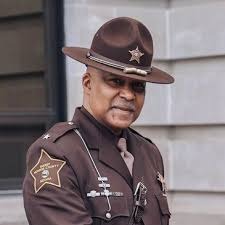

In a letter addressed to Monroe County Sheriff Ruben Marté, FFRF staff attorney Samantha Lawrence argued that while jail officials are permitted to accommodate the religious beliefs of inmates, they cannot actively organize, participate in, or promote them.
“It is commendable for the Sheriff’s Office and Center to facilitate inmates freely exercising their chosen religious beliefs,” Lawrence wrote. “But it is coercive for the Sheriff’s Office, Center, and leadership to organize, participate in, or promote religion and religious exercises, such as baptisms, in ways that make it appear the government sponsors the religious exercise and is encouraging inmates to convert to Christianity.”
Lawrence further noted that correctional facilities are inherently coercive environments because inmates represent a captive audience. FFRF contends that high-profile, staff-sanctioned Christian events could pressure inmates to convert or participate simply to appear cooperative and well-behaved to guards and administrators.
The foundation became aware of the event after several Monroe County residents flagged the social media post. The Facebook thread quickly drew more than 500 comments, with many users praising the religious milestone and others raising concerns over equal representation for non-Christian faiths.
Sheriff’s Office Defends Event as Voluntary
In a statement responding to the allegations, the Monroe County Sheriff’s Office defended the function, emphasizing that it respects and protects the constitutional rights of all individuals in its custody.
According to jail administrators, the baptism service was entirely optional and was held at the direct request of the inmates themselves. The agency stated that participation—or lack thereof—had absolutely no bearing on housing assignments, inmate privileges, available programming, or treatment within the facility.
Sheriff’s officials added that the jail provides similar accommodation and access to representatives of other faith traditions upon request. However, the office did not immediately provide specific examples of comparable large-scale events hosted for non-Christian inmates when questioned by reporters.
The Constitutional Line: Accommodation vs. Promotion
Faith-based programming, such as Bible studies or religious rehabilitation courses, is a common fixture in American jails and prisons. However, government-run institutions must navigate strict legal boundaries set by the First Amendment:
- The Establishment Clause: Prohibits the government from establishing, endorsing, or favoring a state-sponsored religion, or favoring religion over non-religion.
- The Free Exercise Clause: Protects an individual’s right to freely practice their religion, requiring jails to reasonably accommodate diverse faith practices.
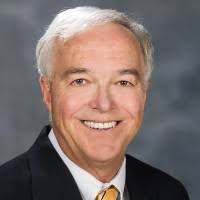
“The role of prison officials is to, when possible, accommodate religions, not promote it,” said Ken Paulson, director of the Free Speech Center at Middle Tennessee State University. “If you are permitting baptisms, then you really have to ask whether there are other religious exercises for prisoners of other faiths that would be comparable in scope and significance.”
Paulson noted that while allowing inmates to express their faith is positive, the prominent presence of uniformed staff and subsequent government promotional messaging raises legitimate legal questions.
A Recurring Issue in Indiana
This is not the first time an Indiana law enforcement agency has drawn scrutiny from church-and-state watchdogs. In 2022, the FFRF similarly challenged the Decatur County Sheriff’s Department in Greensburg, Indiana, over a highly publicized inmate baptism event and regular religious functions held inside that county’s detention center.
The FFRF has requested that Sheriff Marté stop utilizing official office channels and social media platforms to promote Christian conversions and has asked the department to outline the steps it will take to remedy the situation moving forward.

