

JASPER — Federal and state transportation officials have formally entered the next phase of environmental reviews for a major highway project aimed at reshaping regional transit and freight operations through southern Indiana.
The Federal Highway Administration (FHWA) and the Indiana Department of Transportation (INDOT) published a Notice of Intent in the Federal Register, signaling the official start of a Tier 2 Environmental Impact Statement (EIS) for Section 2 of the proposed Mid-States Corridor.
The Tier 2 study focuses on a 23-mile stretch within Dubois County, evaluating potential blueprints for a new south-to-north arterial road designed to link Interstate 64 near Dale to State Road 56 near Haysville.
Narrowing Down the Alternatives
The project builds upon a Tier 1 Final Environmental Impact Statement and Record of Decision completed in September 2023, which established a broader 2,000-foot corridor for the highway.
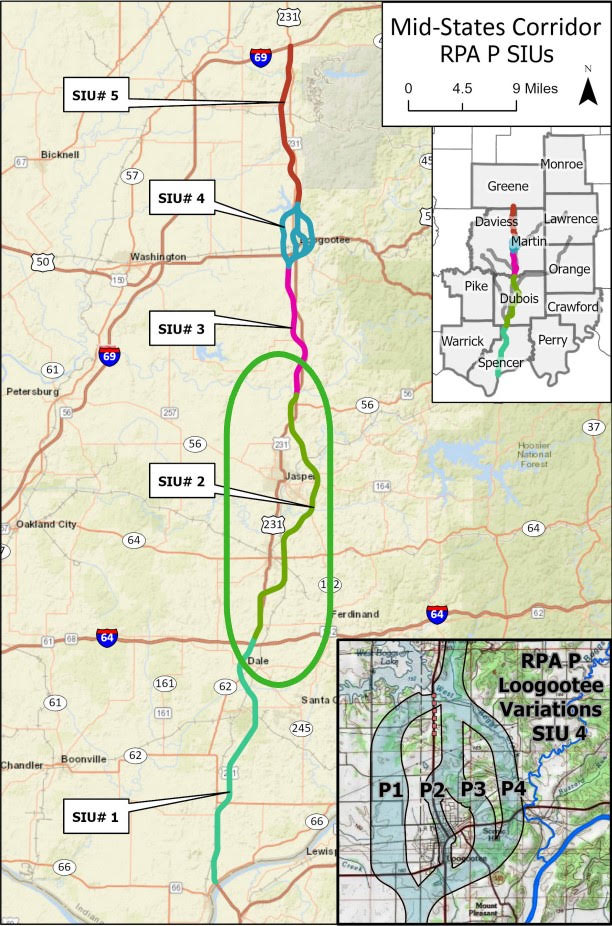
Since Tier 2 activities initially began in July 2024, transportation planners developed 12 preliminary build alternatives. Following a series of community Advisory Committee meetings and public information sessions held between late 2024 and late 2025, engineers have narrowed the scope down to two primary routes:
- Alternative 2B
- Alternative 3B
Both options will be carried forward into the upcoming Draft Environmental Impact Statement (DEIS). While a definitive “preferred route” has not yet been selected, officials expect the final recommendation to blend elements and modifications from both alternatives. The upcoming DEIS will pinpoint the exact location and specific access types for the chosen path.
Expected Environmental and Local Impact
Because the highway will cut through a mix of rural and developed land in Dubois County, the Tier 2 EIS will rigorously evaluate potential disruptions. According to the initial Screening of Preliminary Alternatives Report, the project is expected to impact a wide array of local resources:
| Resource Impact Type | Anticipated Range |
| Right-of-Way Acquisition | 1,462 to 1,596 acres |
| Agricultural Land Displaced | 869 to 935 acres |
| Total Property Relocations | 41 to 82 buildings (Residential, Commercial, Industrial, Agricultural, Public Use) |
| Wetlands Affected | 55 to 90 acres |
| Non-Wetland Forests Impacted | 327 to 362 acres |
Planners are coordinating with multiple cooperating agencies—including the U.S. Fish and Wildlife Service, the U.S. Army Corps of Engineers, and the Environmental Protection Agency—to secure necessary permits regarding local floodplains, farmlands, biological resources, and historic sites before construction can begin.
Economic and Travel Goals
Despite environmental and property impacts, state and federal officials maintain that the Mid-States Corridor is vital for the region’s economic future. The Tier 2 guidelines outline several core objectives:
- Streamlining Freight: Increasing the efficiency of heavy freight truck operations and optimizing highway connections to major multi-modal hubs in Southern Indiana.
- Business Access: Improving commuting routes for employees traveling to major business destinations and employment centers within Dubois County.
- System Linkages: Enhancing overall personal and regional connectivity.
Next Steps and Public Comment
The public has a finite window to influence the shaping of these highway alternatives. Formal public comments on the Notice of Intent must be submitted on or before July 1, 2026.
How to submit feedback: Comments can be filed online through the federal docket at www.regulations.gov (Docket No. FHWA-2026-0562). Alternatively, written feedback can be mailed or hand-delivered directly to the Mid-States Corridor Project Office, located in Room 216 of the Vincennes University Jasper Campus Administration Building (850 College Ave., Jasper, IN 47546).
All feedback gathered by the July deadline will be compiled and addressed in the Draft EIS, which is slated for public release in the fall of 2026. A final decision and a combined Record of Decision from federal regulators are anticipated by the summer of 2027.

