

INDIANA — A sweeping affordability crisis is catching up with homeowners across the United States, and fresh data reveals that Indiana is currently bearing the brunt of the hardship.
According to the Q1 2026 U.S. Foreclosure Market Report released by property data firm ATTOM, nationwide home foreclosures have jumped more than 26% compared to the same period last year. Driven heavily by relentless inflation, climbing interest rates, and soaring local homeownership costs, a total of 118,727 U.S. properties faced foreclosure filings in the first three months of the year alone.
Among all 50 states, analysts found that Indiana logged the highest foreclosure rate in the entire nation during the first quarter, recording one foreclosure filing for every 739 housing units. This rate sits nearly two-thirds higher than the national average, which currently tracks at one in every 1,211 households.
Indiana is closely trailed by South Carolina in second place, with one in every 743 properties facing filings, and Florida in third, at one in every 750 housing units.
The Leading Foreclosure Rates by State (Q1 2026)
| Rank | State | Foreclosure Rate (1 in X Housing Units) |
| 1 | Indiana | 739 |
| 2 | South Carolina | 743 |
| 3 | Florida | 750 |
| 4 | Delaware | 757 |
| 5 | Illinois | 833 |
While ATTOM’s national foreclosure market reports highlight state-level data and major metropolitan areas (ranking Indiana #1 overall and placing Indianapolis and Evansville in the top five worst-hit cities), the firm does not publicly publish a full, standalone numerical ranking for all individual counties in its main quarterly press releases.
Instead, county-level data is typically broken down by real estate data providers to identify specific pockets of “high distress” or localized trends.
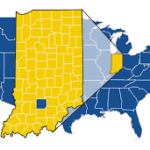
While Lawrence County isn’t specifically singled out as a national outlier like Marion or Vanderburgh counties, it is subject to the same economic pressures that pushed Indiana to the top of the list:
- Statewide Baseline Impact: Because Indiana leads the nation with 1 in every 739 housing units facing a foreclosure filing, rural and suburban counties across the state are seeing an upward trend. According to ATTOM and local real estate analysts, the primary drivers in areas outside of Indianapolis are skyrocketing property tax assessments and surging homeowners’ insurance premiums, which have created unexpected escrow shortages for long-term homeowners.
- The Surrounding Micro-Market: In neighboring areas of southern Indiana (such as Clinton, Sullivan, Lake, and Greene counties), foreclosure filings have routinely popped up in monthly breakdowns as localized pockets of moderate distress. In lower-cost housing markets like Bedford and Mitchell, even minor shifts in the cost of utilities, groceries, and gas can quickly cause a household budget to spiral.
Exact, real-time figures for the total number of foreclosure filings initiated in Lawrence County are not published in macro-level summaries like the national ATTOM report. However, local real estate registry data and upcoming public auction schedules provide a snapshot of the current local landscape:
- Active Foreclosure Listings: As of mid-May 2026, real estate tracking platforms (such as Zillow and Realtor.com) show roughly 10 to 12 properties actively designated under explicit foreclosure or scheduled sheriff sale auction status within Lawrence County—predominantly concentrated in Bedford and Mitchell.
- Upcoming Sheriff Sales: Under Indiana law, once a foreclosure is legally finalized by a judge, the property is sent to a public auction. Lawrence County handles these transactions online via Zeus Auction. The upcoming June 2026 auction block already features local residential properties, such as single-family homes on V Street in Bedford, moving through the final stages of the process.
Because a “foreclosure” can refer to multiple stages of financial distress—ranging from an initial notice of default (lis pendens) to an official bank repossession or a final sheriff’s sale—the macro data gets grouped into statewide totals.
Local real estate experts and housing advocates emphasize that Indiana’s position at the top of this list is the result of a compounding “perfect storm” unique to the region.
While Indiana has traditionally boasted a lower cost of living compared to the coasts, housing experts point out that local wages have failed to keep pace with skyrocketing post-pandemic property values. Furthermore, it isn’t just the base mortgage payments pushing people over the edge—rapidly escalating escrow shortages are catching many off guard.

“Your mortgage might not be going up, but your home insurance and your property taxes are,” explained Amy Nelson, executive director of the Fair Housing Center of Central Indiana, in a recent assessment of the market.
Additionally, housing analysts note that many Hoosiers who overpaid for homes during the pandemic real estate boom are now seeing their local property tax assessments catch up with those inflated prices. When paired with high utility rates and everyday grocery inflation, budgets are snapping. Notably, real estate data indicates a substantial number of these foreclosures are hitting people who have successfully been in their homes for 10 years or more.
The trouble is hitting Indiana’s urban centers the hardest. According to ATTOM’s metro-specific data, Indianapolis ranked 12th worst among major U.S. metropolitan areas with a population of 1 million or more.
Despite the alarming 26% year-over-year spike, real estate economists offer one piece of perspective: today’s numbers are still well below the catastrophic peaks seen during the 2008 Great Recession. For instance, Indiana saw more than 14,000 filings per quarter during the subprime mortgage collapse, compared to just over 4,000 filings in the first quarter of this year.
Still, experts warn that the sharp trajectory signifies deep underlying financial distress for working-class families, signaling that housing affordability will remain a dominant issue for voters and policymakers through the rest of the year.

