

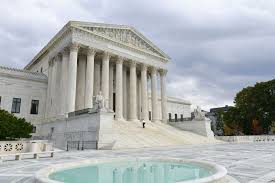
WASHINGTON D.C. – As the United States Supreme Court concludes its 2025-2026 term, the bench has issued a series of landmark decisions that significantly reshape federal administrative power, digital privacy, and interstate commerce.
Legal scholars are characterizing this term as one of the most transformative in recent decades, with several 6-3 and 5-4 splits highlighting deep ideological shifts.
Curbing Administrative Authority
Building on precedents from previous years, the Court continued to narrow the scope of “Chevron deference.” In a major ruling regarding environmental regulations, the Court held that federal agencies cannot implement “major questions” of economic or political significance without explicit, specific authorization from Congress.
This decision is expected to have an immediate ripple effect across various sectors:
- Environmental Policy: Limits the EPA’s ability to set broad carbon emission standards for existing power plants.
- Labor Laws: Restricts the Department of Labor from unilaterally implementing sweeping overtime pay expansions.
- Healthcare: Affects how the Department of Health and Human Services interprets complex Medicare reimbursement formulas.
Digital Privacy and the Fourth Amendment
In a highly anticipated case involving geofence warrants, the Court ruled in favor of increased digital privacy. The majority held that law enforcement’s use of “reverse-location” data—which identifies every mobile device in a specific area at a specific time—constitutes a search under the Fourth Amendment.
“The digital age does not grant the government a pass to bypass the physical protections of our homes and persons by harvesting the data we carry in our pockets,” the majority opinion stated.
Interstate Commerce and State Autonomy
The Court also addressed the “Dormant Commerce Clause” in a case regarding state-level ethical standards for imported goods. The ruling affirmed that states have the right to ban the sale of products produced under conditions that violate state health or moral standards, even if those products originate from other states.
Critics argue this could lead to a “patchwork economy,” while proponents view it as a victory for state sovereignty.
Looking Ahead: The 2026-2027 Docket
Even as the current term ends, the Court has already granted certiorari to several high-profile cases for the fall, including:
- AI Liability: Determining whether tech companies are liable for defamatory content generated by artificial intelligence.
- Second Amendment: A challenge to state-level restrictions on high-capacity magazines.
- Education Funding: Whether public funds can be used for specialized religious vocational training programs.
As these rulings take effect, the lower federal courts are already seeing an influx of filings as businesses and advocacy groups move to apply these new legal standards.