

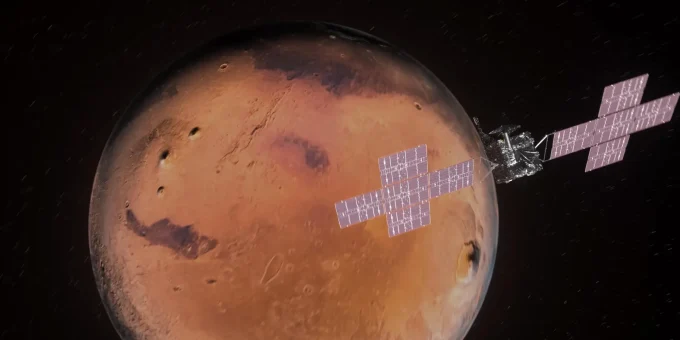
NATIONWIDE — Space enthusiasts and residents keeping an eye on the stars have a major milestone to watch this week. NASA’s Psyche spacecraft is on track to perform a high-stakes flyby of Mars this Friday, May 15, 2026.
The probe, launched in October 2023, will pass within approximately 2,800 miles of the Martian surface. Traveling at over 12,300 mph, the spacecraft will use the Red Planet’s gravity as a “slingshot” to accelerate and adjust its trajectory toward the main asteroid belt.
The primary goal of the encounter is a gravity assist. By harnessing the orbital energy of Mars, the mission can save a significant amount of xenon gas propellant, which is essential for the long journey ahead.
The only reason for this flyby is to get a little help from Mars to speed us up and tilt our trajectory in the direction of the asteroid Psyche, explained Lindy Elkins-Tanton, the mission’s principal investigator.
While the boost in speed is the main objective, the mission team is using the proximity to Mars to test and calibrate the probe’s scientific instruments:
- Imaging: The multispectral imager has already begun capturing photos of Mars, allowing engineers to hone the precise navigation techniques needed for the final destination.
- Searching for “Moonlets”: The team will conduct a “satellite search” around Mars. This serves as a practice run for when the probe arrives at the asteroid Psyche and begins searching for any small moons orbiting the metallic body.
- Dusty Rings: Scientists hope to observe a faint dusty ring, or torus, around Mars created by micrometeorite impacts on its moons, Phobos and Deimos.
The spacecraft is named after its target, 16 Psyche, a unique, metal-rich asteroid located between Mars and Jupiter. Scientists believe the asteroid may be the exposed nickel-iron core of an ancient “planetesimal”—a building block of a planet that had its rocky outer layers stripped away by violent collisions billions of years ago.
Because humans cannot travel to the Earth’s core, studying 16 Psyche offers a rare opportunity to look directly at the “heart” of a terrestrial planet.
The probe is expected to reach the asteroid in August 2029. Following the Mars flyby, any changes in the spacecraft’s speed will be verified via Doppler shift signals recorded by NASA’s Deep Space Network.

