

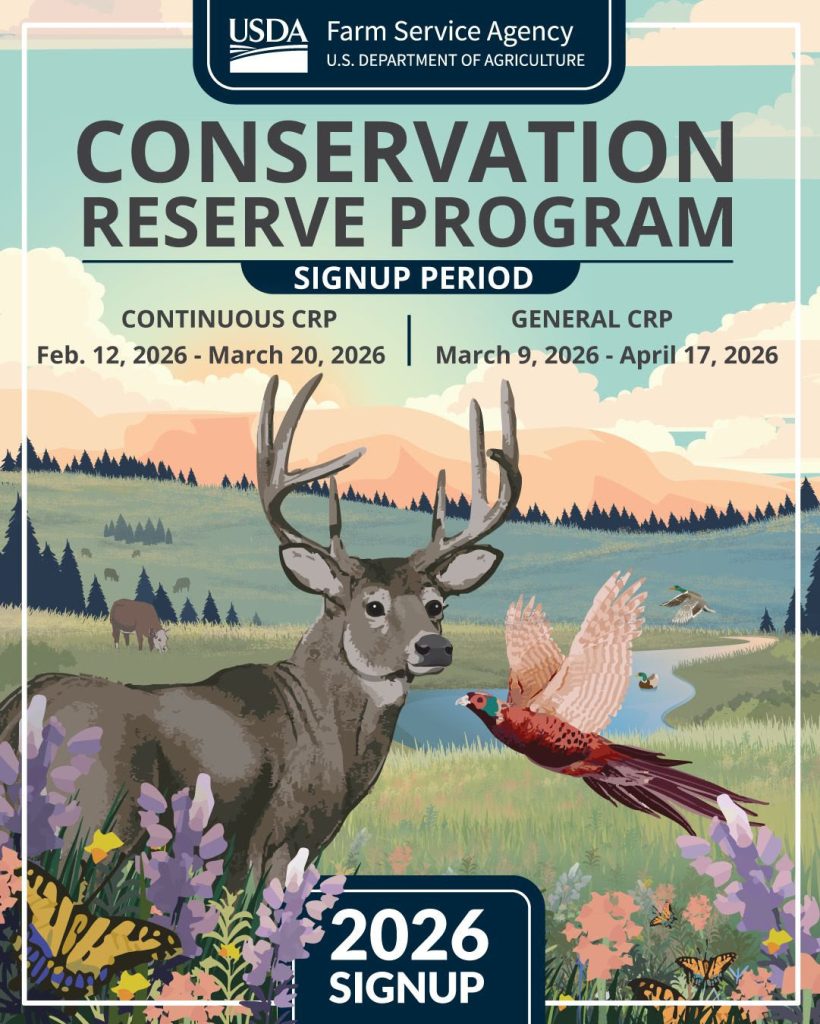
INDIANA — The U.S. Department of Agriculture (USDA) has officially launched the 2026 enrollment periods for its flagship conservation initiative, the Conservation Reserve Program (CRP). Marking 40 years since the program’s inception, the USDA’s Farm Service Agency (FSA) is now inviting agricultural producers and landowners to submit offers for both Continuous and General CRP signups.
As the program remains near its statutory cap of 27 million acres, officials expect this year’s enrollment to be highly competitive.
Key Enrollment Dates
Farmers and landowners should take note of the two distinct application windows currently available:
| Program Type | Signup Start Date | Signup End Date |
| Continuous CRP | February 12, 2026 | March 20, 2026 |
| General CRP | March 9, 2026 | April 17, 2026 |
| Grassland CRP | To Be Announced | To Be Announced |
While the first batching period for Continuous CRP ends on March 20, offers submitted after this date may be considered in subsequent periods if acreage remains available.
Understanding Your Options
The CRP provides annual rental payments and cost-share assistance to producers who voluntarily remove environmentally sensitive or marginal cropland from production and plant long-term, resource-conserving covers.
1. Continuous CRP (Signup 65)
This option targets specific, high-priority conservation practices on smaller parcels of land.
- Selection Process: Unlike the General signup, these offers are typically accepted on a first-come, first-served basis rather than through a competitive bidding process.
- Focus Areas: High-impact practices such as filter strips, riparian buffers, and the Clean Lakes, Estuaries and Rivers (CLEAR) initiative.
2. General CRP (Signup 66)
This is the primary offering for larger tracts of land aimed at broad environmental improvements.
- Selection Process: Offers are ranked nationally using the Environmental Benefits Index (EBI), which scores bids based on soil erosion control, water quality, and wildlife habitat potential.
- Focus Areas: Establishing native grasses and trees to provide long-term ecological stability.
The 2026 signup is particularly critical for states with high numbers of expiring contracts, including Iowa, Washington, Illinois, and Kansas, where over 100,000 acres are set to expire this year.
“This isn’t just about the total number of acres,” said Richard Fordyce, USDA Under Secretary for Farm Production and Conservation. “It’s about producers and landowners offering the acres that can best deliver real and lasting benefits to soil, water, and wildlife.”
To submit an offer or check eligibility, producers must contact their local USDA Service Center. Experts recommend reaching out early to navigate the mapping and paperwork requirements before the respective deadlines.
Visit farmers.gov/service-locatorto find contact information for your county’s FSA office.

