

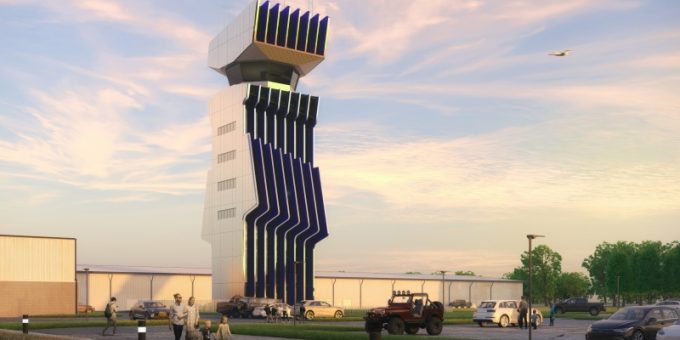
COLUMBUS — The Columbus Municipal Airport has announced that it has secured 100 percent of the necessary funding to construct a state-of-the-art new air traffic control tower, replacing its existing 80-year-old structure. The announcement follows the approval of a critical grant from the Federal Aviation Administration (FAA).

The new tower, estimated to cost $29 million, is set to enhance the airport’s capabilities while contributing to Columbus’s renowned architectural landscape.
Airport Director Brian Payne confirmed the full financial commitment, with the bulk of the funding coming from federal sources. The breakdown of the project’s cost is:
- FAA Grant: $27.2 million
- INDOT Office of Aviation (State): $1 million
- Local Airport Funds: $1 million (serving as a match)
The project also received support for its design phase through a grant from the Cummins Foundation Architecture program, which encourages architectural excellence in public buildings within the community.
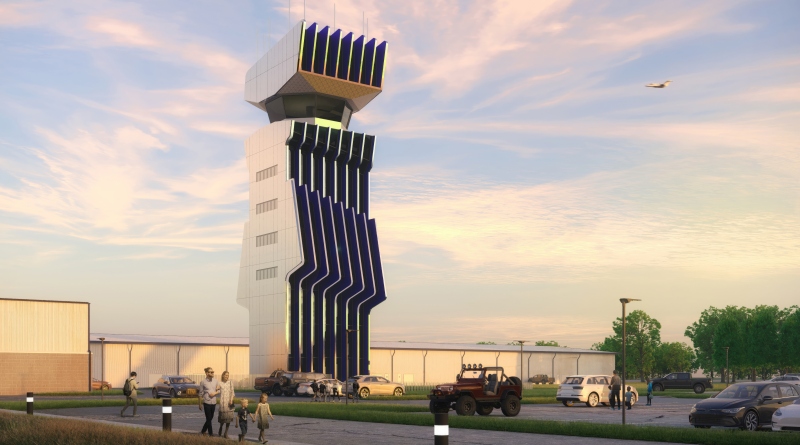
The new tower will stand 128 feet tall, roughly twice the height of the current structure, and will be constructed from steel, aluminum, and glass. Its design, created by Marlon Blackwell Architects of Fayetteville, Arkansas, in conjunction with the Woolpert engineering firm, features a distinct, layered, and segmented look.
The primary goal of the new facility is to meet all current FAA standards for safety and operation, including requirements for:
- Sighting (visibility)
- Backup cooling and power systems
- Security
- Fire and life safety
- Modern FAA equipment
The city has selected Force Construction to build the tower in collaboration with Woolpert.
A groundbreaking ceremony is scheduled for Monday, November 17, with construction expected to begin in December.
The new control tower slated for the Columbus Municipal Airport will not only be a modern piece of aviation infrastructure—it’s designed to be a significant addition to the city’s renowned modernist architectural landscape.

Architect Marlon Blackwell, whose firm was selected following a competition, aimed to create a structure that honors Columbus’s design heritage without imitating past works by masters like Eero Saarinen or I.M. Pei.
- Form and Material: The 128-foot-tall tower is clad in steel, aluminum, and glass, giving it a modern, planar figure. Blackwell described the design as being inspired by the “spirit of flight and aviation”—a form that shifts, undulates, and speaks to the essence of mobility.
- A Sentinel and Beacon: Renderings show a layered, segmented profile with vertical fins rising along the glazed east and west sides. These fins act as ribs that filter natural light inside, causing the tower’s appearance to subtly change color based on the time of day and the sun’s angle.
Unlike traditional, utilitarian control towers, the new design is meant to serve as both a functional workplace and a civic hub for the community.
- Public Access: The design features eight stories below the actual control cab, including a designated event space and an educational room where students can simulate air traffic control operations. This public component is a rare feature for an air traffic control tower.
- Dignified Workspace: Blackwell emphasized that a key priority was ensuring that the controllers and staff who spend long hours inside have a “dignified and functional work environment,” complete with modern amenities and safety upgrades.
Even before the groundbreaking, the design has received acclaim, including a nomination in the Future Project: Infrastructure category at the World Architecture Festival, sitting among ten other visionary designs from around the world.
Construction of this iconic gateway to Columbus is scheduled for completion by summer 2027.

