


WEST LAFAYETTE — In 30 days, Purdue University and the Purdue Research Foundation will join an Archaeological Legacy Institute (ALI) expedition to the South Pacific, attempting to solve the mystery of Amelia Earhart’s disappearance during her mission to become the first woman to fly around the world at the equator.

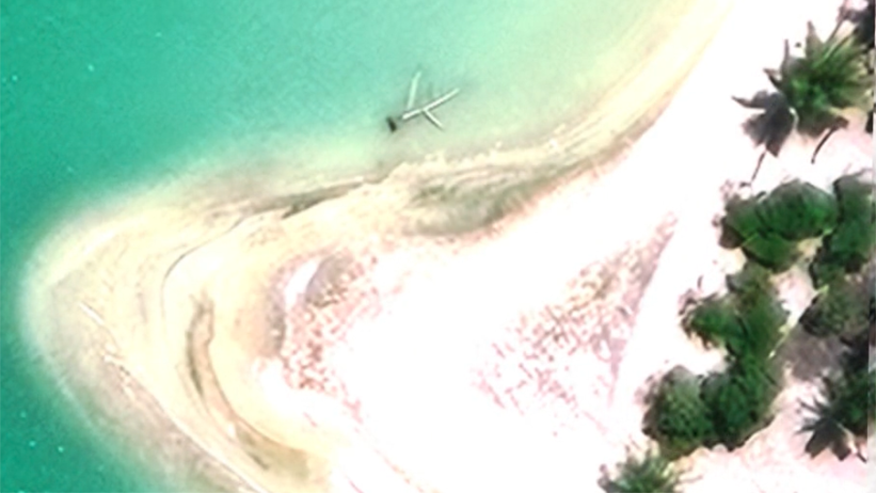
Announced July 2, 88 years to the day that Earhart and her navigator, Fred Noonan, mysteriously disappeared, the expedition will include three weeks of travel to determine if a visual anomaly in a lagoon of Nikumaroro Island is Earhart’s missing Lockheed Electra 10E.
Some members of the expedition will fly out of the Amelia Earhart Terminal at the Purdue University Airport on Oct. 30 and will rendezvous with other team members on Majuro in the Marshall Islands. The entire expedition will depart Majuro by sea on Nov. 4, sail approximately 1,200 nautical miles to Nikumaroro, and then spend several days on the small island in the search effort.
Three Purdue representatives will be part of the 15-person crew: Sirisha Bandla and Marc Hagle, both alumni and members of Purdue’s Cradle of Astronauts, along with Steve Schultz, senior vice president and general counsel.
Work on Nikumaroro will focus on inspecting the Taraia Object, first noticed in satellite imagery in 2020 and later confirmed to be visible on aerial photos taken of the island’s lagoon as far back as 1938.
Initial work will include videos and still images of the site before any disturbance, followed by remote sensing with magnetometers and sonar. Then the team will employ underwater excavation using a hydraulic dredge to expose the object for identification. Fieldwork will include a walk-over survey of nearby land surfaces to search for debris washed up by waves.
The expedition is scheduled to return to port in Majuro around Nov. 21 and fly home the following day.
Richard Pettigrew, executive director of ALI, is part of the expedition team traveling to Nikumaroro. He said the mission offers more than just the opportunity to solve one of the greatest mysteries of the 20th century.
“Finding Amelia Earhart’s Electra aircraft would be the discovery of a lifetime,” he said. “Other evidence already collected by The International Group for Historic Aircraft Recovery establishes an extremely persuasive, multifaceted case that the final destination for Earhart and her navigator, Fred Noonan, was on Nikumaroro. Confirming the plane wreckage there would be the smoking-gun proof.”
Purdue Research Foundation initially funded the “Flying Laboratory” Lockheed Electra 10E airplane through the Amelia Earhart Fund for Aeronautical Research as part of Purdue’s pioneering efforts in aviation.
“A successful identification would be the first step toward fulfilling Amelia’s original plan to return the Electra to West Lafayette after her historic flight,” Schultz said. “Additional work would still be needed to accomplish that objective, but we feel we owe it to her legacy, which remains so strong at Purdue, to try to find a way to bring it home.”
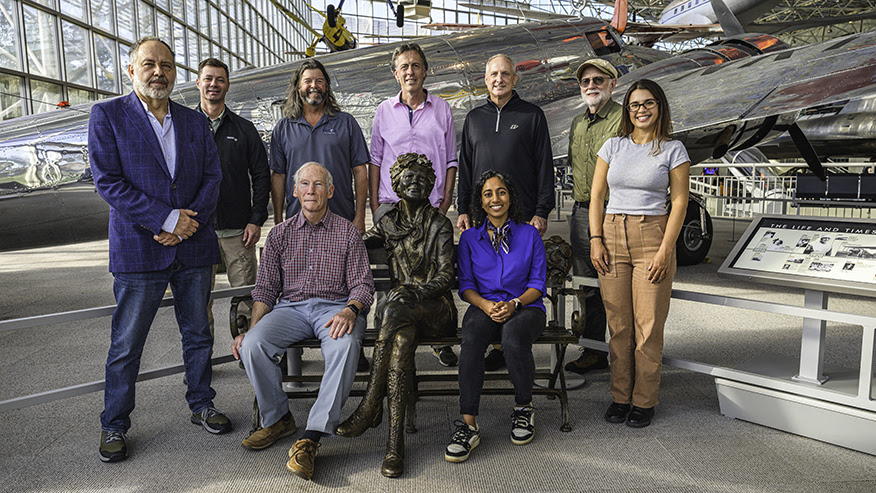
On Sept. 26, the Taraia Object expedition team convened at Seattle’s Museum of Flight to photograph and view a Lockheed Electra 10E — identical to Earhart’s aircraft. Several Purdue students joined the gathering to share insights on Purdue’s aviation legacy and Earhart’s enduring connection to the university.
Earhart began her attempt to circumnavigate the globe and set a record for long-distance flight in late May 1937, departing from Oakland, California.
On Oct. 20, “This Is Purdue,” the university’s official podcast, will release a four-part miniseries called “Finding Amelia.” The storytelling centers around the decades-long connection between the legendary aviator and Purdue.
The miniseries delves into Amelia’s life and her journey to the university, the “Flying Laboratory” plane she was flying when she disappeared, the Amelia Earhart Collection within the Purdue University Archives and Special Collections, and the upcoming Taraia Object expedition.
You can listen to the podcast at purdue.edu/podcast or wherever you get your podcasts, and watch these episodes on YouTube.
Earhart, already an aviation legend in the 1930s, came to Purdue in 1935 and worked for two years as a women’s career counselor and advisor in the university’s aeronautics department. The recently opened Amelia Earhart Terminal at Purdue Airport pays tribute to her legacy as a valued Boilermaker. She is also remembered across campus through facilities, programs, and clubs.
Nikumaroro is located halfway between Australia and Hawaii, lying approximately 400 miles southeast of Howland Island, the planned destination of Earhart and Noonan on the third-to-last leg of their 1937 attempt to circumnavigate the world around the equator.
“Purdue has never been shy to take compelling ideas off paper; in fact they encourage it. It’s why I’m not only proud to be an alumna but continue to be actively engaged in the community,” Bandla said. “I cannot express how meaningful it is to be a part of this expedition. Not only are we working to solve one of aviation’s greatest mysteries, but it is centered around a trailblazing woman who dared to blaze her own path — to take the first step — so that other women were inspired to take flight as well.”
About Archaeological Legacy Institute
Archaeological Legacy Institute is a 501(c)(3) nonprofit based in Eugene, Oregon, and organized to share the human cultural heritage widely through the use of cutting-edge media technology. ALI’s core project is The Archaeology Channel (http://www.archaeologychannel.org), a free streaming-media website featuring video and audio programs on archaeology, indigenous peoples and cultural heritage. This combines with news site Archaeologica.org, the social media site ArchaeoSeek.com, and subscription video-on-demand platform Heritage Broadcasting Service (heritagetac.org) to form a unique constellation of online services and resources for those keen to learn about and enjoy cultural-heritage information, events, programming, and discussions. Through TAC Tours, ALI also organizes in-person group visits to significant cultural heritage sites worldwide, which have included Stonehenge, Machu Picchu, Chichén Itzá, Uxmal, Newgrange, Persepolis, Carnac, the Ness of Brodgar, the Malta prehistoric temples, and many others.
About Purdue University and Purdue Research Foundation
Purdue University is a public research university leading with excellence at scale, and the Purdue Research Foundation (PRF) is a private nonprofit operating as a separate entity to advance the university’s mission. Purdue is committed to affordability and accessibility with more than 106,000 students studying at Purdue across multiple campuses, locations and modalities. PRF operates Purdue Innovates, including the Office of Technology Commercialization, Incubator and Ventures, as well as managing Purdue Research Park, Discovery Park District, Purdue Technology Centers and the Purdue for Life Foundation. See how Purdue never stops in the persistent pursuit of the next giant leap at https://www.purdue.edu/president/strategic-initiatives.

