

BEDFORD—This morning, Lawrence County Commissioners received a comprehensive update on the vital work of the Soil and Water Conservation District (SWCD). Mandy Robbins presented an overview of the district’s conservation, education, and funding achievements.
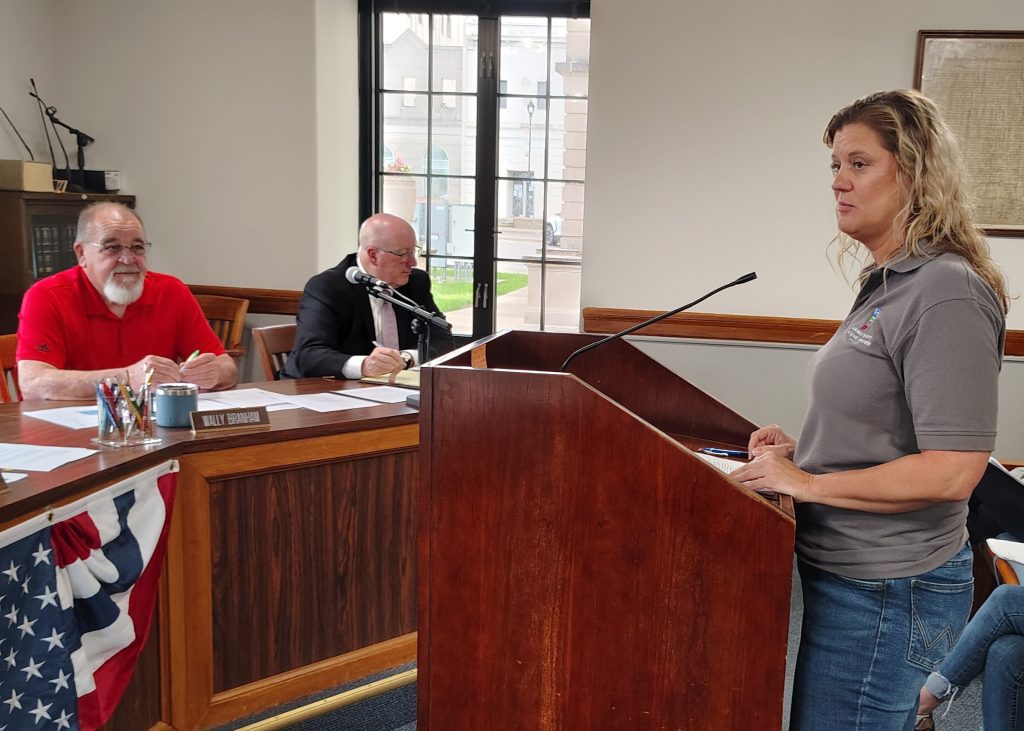
Robbins highlighted the SWCD’s active partnerships and significant grant money received, underscoring their commitment to environmental stewardship in the county. Key funding initiatives include:
- Lawrence County KIC (Keep Invasives in Check): $10,000 for Weed Wranglings in County (invasive removal)
- Lawrence County C.R.U.S.H. (Community Revitalizing Urban Soil Health): $8,669.74
- White River Forestry Committee: $12,347.76 for Bedford Tree Nursery
- Land of Limestone Master Gardeners: $3,000 for Growing Together Grant
- Support from the Natural Resources Conservation Service (NRCS)
The SWCD also collaborates with a wide array of associated organizations, including Purdue Extension, Bedford Parks Department, Lawrence County Farm Bureau, US Forest Service, Indiana Department of Natural Resources, Urban Soil Health, and Indiana Karst Conservancy, demonstrating a broad network dedicated to conservation.
Educational outreach has been a cornerstone of the SWCD’s efforts. In 2024 alone, their programs reached 4,698 students through 178 classes, offering 18 unique programs. Past educational initiatives have included diverse topics such as Maple Syrup workshops, Wildflower Hikes, Forestry Field Days, and workshops on soil health, gardening, and pond and soil.
Looking specifically at soil conservation, Robbins presented data on best management practices (BMPs) installed by SWCDs in 2024 that actively reduced sediment loss. A heatmap indicated that Lawrence County was a significant area for these efforts. The report showed that Lawrence County SWCD assisted private land owners in installing 128 best management practices, with 126 leveraging Clean Water Indiana funds. These BMPs resulted in substantial environmental benefits in 2024, keeping:
- 11,844 tons of sediment in place
- 10,632 pounds of phosphorus out of waterways
- 21,219 pounds of nitrogen out of waterways
Robbins further elaborated on the county’s conservation achievements, presenting data for 2023 showing significant nutrient and sediment load reductions. That year, Lawrence County achieved a total funding of $2,651,926.89 for conservation, comprising $81,047.04 from local sources, $62,973.85 from state funds, and $2,507,906 from federal sources.
Regarding land use in Lawrence County, the report for 2023 indicated 108,739 agricultural acres, 22,600 developed acres, 154,639 forest and wetland acres, and 3,214 other acres.
The presentation also detailed a long-term trend of county sediment and load reductions. In 2023, 1,333 practices were installed and active, leading to 225,826,354 pounds of sediment reduction, 101,187 pounds of phosphorus reduction, and 201,539 pounds of nitrogen reduction. This builds on a consistent effort dating back to 2013, which has seen an increase in both practices installed and the resulting reductions in sediment, phosphorus, and nitrogen over the years.
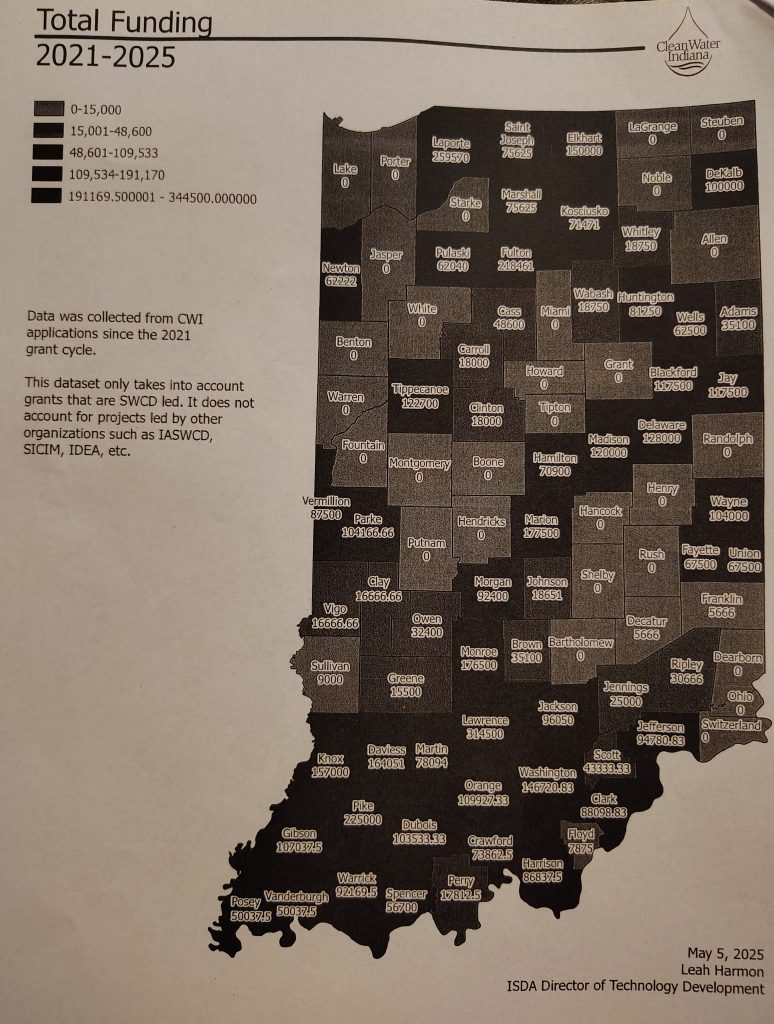
Robbins also provided a statewide overview of total funding for 2021-2025 from the Clean Water Indiana grant cycle. The data indicated varying funding levels across Indiana counties, with Lawrence County receiving between $109,534 and $191,169. This dataset only accounts for grants that the SWCD led and does not include projects led by other organizations.
The update underscored the Lawrence County SWCD’s vital role in promoting environmental health, educating the public, and securing crucial funding for conservation initiatives.

