


WEST LAFAYETTE— When you walk through a pine forest, the crisp, fresh scent is one of the first things you notice.
But bringing that pine scent or other aromas indoors with the help of chemical products — yes, air fresheners, wax melts, floor cleaners, deodorants, and others — rapidly fills the air with nanoscale particles that are small enough to get deep into your lungs, Purdue University engineers have found over a series of studies.
These nanoparticles form when fragrances interact with ozone, which enters buildings through ventilation systems, triggering chemical transformations that create new airborne pollutants.
“A forest is a pristine environment, but if you’re using cleaning and aromatherapy products full of chemically manufactured scents to recreate a forest in your home, you’re actually creating a tremendous amount of indoor air pollution that you shouldn’t be breathing in,” said Nusrat Jung, an assistant professor in Purdue’s Lyles School of Civil and Construction Engineering.
Nanoparticles just a few nanometers in size can penetrate deep into the respiratory system and spread to other organs. Jung and fellow civil engineering professor Brandon Boor have been the first to study nanoscale airborne particle formation indoors and compare it to outdoor atmospheric processes.
“To understand how airborne particles form indoors, you need to measure the smallest nanoparticles — down to a single nanometer. At this scale, we can observe the earliest stages of new particle formation, where fragrances react with ozone to form tiny molecular clusters. These clusters then rapidly evolve, growing and transforming in the air around us,” said Boor, Purdue’s Dr. Margery E. Hoffman Associate Professor in Civil Engineering.

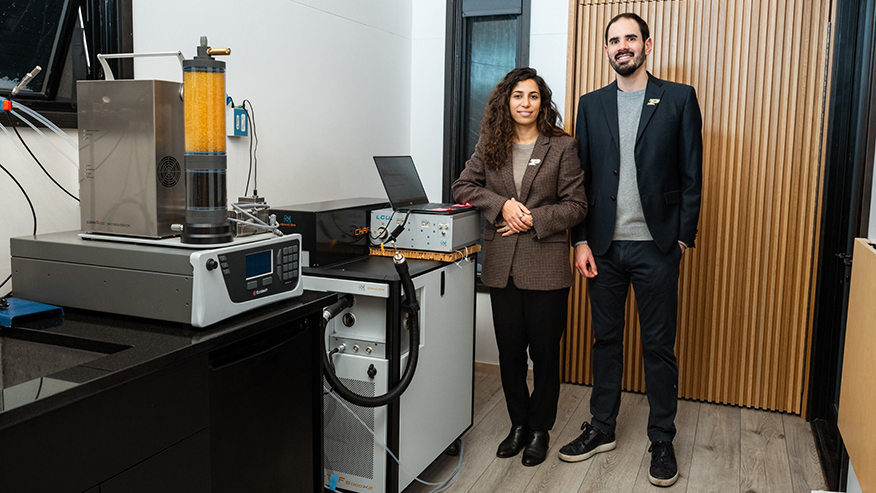
In a “tiny house lab” — a dedicated residential lab space for indoor air quality research — Jung and Boor are using the latest industry-developed air quality instruments to track how household products emit chemicals that evaporate easily, called volatile chemicals, and generate the tiniest airborne nanoparticles.
Called the Purdue zero Energy Design Guidance for Engineers (zEDGE) lab, the tiny house has all the features of a typical home but is equipped with sensors for closely monitoring the impact of everyday activities on a home’s air quality. Jung led the design of the lab, which was built in 2020 as the first of its kind.
With this unprecedented level of detail and accuracy, Jung and Boor have made discoveries suggesting that many everyday household products used indoors may not be as safe as previously assumed.
Even though it’s yet to be determined how breathing in volatile chemicals from these products impacts your health, the two have repeatedly found that when fragrances are released indoors, they quickly react with ozone to form nanoparticles. These newly formed nanoparticles are particularly concerning because they can reach very high concentrations, potentially posing risks to respiratory health.
Jung and Boor believe these findings highlight the need for further research into indoor nanoparticle formation triggered by heavily scented chemical products.
“Our research shows that fragranced products are not just passive sources of pleasant scents — they actively alter indoor air chemistry, leading to the formation of nanoparticles at concentrations that could have significant health implications,” Jung said. “These processes should be considered in the design and operation of buildings and their HVAC systems to reduce our exposures.”
Read more on the study and its findings here

