

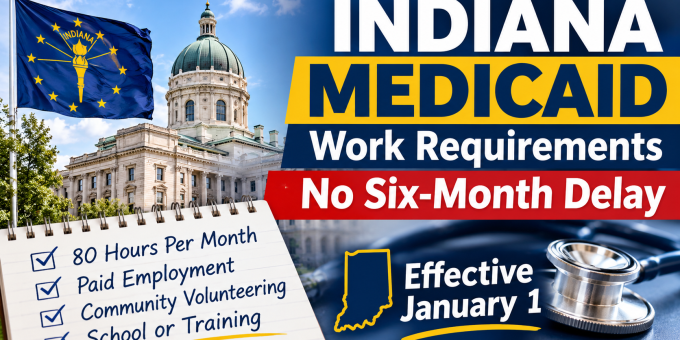
INDIANA — Indiana will move forward with enforcing new Medicaid work requirements on January 1, declining an optional six-month federal grace period designed to give states extra time to transition their tracking systems and ease beneficiaries into the rules.
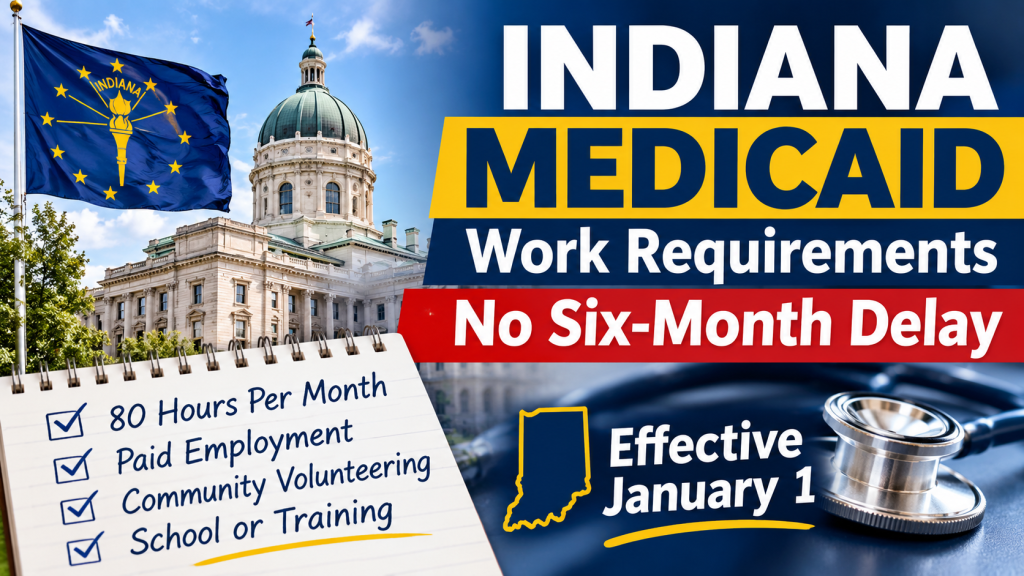
The decision comes after the federal Centers for Medicare & Medicaid Services (CMS) updated its guidance last week to establish an optional “hold-harmless” period. Under the federal update, states could delay penalizing enrollees—such as denying or terminating coverage—for up to six months while upgrading systems that track compliance and exemptions. Those rules stem from work reporting mandates established under the federal One Big Beautiful Bill Act.
State Law Leaves No Room for Delay
Following a review of the new federal guidance, the Indiana Family and Social Services Administration (FSSA) announced that state statutes prevent the agency from participating in the transition window.
Indiana law does not provide the agency with the authority to delay implementation of these requirements, according to FSSA spokesperson Marcus Barlow. While the updated federal guidance affords states additional flexibility, FSSA’s actions must remain consistent with state statutes that require implementation of the work requirements by January 1.
The agency’s stance has drawn pushback from health care advocates. Adam Mueller, executive director of the Indiana Justice Project, argued that taking the hold-harmless period would not violate state law because Indiana would still officially launch the program, conduct assessments, and send notices on January 1. Calling the grace period a “no-brainer,” Mueller noted that pausing coverage terminations during the first six months would protect Hoosiers from losing health care due to administrative errors or confusion.
Who Is Affected and How to Comply
The new reporting rules apply specifically to most working-age adults between 19 and 64 who receive coverage through the Healthy Indiana Plan (HIP). Traditional Medicaid enrollees are unaffected by the mandate.
Beginning January 1, non-exempt HIP members and new applicants must complete and report at least 80 hours per month of qualifying activities—or meet an equivalent monthly income threshold—to keep their health insurance. Approved activities can be combined to reach the 80-hour mark and include:
- Paid employment
- Community volunteering
- Attending school at least half-time
- Participating in an apprenticeship or qualifying job-training program
Key Exemptions: According to FSSA guidelines, members are exempt from the 80-hour monthly requirement if they meet certain criteria, including:
- Being pregnant or within 12 months postpartum
- Caring for a dependent child age 13 or younger, or caring for a person with a disability
- Experiencing “medical frailty” or special medical needs, such as a serious physical, intellectual, developmental, or mental health condition, blindness, disability, or substance use disorder
- Participating in a drug or alcohol treatment program
- Being a veteran with a 100% disability rating, a member of a federally recognized Tribe, or under age 26 and formerly in foster care
- Currently complying with SNAP or TANF work rules, or having been incarcerated within the past 90 days
Three-Month Look-Back Already Underway
While formal enforcement begins in January, compliance is already affecting eligibility. Indiana utilizes a three-month look-back window for eligibility determinations—meaning individuals applying for or renewing HIP coverage in January must demonstrate they met the work or exemption criteria during October, November, and December.
Last month, FSSA estimated that at least 58,000 Hoosiers enrolled in HIP were not yet meeting the forthcoming requirements.
To prevent coverage gaps, state officials are urging HIP members to set up an online Benefits Portal account, verify their contact information, check whether they qualify for an exemption, and begin logging their monthly hours.
“The agency remains committed to providing clear information, resources, and support to help members successfully navigate implementation and avoid unnecessary disruptions in coverage,” Barlow said.