

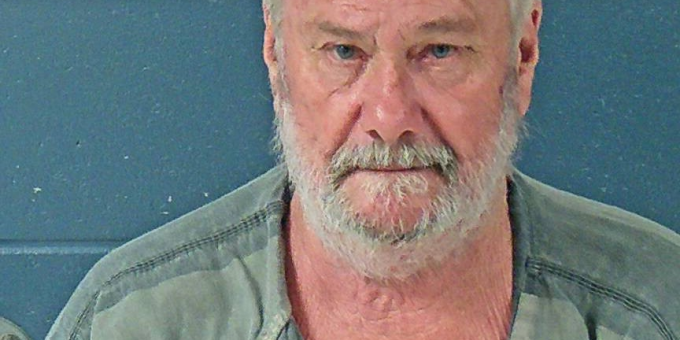
BEDFORD — A 75-year-old Bedford man was booked into the Lawrence County Jail over the weekend after allegedly speeding past a marked police cruiser with an active license suspension and an open beer bottle in his truck.
Michael O. Flick faces preliminary local charges of operating a vehicle while intoxicated (OWI), OWI endangerment, and a driving while suspended infraction following his arrest on Saturday, June 13th.

According to a probable cause affidavit filed by Bedford Police Department Officer Sarah Haluda, the incident began Saturday evening while she was patrolling near the intersection of X and 5th Streets. Officer Haluda observed a white Chevrolet pickup truck traveling westbound toward State Road 37 at a high rate of speed.
While waiting at the stoplight at 5th Street and State Road 37, a routine computer check of the truck’s registration and its owner revealed that Flick’s Indiana driver’s license had been suspended since February 2026.
Both vehicles turned south onto State Road 37. Despite the marked police cruiser driving directly behind him, Flick allegedly accelerated to 67 mph in a 55 mph zone. Officer Haluda activated her emergency lights and initiated a traffic stop just south of John Williams Boulevard.
Upon approaching the truck, Officer Haluda noted that Flick’s eyes were red and glassy, his speech was slurred, and a strong odor of alcohol was present on his breath. During their initial conversation, Flick reportedly mentioned that he had been cited recently for having an open alcohol container while driving. He admitted to having “a couple” of beers earlier in the evening.
Flick stepped out of his truck for standardized field sobriety tests but appeared confused, asking the officer a second time why he had been pulled over. He then adjusted his timeline, disclosing that he had actually consumed four beers at the Green Mill bar before driving.
The investigation hit several roadblocks during physical testing:
- Horizontal Gaze Nystagmus (HGN): Flick completed this eye test, displaying failing indicators in both eyes, including an involuntary jerking of the pupils before a 45-degree angle.
- Walk and Turn Test: Flick entered the initial instruction phase but immediately discontinued the test, citing unnamed medical conditions that would make completion too difficult.
- One Leg Stand: Flick initially agreed to the balance test but then raised further medical concerns and ultimately declined to attempt it.
- Roadside Breath Test: Flick agreed to provide a breath sample but immediately claimed a previously unmentioned breathing condition and failed to provide an adequate sample on the scene.
Flick was advised of the Indiana Implied Consent law and agreed to a chemical test. Officer Haluda transported him to IU Health Bedford Hospital, where a registered nurse drew two vials of blood to be sent to the Indiana Department of Toxicology for analysis.
While at the hospital, Flick was read his Miranda rights and grew more candid about his alcohol consumption. He admitted to drinking one beer before leaving his house, four beers at the bar, and taking an additional beer from the bar to drink on his ride home. He informed the officer that an empty Bud Light bottle in his truck was from earlier in the day, and a still-cold, sealed Bud Light on his front passenger seat had just been purchased at the bar.
While at the hospital, Flick also completed a preliminary breath test, which registered a .111% breath alcohol content (BrAC), well above the state’s 0.08% legal driving limit.
Flick was transported to the Lawrence County Jail for housing. His truck was inventoried and impounded by Jackson’s Heavy Haul. While being booked into jail, Flick told staff he had a .380-caliber pistol in his glovebox, though officers noted the firearm was not recovered during the initial vehicle inventory.
All individuals are presumed innocent until proven guilty in a court of law. This article is based on the information provided in the probable cause affidavit and does not represent a final determination of guilt or innocence.

