

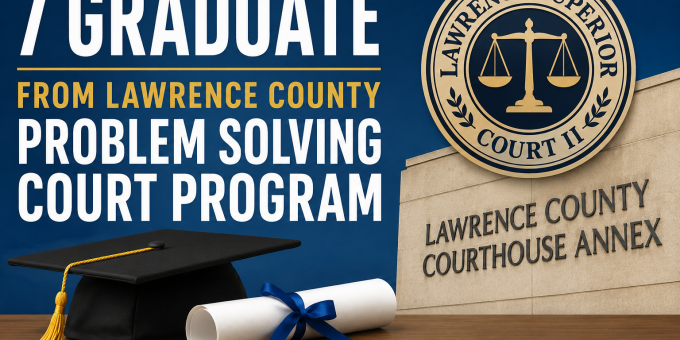
BEDFORD — Seven individuals graduated Thursday morning from the Problem Solving Court program in Lawrence Superior Court II, marking major milestones in their recovery journeys and highlighting the program’s role in helping participants rebuild their lives through treatment, accountability, and support.
The graduation ceremony was held in the courtroom of Superior Court II inside the Lawrence County Courthouse Annex in Bedford and recognized participants from the county’s problem-solving court programs, including Drug Treatment Court and Veterans Court. The programs serve as alternatives to incarceration for individuals dealing with substance abuse and mental health issues.
Located in Lawrence Superior Court II, the programs use a non-adversarial, team-based approach that focuses on rehabilitation rather than punishment. Participants undergo intensive supervision, treatment, frequent drug testing, court appearances, and counseling while working toward sobriety and stability.
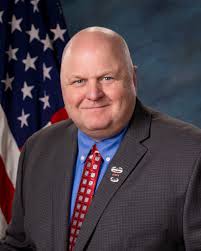
Judge Robert Cline praised the graduates for their commitment and determination throughout the program.
“We’ve had seven people graduate today, and when you look at it, those seven have an impact beyond the community,” Cline said. “When they started out, they were ready to change. They just needed the steps put in place to help them change, and now we have seven people instead of sitting in jail or prison; they are going out, they are working, and they have really good jobs, and they are taking care of their families, which is awesome.”
During the ceremony, Cline personally introduced each graduate before they shared impact statements about how the program changed their lives.
Graduate Jason Kristan described the transformation he experienced through the program.
“It’s everything,” Kristan said. “My life is a total 180. I’ve got a relationship with my family, a fiancé, I’ve got a good job. Everything.”
Another graduate, Jayci, spoke emotionally about regaining stability and reconnecting with loved ones.
“I’ve got my family back, and I’ve got my life back,” she said. “I didn’t have a life before.”
When asked what life may have looked like without the program, she responded, “I’d probably be in prison.”
Graduates spoke about a variety of personal successes achieved during the program, including obtaining reliable transportation, securing housing, beginning new careers, and improving relationships with family members. Others discussed spiritual and professional growth, as well as the importance of maintaining sobriety and having a support system.
Problem-solving courts are designed to reduce recidivism by addressing the root causes of criminal behavior, particularly addiction and mental health struggles. Participants who successfully complete the program often leave with dismissed or reduced charges, employment opportunities, and stronger community connections.
Thursday’s ceremony served as both a celebration of recovery and a reminder of the lasting impact rehabilitation programs can have on individuals, families, and the community as a whole.

