

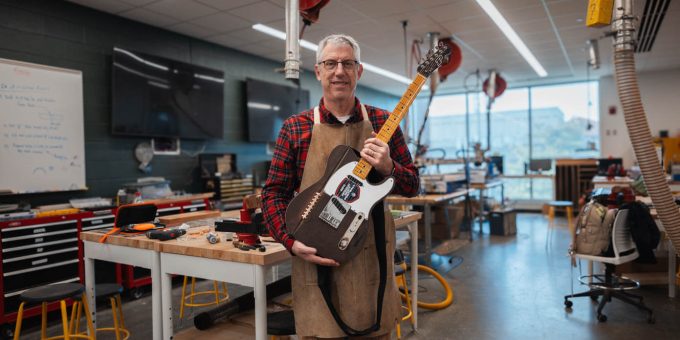
WEST LAFAYETTE – After observing the excitement Purdue’s guitar lab generated by building the “Win for Jim” guitar for the Indianapolis Colts, ESPN decided it wanted a one-of-a-kind instrument of its own.
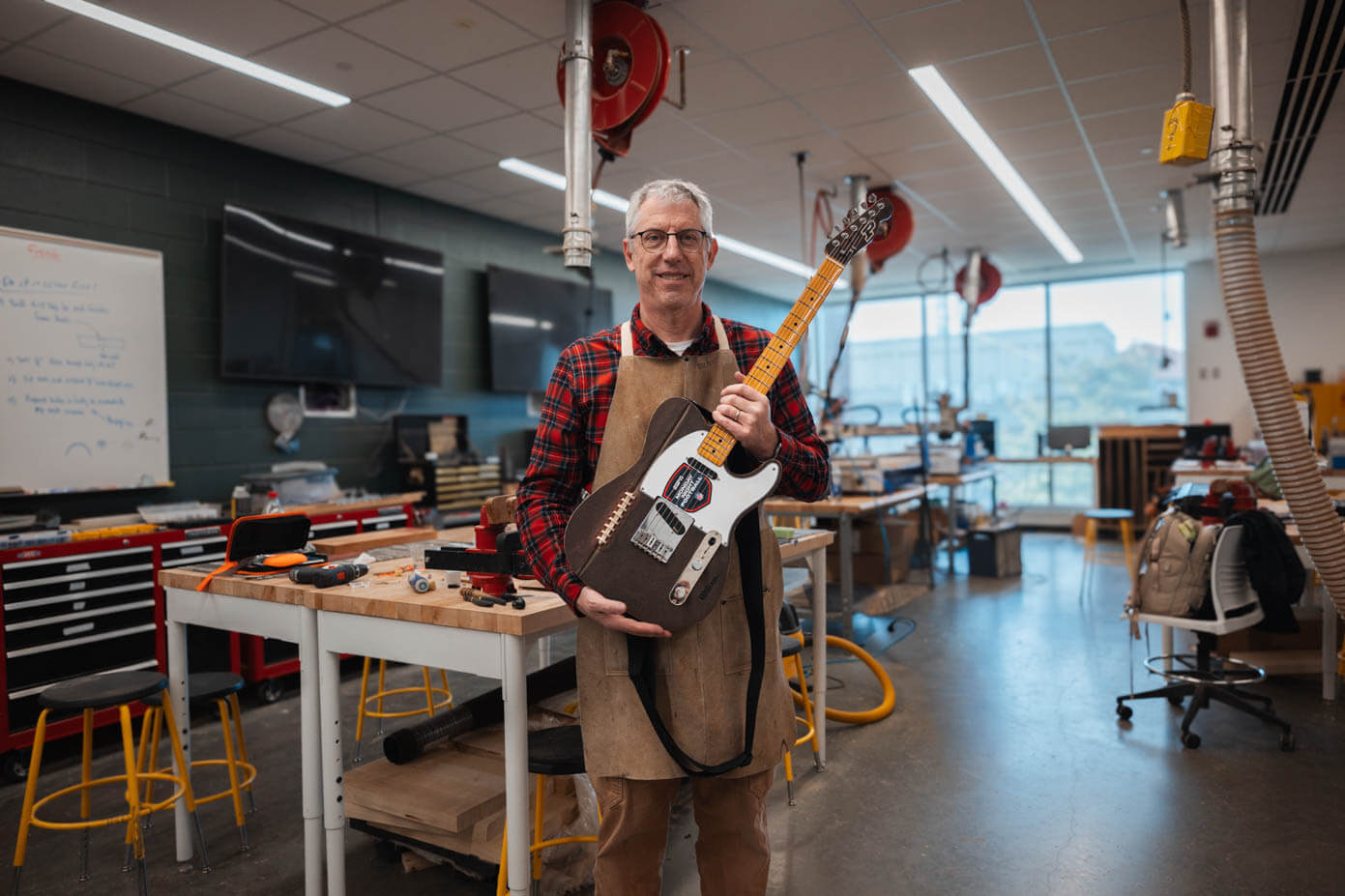
And the network knew the perfect time to show it off: during its pregame coverage for the “Monday Night Football” matchup between the San Francisco 49ers and the Colts — the team once owned by Jim Irsay, the late guitar collector who inspired the tribute guitar.
This time, the uniquely talented group of Boilermakers designed a custom electric guitar with a leather face resembling an NFL football — laces and all.
And not just any leather. The leather face sheet came directly from the Wilson Football Factory in Ada, Ohio, where Wilson Sporting Goods has been making NFL game balls since 1955.
The material was not the only unique aspect of the guitar face, however. The leather also received authentic game day treatment courtesy of the Purdue football equipment staff.
Follow along to see how the guitar-building process occurred before the instrument made its network debut:
Acquiring authentic NFL game-ball leather
After collaborating on the “Win for Jim” guitar prior to the season, Purdue guitar lab creator and mechanical engineering technology professor Mark French asked alumnus Noah Scott to once again take the lead on the project once ESPN reached out with its request.
Scott started by coordinating with ESPN on a design and reaching out to Wilson, seeking to acquire sheets of authentic NFL game-ball leather to use on the guitar face.
Fortunately, Wilson agreed to help, assigning recent Purdue engineering alum Parker Nordstrom to the project.
“It felt a bit like a movie where the script had things work out with just the right people and just in time,” says Scott (BS industrial engineering technology ’20, BS organizational leadership ’20, MS finance ’21). “Wilson thoughtfully assigned a young Purdue alum, Parker, who quickly stepped up to the plate, took creative ownership of Wilson’s end of the project, and stayed after hours most days to get the leather put together according to our design.”
Scott drove to Ohio to pick up the guitar leather at the Wilson facility, where Nordstrom and his colleagues showed him the steps they follow to produce 500,000 footballs each year — a process they mimicked in assembling the guitar leather, right up to the stitching and lacing they applied to the material.
“Once I realized we were trying to take materials and processes designed for a football and apply them to a guitar, it instantly felt like a big engineering puzzle,” says Nordstrom (BS mechanical engineering ’23, MS sports engineering ’24), a manufacturing/mechanical engineer at Wilson. “We were constantly asking, ‘How do we sew this panel so the seam lands in the right place? How do we lace it so it looks authentic but still lays flat on the guitar? How do we stamp it so the Motion P and foil stamps fall into the correct spot?’
“Working through those questions and testing different approaches was a blast,” he adds. “It’s the kind of challenge you don’t get very often — familiar materials, completely new application — and it pushed me to think differently about our normal processes.”
Nordstrom was uniquely qualified to take on this challenge, having been part of Purdue’s first full cohort in the sports engineering professional master’s program that began when Purdue launched the Ray Ewry Sports Engineering Center. Since that background helped Nordstrom launch a career in the sporting goods industry, he saw the guitar project as a way to return the favor.
“What made it even better was getting to do it alongside Purdue,” Nordstrom says. “Being able to support a project coming out of my alma mater, and specifically out of a space like the guitar lab, felt pretty full circle for me.”
Purdue football staff gives leather the game day treatment
Scott also asked the Purdue football staff to help ensure that the leather on the guitar face was as authentic as possible. So Kyle Gergely, the football program’s associate director of equipment, invited student manager Drew Decker to prepare a section of the leather as if he were breaking in a football to make it easier for the Boilermakers’ quarterbacks to grip during a game.
Allow Decker to break down Purdue’s standard ball-prep process:
- STAGE 1: “It starts with taking off the factory coating and dye with a brush, then we massage in shaving cream and let that sit for a while,” he says.
- STAGE 2: “Next, we do the same thing with the leather conditioner, then we rub a layer of mud all over the ball, which allows for the leather to turn a dark brown, which the majority of quarterbacks prefer.”
- STAGE 3: “Let the mud sit overnight and then brush the mud off with a hand brush.”
- AND FINALLY: “Once we get the mud off, we add another layer of leather conditioner, which helps bring out a nice shine.”
The ball-prep process takes more than a day to complete, but Decker was excited to tackle the unique assignment.
“I know how much guitars have meant for the Colts this season and how much they meant to Jim Irsay, so being able to be a part of something with this magnitude is pretty special,” says Decker, who is majoring in construction management when not working with the Boilermaker football team.
Building a guitar worthy of the ‘MNF’ spotlight
Using such an unusual material on the guitar face made it a stressful four-day assembly process for guitar lab professor French, who had never bonded leather to the wooden body of a guitar.
“I don’t know if anyone has ever done this before, so I’m on a voyage of discovery,” French says, noting that he leaned on the leatherworking expertise of Eric Martinez, a student in his guitar class.
The complicated process also involved preparing the body and neck, applying the “Monday Night Football” logo to the pickguard, trimming and refining the leather after curing, and making precise cuts to the material to allow for installation of the guitar’s hardware as they completed the assembly.
As was the case with the “Win for Jim” guitar, French viewed the ESPN project as a worthwhile endeavor to showcase what Boilermakers can do in the guitar lab, which relies on donations to operate.
“They both seemed like a good chance to show a larger audience what kinds of things happen at Purdue,” French says. “They also looked like opportunities to introduce people to the guitar lab. This is a unique place, and one that the students really value. It’s a great place for them to combine their classroom learning with the act of making a product they are really interested in.”
But it was a rushed process throughout due to the compressed timeline. Once the team completed the assembly, they still had to leave enough time for testing and for Scott to practice with the instrument before playing it alongside ESPN analyst Jason Kelce before the game.
“I’m less nervous about my performance — as I’m practiced enough to do it in my sleep — but more so nervous about representing the lab, its students and inherently Purdue as a whole, to a certain extent,” Scott said prior to his ESPN appearance. “The performance isn’t about me; I just happen to be the guy lucky enough to get the call.”
Information: Derek Schultz, dcschultz@purdue.edu.

