

BLUE RIVER WATERSHED – A significant milestone in amphibian conservation was reached this summer as Purdue University, the Indiana Department of Natural Resources (DNR), and conservation partners released 170 hellbenders into the Blue River.
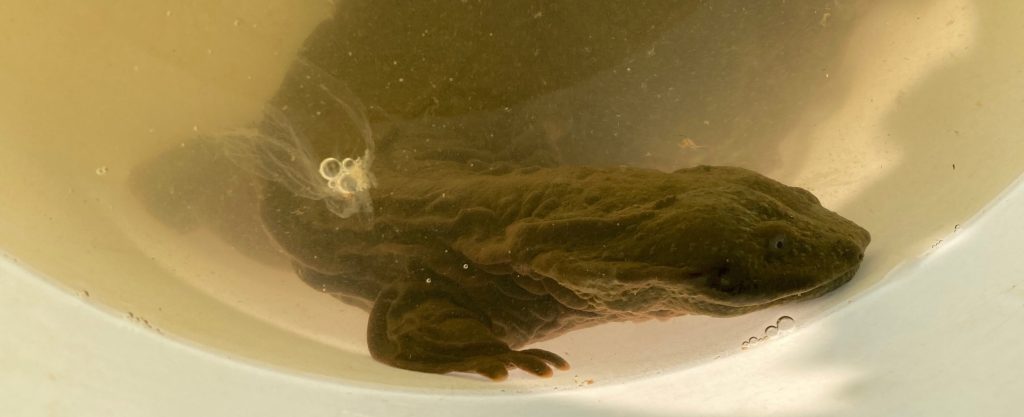
The effort, spanning July and August 2025, brings the total number of captive-raised hellbenders released into the Blue River since the program’s inception in 2017 to 979 individuals. The eastern hellbender—North America’s largest salamander and a critical indicator of clean water—is endangered in Indiana, with the Blue River watershed serving as the species’ last stronghold in the state.
The summer release is part of a meticulous “head-starting” program designed to give the juvenile hellbenders a fighting chance. Typically, hellbenders are held in captivity until they reach approximately 4.5 years of age to ensure they are large enough to avoid most predatory fish upon release.
However, a subset of hellbenders raised at the Fort Wayne Zoo showed exceptional growth, reaching an ideal size at just 2.5 years old. This presented a unique research opportunity for Purdue scientists.
To determine the optimal release age and maximize survival rates, Purdue researchers radio-tagged 24 hellbenders in each age class (the exceptionally large 2.5-year-olds and the standard 4.5-year-olds).
“Purdue researchers fitted each of the 48 study hellbenders with a radio transmitter and are tracking them in order to monitor survival,” a project spokesperson stated.
By monitoring the survival of young, big hellbenders compared to their older counterparts, biologists aim to refine their rearing and release protocols, potentially accelerating the species’ recovery.
The tracking data collected by the DNR and Purdue will provide crucial insights that inform future conservation efforts. With the success of this year’s efforts, additional hellbenders are already scheduled for release into the Blue River next summer, bringing the multi-partner project closer to its ultimate goal of establishing a self-sustaining wild population.

