

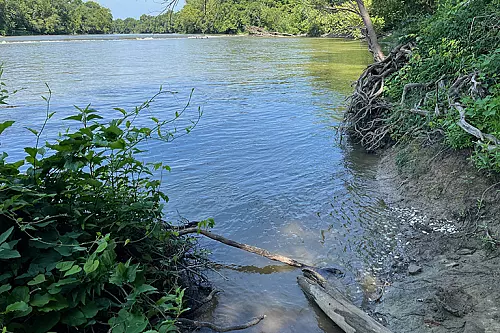
HINDOSTAN FALLS — A new species of freshwater fungus, named Atrumagnus indianensis, has been discovered in the East Fork of the White River in Indiana, underscoring the state’s rich yet understudied biodiversity.
The discovery was the result of an interdisciplinary partnership between Indiana University Columbus Professor Luke Jacobus, an entomologist known for his work on mayflies, and Huzefa Raja, a mycologist from the University of North Carolina at Greensboro. The collaboration, supported by a grant from the Indianapolis Zoo, merged the study of insects and fungi within freshwater ecosystems.


Huzefa Raja
The new species was found on submerged decaying wood collected from Hindostan Falls—a site of ecological importance and a biodiversity hotspot now preserved by the Indiana Department of Natural Resources.
Ecological and Medical Importance
The fungus belongs to the Lindgomycetaceae family of ascomycetes, which includes morel mushrooms. Its Latin name, Atrumagnus indianensis, refers to its dark, large ascospores (“atrum” for dark, “magnus” for large) and pays tribute to its state of origin.
Jacobus emphasized the fungus’s crucial role: “Freshwater fungi like A. indianensis help break down dead plant life and some pollutants, making them crucial to ecosystem health.”
Furthermore, the discovery highlights the medical potential of fungi, which remain one of the least studied groups of organisms. Many life-saving drugs, including antibiotics and immunosuppressants, have been derived from fungi, suggesting that this new species could “lay the foundation for future medical breakthroughs,” according to Jacobus.
The Indianapolis Zoo, which supported the research, stated that such findings reflect its mission to protect nature, noting: “All species have value, including the ones not yet known!” The research, which included experts from the Global Center for Species Survival, is published in the June 2025 issue of the journal Persoonia: Molecular Phylogeny and Evolution of Fungi.

