

BLOOMINGTON – Indiana University (IU) has been ranked the third-worst university in the country for free speech, according to a new report from the Foundation for Individual Rights and Expression (FIRE). Among public universities, IU received the lowest ranking.
- Claremont McKenna takes the top spot, while Barnard College, Columbia University, and Indiana University come in last.
- 166 of the 257 schools surveyed got an F for their speech climate.
- For the first time ever, a majority of students would prevent speakers from both the left and right who express controversial views, ranging from abortion to transgender issues, from stepping foot on campus.
The ranking, which placed IU behind only two private institutions—Barnard College and Columbia University—stemmed from a series of five “speech controversies” that occurred between 2024 and 2025. These incidents included:
- Cancellation of an art exhibition: IU canceled a scheduled art show by Palestinian-American artist Samia Halaby, citing safety concerns and her social media posts in support of Palestine.
- Postponement of a controversial speaker: Following criticism from student groups and planned protests, IU Hillel postponed a speaker event featuring former Hamas member Mosab Hassan Yousef due to security concerns. The event was never rescheduled.
- Protest disruptions: When the College Republicans at IU hosted Rep. Jim Banks and “Libs of TikTok” creator Chaya Raichik, protesters disrupted the event. Two individuals were briefly detained before being released.
- Dunn Meadow encampment: The university faced backlash for arresting over 50 pro-Palestinian protesters who set up an encampment in Dunn Meadow last spring. The arrests followed a policy change made the night before the protest, which a county prosecutor later described as “constitutionally dubious.” The campus bans and criminal charges were eventually dropped.
- Canceled healthcare conference: The IU School of Medicine canceled its annual LGBTQ+ healthcare conference, with an executive dean citing “challenging” timing due to state and federal actions restricting diversity, equity, and inclusion initiatives.
The best colleges for free speech
- Claremont McKenna College
- Purdue University
- University of Chicago
- Michigan Technological University
- University of Colorado, Boulder
- University of North Carolina, Greensboro
- Vanderbilt University
- Appalachian State University
- Eastern Kentucky University
- North Carolina State University
The worst colleges for free speech
- Loyola University, Chicago
- Middlebury College
- New York University
- Boston College
- University of California, Davis
- Northeastern University
- University of Washington
- Indiana University
- Columbia University
- Barnard College
Other key findings from the report include:
- 166 of the 257 schools surveyed got an F for their speech climate, while only 11 schools received a speech climate grade of C or higher.
- Only 36% of students said that it was “extremely” or “very” clear that their administration protects free speech on campus.
- A record 1 in 3 students now holds some level of acceptance – even if only “rarely” — for resorting to violence to stop a campus speech.
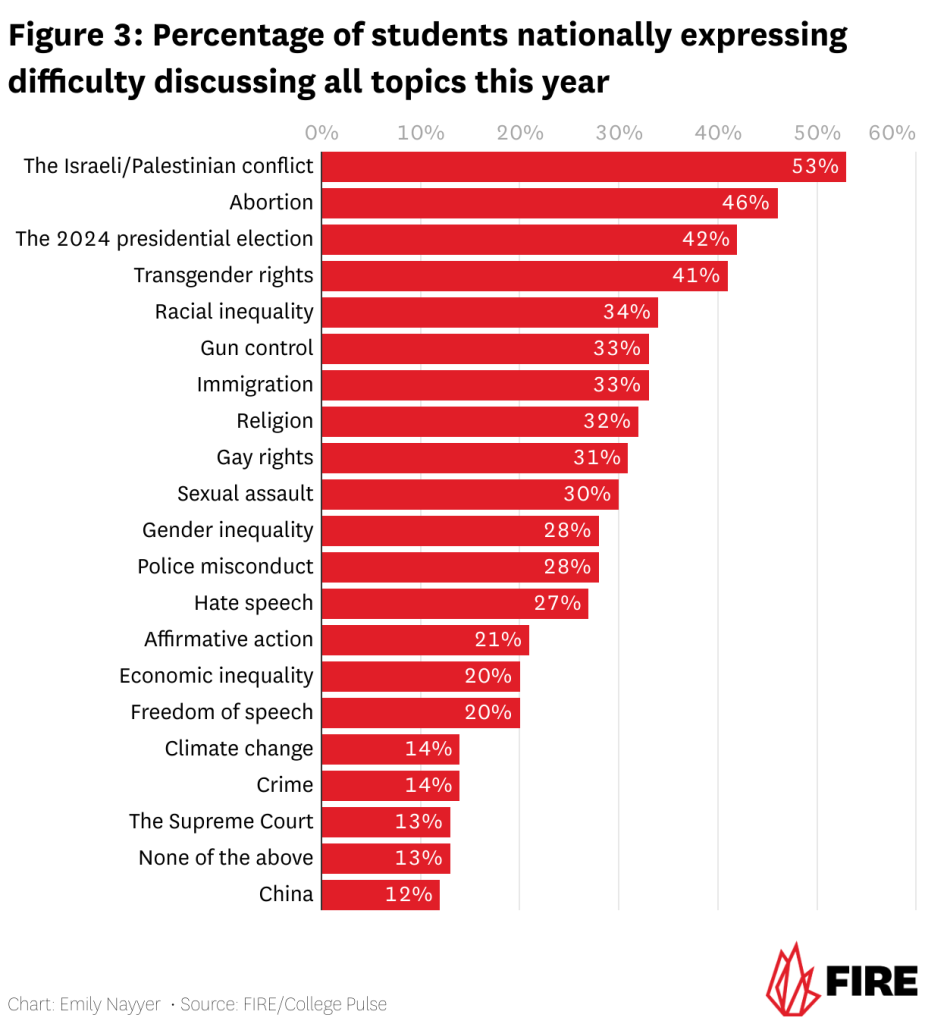
- 53% of students say that the Israeli-Palestinian conflict is a difficult topic to discuss openly on campus. On 21 of the campuses surveyed, at least 75% of students said this, including 90% of students at Barnard.
- For the first time, a majority of students oppose their school allowing any of the six controversial speakers they were asked about to come onto campus — three conservative speakers and three liberal ones.
“More students than ever think violence and chaos are acceptable alternatives to peaceful protest,” said FIRE Chief Research Advisor Sean Stevens. “This finding cuts across partisan lines. It is not a liberal or conservative problem — it’s an American problem. Students see speech that they oppose as threatening, and their overblown response contributes to a volatile political climate.”
How the Ranking Was Determined
The FIRE study surveyed over 68,000 undergraduate students nationwide, asking about their trust in university officials to protect free speech. IU’s low ranking was largely influenced by the university’s handling of the pro-Palestinian protests.
The findings highlight a serious concern for free expression at IU, placing it at the bottom of the list for public higher education institutions in the United States.

