

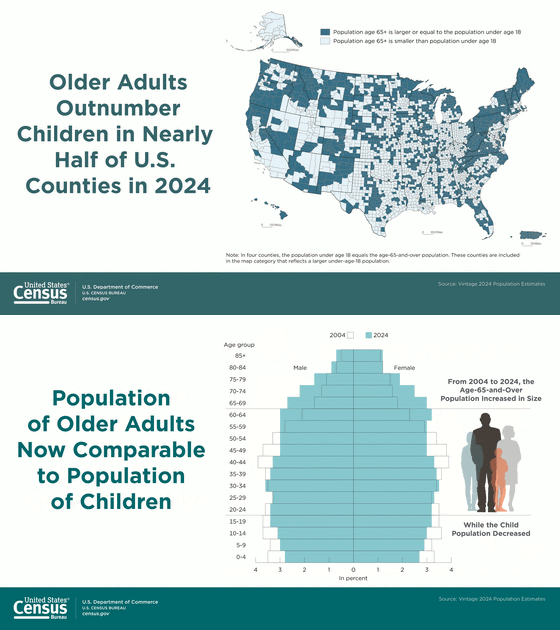
WASHINGTON D.C. – The United States is experiencing a significant demographic shift, with its population steadily aging as the number of older adults continues to grow while the youth population declines. New data released today by the U.S. Census Bureau in its Vintage 2024 Population Estimates highlights this trend, revealing a narrowing gap between the two age groups.
Between 2023 and 2024, the U.S. population aged 65 and older increased by 3.1%, reaching 61.2 million. In contrast, the population under age 18 decreased by 0.2% to 73.1 million. This ongoing trend has led to a notable change in the country’s age composition. In 2004, individuals aged 65 and older constituted 12.4% of the population, a share that is projected to rise to 18.0% by 2024. Conversely, the proportion of children has dropped from 25.0% to 21.5% over the same period.
“Children still outnumber older adults in the United States, despite a decline in births this decade,” stated Lauren Bowers, chief of the Census Bureau’s Population Estimates Branch. “However, the gap is narrowing as baby boomers continue to age into their retirement years. The number of states and counties where older adults outnumber children is on the rise, especially in sparsely populated areas.”
The data shows a dramatic reduction in the size difference between these two age groups, from just over 20 million in 2020 to just below 12 million in 2024. Between 2020 and 2024, the older population experienced a robust 13.0% growth, significantly outpacing the 1.4% growth of working-age adults (ages 18 to 64). During this same timeframe, the number of children declined by 1.7%.
This shift is increasingly evident across states and metropolitan areas. As recently as 2020, only three states—Maine, Vermont, and Florida—had more older adults than children. By 2024, this number had surged to 11, with Delaware, Hawaii, Montana, New Hampshire, Oregon, Pennsylvania, Rhode Island, and West Virginia joining the list. Similarly, the number of U.S. metro areas where older adults outnumbered children more than doubled, increasing from 58 in 2020 to 112 in 2024, representing nearly 30% of the nation’s 387 metro areas. Notably, three major metro areas with at least 1 million people—Cleveland, OH; Providence-Warwick, RI-MA; and Hartford-West Hartford-East Hartford, CT—reported more older residents than younger ones for the first time in 2024.
At the county level, the trend is even more pronounced. In 2020, 31.3% (983 out of 3,144) of U.S. counties had more older adults than children. This figure climbed to almost 45% (1,411 counties) by 2024. The Census Bureau notes that most of these counties have smaller populations and are located outside of metro and micro areas.
Other Key Highlights from the Report:
Age and Sex:
- The U.S. median age reached a new record high of 39.1 in 2024, an increase of 0.1 years from 2023 and 0.6 years from 38.5 in 2020.
- Regionally, the West (38.4) and South (38.8) had the lowest median ages in 2024, while the Northeast had the highest (40.6), followed by the Midwest (39.3).
- Maine had the oldest population in 2024, with a median age of 44.8, while Utah had the youngest at 32.4.
- In 2024, 74% (2,340 of 3,144) of all U.S. counties had a median age at or above the national median.
- Women continued to outnumber men in 2024, comprising 50.5% of the U.S. population, a difference of 3.4 million.
Race and Hispanic Origin: (Note: References to race and Hispanic origin compositions are for non-Hispanic race alone groups. Hispanic or Latino populations are of any race unless otherwise specified.)
| Race alone or Hispanic origin | April 1, 2020 (estimates base) | July 1, 2023 | July 1, 2024 | Numeric change 2023-2024 | Percent change 2023-2024 |
|---|---|---|---|---|---|
| White | 197,579,168 | 195,659,296 | 195,433,224 | -226,072 | -0.1% |
| Hispanic or Latino | 62,075,161 | 66,142,156 | 68,086,153 | 1,943,997 | 2.9% |
| Black or African American | 41,716,008 | 42,514,641 | 42,951,595 | 436,954 | 1.0% |
| Asian | 19,539,797 | 21,182,731 | 22,080,844 | 898,113 | 4.2% |
| Two or More Races | 7,577,977 | 8,217,797 | 8,441,923 | 224,126 | 2.7% |
| American Indian and Alaska Native | 2,409,713 | 2,432,832 | 2,442,428 | 9,596 | 0.4% |
| Native Hawaiian and Other Pacific Islander | 617,912 | 656,778 | 674,821 | 18,043 | 2.7% |
| Source: U.S. Census Bureau, Vintage 2024 Population Estimates | |||||
- Between 2023 and 2024, the Asian population experienced the fastest growth at 4.2%, followed by the Hispanic or Latino population at 2.9%.
- The Hispanic or Latino population increased by 1.9 million from 2023 to 2024, a gain larger than the combined change for all other racial and ethnic groups.
- The White population was the only group to see a decline, dropping by 0.1% between 2023 and 2024.
- While the Hispanic or Latino share of the U.S. total population reached 20% for the first time in 2024, only nine states and 457 counties had a Hispanic population of at least 20%.
- The Asian population experienced its most significant gains in California, followed by Texas. However, Texas’s annual growth rate for the Asian population (6.9%) was substantially faster than California’s (2.7%).